Moscow Hustle, Blue Apron and Concentration Risk, Interest Costs more than Defence, A380 and Emirates and Shein Loses its Shine again

45th Edition
Greetings folks and a warm welcome to the 45th Edition of Friday Finance,
Donald Trump signed an executive order yesterday renaming Lake Ontario as Lake America, effective immediately. The legal reasoning is that because the deepest water sits on the American side, the United States claims most of the lake’s volume, which is a novel way to draw a border and would redraw a great many maps if it caught on. He also observed that having acquired a gulf and a lake, all he now needs is an ocean, and floated renaming the Atlantic, the Pacific, or both. Mark Carney pointed out that the name comes from the Wendat word Ontari’io, meaning roughly that the lake is beautiful and the lake is big, and that it is more than 400 years old, predating both Confederation and the Declaration of Independence. The order binds American federal agencies and nobody else, so what it produces is not a new name but a second one. Thank you for your attention to this matter. Let’s get right to it.

TL;DR: Sanctions stranded Gazprom's bonds in Europe at half their face value, then a Kremlin decree let holders swap them for Russian bonds at full value. Four directors of Gazprombank's Luxembourg arm borrowed from their own employer and bought the cheap side. The price gap was public. The swap schedule was not. All four deny wrongdoing, and the regulator told the bank to update its employee handbook.
When Europe sanctioned Russia in 2022 it left Gazprom itself largely alone, but it broke the plumbing around it, and the company found it hard to get interest payments through to bondholders. Its foreign-currency bonds duly collapsed, some to half their face value, stranded in Europe. Then on July 5 that year the Kremlin opened a door: holders could exchange those bonds for new ones issued in Russia, tradeable in roubles at their full original value. That left the same issuer’s same debt, with the same claim on the same cash flows, worth about 50 in Europe and 100 in Moscow. It was not a credit spread, it was a location spread, and the discount reflected not whether Gazprom could pay but whether a holder could be paid. The four managing directors of Gazprombank’s Luxembourg arm, the main conduit for European payments to Gazprom, sat exactly on the seam.
According to documents seen by the Financial Times, the four took personal loans from their employer’s Moscow office and began buying the discounted bonds in personal accounts, at a bank whose own policy did not allow employees to have them. More than €17 million flowed through, converted from roubles, across more than 50 transactions, for combined potential profits the FT calculates at over €9 million, which is around a 53% return in five months. The first purchase came nine days after the decree, at about €65,000 for a bond with a face value of €150,000. The price gap was public and enormous, and what was not public was which bonds would be swapped, and when. Gazprom gave very little notice, ran windows of about two weeks, and published no advance list, and the bonds were illiquid enough that one person familiar with the trades said doing it quickly without prior knowledge would have been impossible. The bond bought nine days after the decree was not announced for replacement until November. All four men deny wrongdoing, as does the bank.
Luxembourg’s regulator inspected the bank in 2023 after a tip-off. It found the bank had broken its own rule against employee accounts, and that the four directors, classified internally as high risk, had never been vetted. It found no other wrongdoing, imposed no fines, and told the bank to update its employee handbook. Two people familiar with the trades say the regulator did not interview some of those who knew about them. A further question has not been answered at all: EU sanctions prohibit transactions that even indirectly result in a fee reaching Russia’s National Settlement Depository, and Gazprom’s own announcements indicate the depository settled these replacements. One EU official presented with the findings said it sounded like circumvention and called for a criminal investigation. Luxembourg’s finance ministry, which enforces sanctions, declined to comment. All four have since left the bank. Two run an investment firm in Luxembourg, one says he lives a private life there, and the fourth went back to Russia, where he runs Spartak Moscow (football club). Now this is the art of the deal.

TL;DR: Blue Apron sold its fulfillment centres in 2023 to go asset-light. The buyer became its sole supplier, then went bankrupt, and now the boxes turn up empty. Outsourcing capex did not remove the risk, it converted it into a counterparty risk, and the dependency ran both ways: Blue Apron was about 70% of its supplier's revenue.
In June 2023 Blue Apron sold its fulfillment centres, its equipment, its know-how and the people who ran them to a company called FreshRealm, for up to $50 million with about $25 million in cash upfront. The press release said the transaction let it execute its asset-light model and clear its debt, and FreshRealm became its exclusive supplier. Five months later Marc Lore’s Wonder bought what was left of the company for about $103 million, against the $1.9 billion the market had put on Blue Apron at its 2017 IPO. The factories it had just sold were worth roughly half what the whole remaining business fetched. In January 2024 FreshRealm did the same deal with Marley Spoon, buying its US operations for $24 million under a seven-year exclusive agreement, which meant the two largest meal-kit brands in America were now cooking in the same buildings.
What Blue Apron had actually done was convert a capital problem into a counterparty problem. It no longer owned warehouses, and it now owned a total dependency on one private company it did not control. The dependency ran both ways, which is worse: at the end, Blue Apron and Marley Spoon were more than 90% of FreshRealm’s revenue, with Blue Apron alone at roughly 70 to 75%, about 60,000 of the 70,000 boxes packed each week. Then FreshRealm’s other business broke. A listeria outbreak traced to its plants, in meals sold at Walmart and Kroger, sickened 17 people, hospitalised 16 and was linked to three deaths and one fetal loss. Walmart, more than 20% of revenue, stopped buying in January 2026. Blue Apron had already served notice in December purporting to terminate its supply agreement, and FreshRealm’s filings cite that disputed termination among the reasons an out-of-court restructuring became impossible. It filed for Chapter 11 in April. When a supplier’s solvency depends on your revenue, leaving is not an exit, it is a trigger.
Misfits Market took the fulfillment business out of bankruptcy and is now compressing what its own spokesperson says would normally be a year of integration into under ten weeks, on perishable food with a fixed weekly delivery promise. Customers spent July and August receiving damaged boxes, missing ingredients and nothing at all. Blue Apron has narrowed its menu to what it can reliably ship, added checks before boxes leave the building, and conceded on Facebook that to say the transition had not gone smoothly would be an understatement. It has also disabled its main phone line, where a recorded message explains there have been too many calls about deliveries before hanging up without offering to take a message. In fairness the original decision was not stupid, because meal kits are capital-intensive, which is exactly why both companies sold their plants, and Blue Apron was losing money and carrying debt when it did. Selling the factories did not remove the risk. It moved it somewhere nobody was watching. At least they weren’t using lettuce from Taylor Farms, that would have been explosive (too soon?).
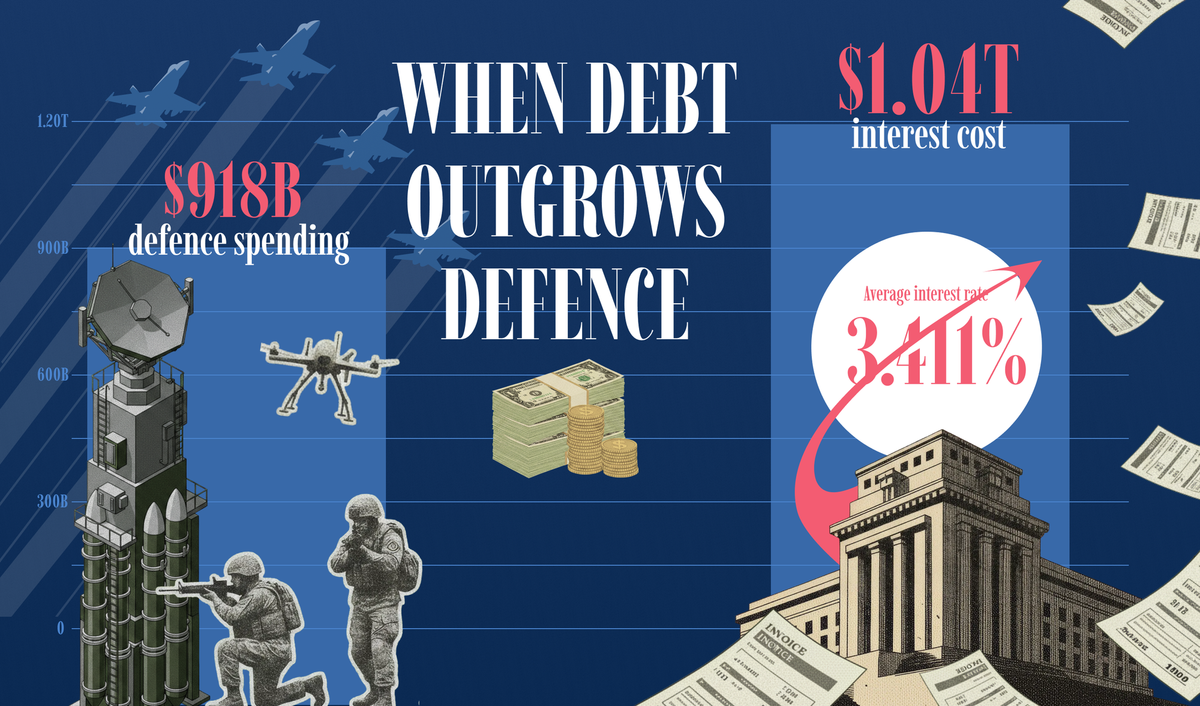
TL;DR: American debt passed $40 trillion, just a number right? The doves' case was always conditional: debt is fine while growth outpaces the interest rate on it. The average rate has more than doubled in five years to 3.4%. Net interest will cost $1.04 trillion this year against $918 billion for defence, and the primary deficit is projected to improve while the total gets worse.
American national debt passed $40 trillion last week, about two years earlier than the Congressional Budget Office forecast in 2023, and the number itself is close to useless. Debt has been measured in trillions for decades, and the reason a large group of economists spent that time unbothered was not denial but a specific test: as long as the economy grows faster than the average interest rate the Treasury pays, the debt shrinks relative to the economy without anyone doing anything. That condition held comfortably through the 2010s, when the average rate on the debt was under 1.5%. It is now 3.411%, more than double five years ago, against real growth the CBO expects to average 1.8% a year through 2036. Jared Bernstein, who ran Joe Biden’s Council of Economic Advisers, has written that he flipped from dove to hawk, and Martha Gimbel of Yale’s Budget Lab puts it plainly, that she was not a deficit hawk and the environment has changed.
What makes it worse is that the average rate lags the market. Debt issued at 1.5% is still maturing and being refinanced at 4-5%, so even if yields froze this afternoon the government’s average coupon would keep climbing for years as the cheap paper rolls off. The interest cost of the pandemic-era borrowing has not been paid so much as scheduled. Net interest will cost about $1.04 trillion this fiscal year against $918 billion for defence, so the United States now spends more servicing past decisions than it spends on its military. Interest is the second-largest line in the budget, it passed Medicare a year ago, and in the first ten months of this fiscal year it grew 14% while Social Security grew 5% and the health programmes 8%. It is the fastest-growing item. Among the reasons cited for higher rates, incidentally, is the enormous credit demand from companies financing artificial intelligence, so the data centres and the Treasury are drawing on the same pool of savings.
The CBO expects the primary deficit, which is the gap before interest payments, to fall from 2.6% of GDP to 2.1% over the next decade, while net interest rises from 3.3% to 4.6%. The part of the budget Washington actually fights about is forecast to improve, and the total gets worse regardless. By 2036 interest consumes a quarter of all federal revenue, against 18.5% today, and by 2047 it becomes the single largest government programme. The Treasury’s answer is to buy back long-dated debt and issue more short-term paper to bring the average coupon down, which lowers today’s cost by shortening the maturity profile, the same trade as refinancing out of a thirty-year fixed mortgage into a one-year adjustable. Stanley Druckenmiller, who worked with Treasury Secretary Scott Bessent under George Soros and is often called his mentor, wrote this week that the buybacks amount to price management and that the long bond yield is the only fiscal disciplinarian the country has left. The payment falls and you have to go back to the market far more often.
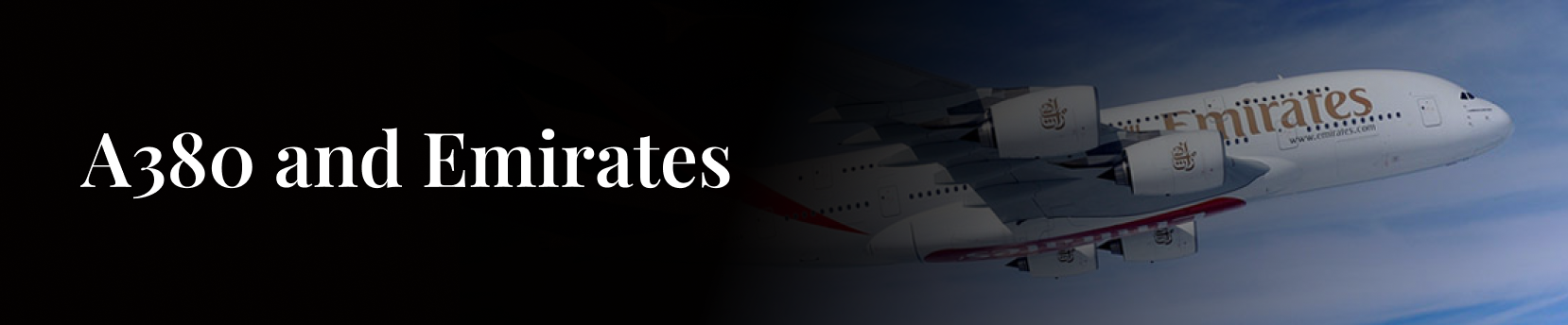
TL;DR: Qantas pulled its A380 retirement forward by four years this week because fuel costs rose A$610M on the Middle East war. Emirates is doing the opposite, spending $2B to refit 118 of them, and not because it loves the aircraft: Boeing's 777X is years late, so the replacement does not exist. A fuel shock hits the least efficient asset hardest, and the A380 has two more engines than anything built today.
Qantas said this week it will start retiring its ten A380s in 2028, four years earlier than planned, with the first aircraft leaving in March of that year. The reason is fuel. Its underlying profit fell 14% to A$2.06 billion, fuel costs rose A$610 million on the back of the Middle East conflict, hedging cut the second-half damage to A$420 million, and it expects another A$1 billion of fuel expense in the current half alone. A fuel shock does not hit a fleet evenly. It hits the least efficient asset hardest, and the A380 carries two more engines than anything anybody would design today. Its chief executive added the quieter problem: the aircraft stopped being built in 2021, so maintenance costs and the cost of the disruptions they cause will only rise from here. An orphaned fleet does not have a flat cost curve.
Which makes Emirates interesting, because it is going the other way entirely. It holds 118 of the 251 A380s ever built, is targeting about 110 in active service by the end of this year, and is spending roughly $2 billion refitting 60 of them alongside 51 Boeing 777s, with new business seats, 4K screens and satellite internet. That is not a cushion refresh; it involves pulling seats, running new cabling and certifying new antennas on an aircraft out of production for five years. Emirates has more than 200 Boeing 777Xs on order and the aeroplane is years late, so it arrived at 2026 without the twin-engine fleet it had planned to phase in as the A380s wound down. Tim Clark has said as much, that without the 777X the airline had to rethink its growth entirely, and it has been buying additional A380s from lessors to fill the hole. The $2 billion is not a vote of confidence. It is forced capital expenditure caused by somebody else’s delay.
There is a second problem underneath the fuel bill. The A380 only works full, at five hundred or more seats a departure, which requires an airport moving enormous volumes of connecting traffic. In Ed 43 we wrote that Dubai’s international passenger numbers fell from 7.4 million in February to 2.5 million in March when the war began, and had recovered only to 4.7 million by June. So the conflict raised the cost of the fuel and emptied the hub the aircraft was sized for, at the same time and for the same reason. None of which is really a verdict on the aeroplane. Airbus forecast in 2000 that the industry would take 1,235 very large aircraft over the following two decades and had delivered 234 by the start of 2019, about a fifth of that.
TL;DR: Shein lists in Hong Kong on Monday at about $27B, against $98.2B in 2022. The decline came in steps, every one of them while the company was trying to go public. Its innovations were real, but the price of a $3 blouse rested on a customs rule exempting parcels under $800. That rule is gone, and the same goods now face duties of 10% to 87.5%.
Shein lists in Hong Kong on Monday at a valuation of about $27 billion. Private investors valued it at $98.2 billion in 2022. The decline is roughly 73%, and it happened in steps rather than in one fall: $64 billion through to April 2024, about $50 billion when a London listing was the plan, $30 to $40 billion when investor meetings opened this month, and $27 billion at pricing. Every one of those markdowns occurred while the company was actively trying to go public. Shein spent four years attempting to sell shares, and the attempt itself turned out to be the largest single source of value destruction, which is an unusual way to run a process.
Shein’s innovations were genuine: more than two million items in the catalogue, 4,700 new designs added every day, and a supplier network producing them in small batches on demand. But the price of a $3 blouse depended on a customs rule. Parcels worth under $800 entered the United States duty-free, and a congressional committee found that Shein and Temu between them accounted for more than 30% of every package arriving in America under that provision. When the exemption ended, the same goods started facing duties Shein itself puts at between 10% and 87.5%. American revenue fell 14.3% in the first quarter, the US share of the total dropped from nearly 30% in 2023 to about 23%, and the company swung from a $395 million quarterly profit to a $99 million loss. Revenue growth went from 40% in 2023 to 8% last year to 1.1% in the first quarter.
PDD launched Temu in America in 2022, Amazon launched its own ultra-cheap Haul in 2024, and TikTok Shop has now overtaken Shein in US sales. Three companies replicated the model in about two years and one passed it in its biggest market, which suggests the advantage was never the algorithm. As for the listing, buyers are getting shares with a tenth of the voting rights of the founders’ stock, while the four co-founders keep 90% of the votes, and the $383 million cornerstone book includes General Atlantic and Tiger Global, among the investors who marked the company far higher and are now helping anchor it at a quarter of that. The company had wanted to list in New York, which fell away amid allegations about forced labour in its supply chain that it denies, then in London, where it had British regulatory approval but never got Beijing’s blessing. The listing raises $1.77 billion, against roughly $71 billion of paper value that disappeared on the way to it.
Harvard Medical School has agreed to pay $53 million to settle class actions brought by 47 relatives of people who donated their bodies to its Anatomical Gift Program, after its former morgue manager was found to have stolen and sold remains. He was sentenced to eight years last year. The detail that makes it a governance story rather than only a criminal one is that Harvard cannot determine which donors were affected, so the settlement covers everyone who donated between January 2018 and March 2023. The programme has no purchase price, no contract and no supplier, because its only input is the willingness of strangers to give, which is why the remediation includes an outside expert review, a written statement to families, and a scholarship named for the donors starting in 2027. Each relative received around $1.13M, which isn’t a bad inheritance.
“If something cannot go on forever, it will stop.” — Herbert Stein
Have a fantastic weekend. I welcome feedback and please forward this if you see fit.
Many thanks,
Sam.
Market Snapshots
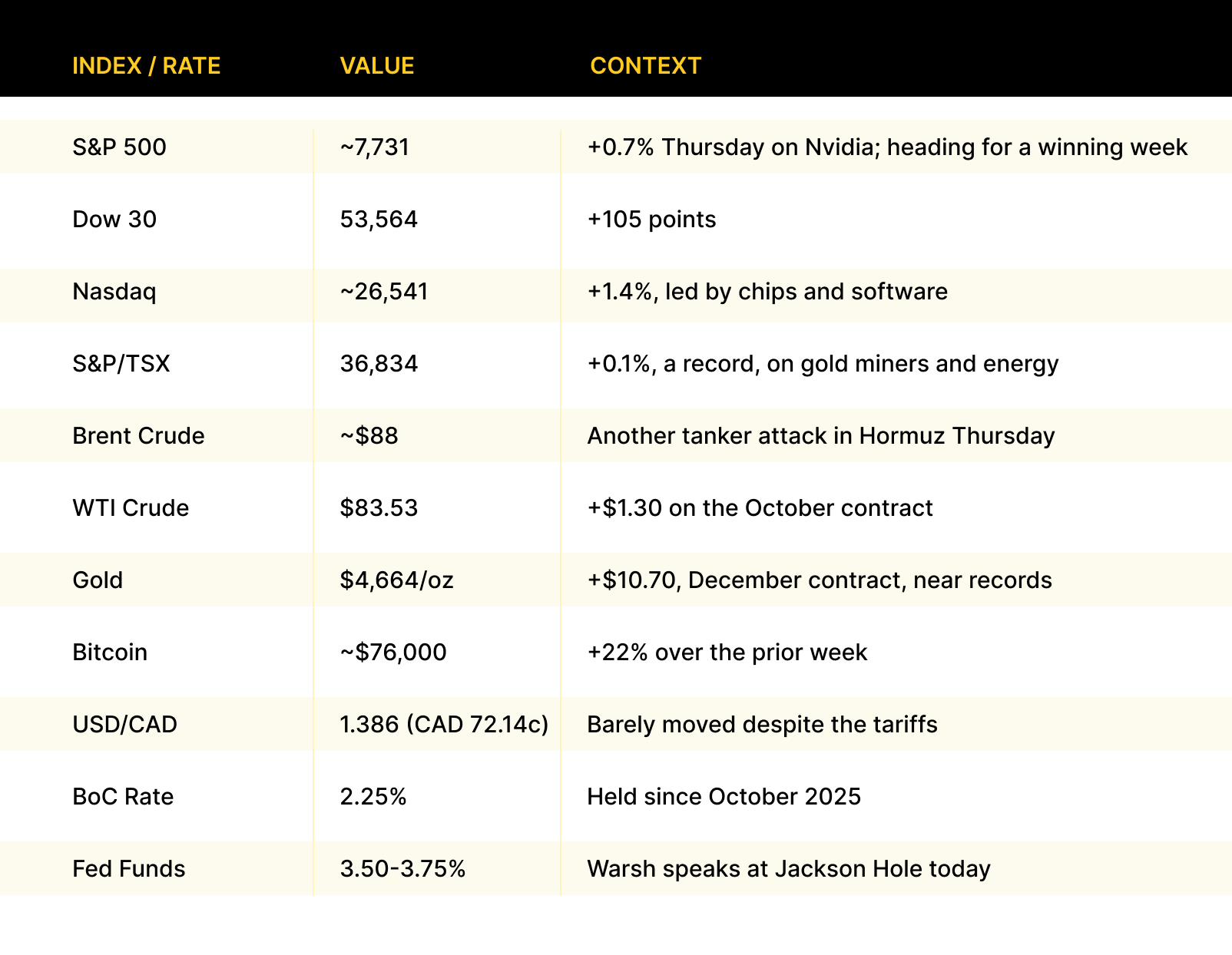
Note: two things happened to Canada this week and only one of them mattered. On Saturday the United States imposed 50% tariffs on $20 billion of Canadian goods including autos and auto parts, after trade talks collapsed with each side accusing the other of eleventh-hour changes. On Thursday the president renamed a lake. The market's verdict was clear enough: the TSX closed at a record, the loonie barely moved, and Bank of Nova Scotia rose 7% to an all-time high. One Toronto portfolio manager described the headlines as a little concerning, a little comical, and not something the market is treating as serious. South of the border the week belonged to Nvidia, whose guidance lifted the Nasdaq 1.4% on Thursday, and to Jackson Hole, where Fed Chair Kevin Warsh speaks today and where the Cleveland Fed president spent Thursday arguing for higher rates with inflation running near 3%. Oil rose on another tanker attack in the Strait of Hormuz, though traffic through the strait was up 50% week over week and remains well below prewar levels. The Bank of Canada is unchanged at 2.25%.
1 USD = 1.386 CAD = 0.88 EUR = 0.75 GBP at Thursday spot.
Sources
NBC News, CNN, CBC, Canadian Press, Washington Post (opener); Financial Times investigation, Clearstream, Mayer Brown, CSSF inspection report (Gazprombank); SFGate, Inc., Wall Street Journal, Business Wire, Chapter 11 filings in the District of New Jersey, Retail Dive (Blue Apron); The Atlantic, Congressional Budget Office, Senate Joint Economic Committee, Peterson Foundation, CRFB, Forbes, Washington Post (US debt); Reuters, Qantas FY26 results, Cirium, ch-aviation, Simple Flying, AGBI, Gulf News (A380); The Economist, Reuters, CNBC, Quartz, Shein prospectus, US congressional committee on China (Shein); Associated Press (closer); CNBC, BNN Bloomberg, Canadian Press, Investing.com, Trading Economics, Bank of Canada (market data).
Market data pulled Friday August 28, 2026 using August 27 closes. Live items this edition: Shein prices its offering on Monday August 31 and begins trading September 1, so the final number may differ from the $27 billion at the top of the range; the Canada-US tariff dispute is escalating rather than resolving and the Keystone XL revival floated in Ed 44 appears to have gone with the talks; all four Gazprombank directors deny wrongdoing and Luxembourg's regulator found no other violations and imposed no fines, and the FT's profit figures are its own calculations of potential rather than realised gains; Shein's 2024 profit figures differ materially between sources, so the prospectus-derived 2025 and 2026 numbers are used here; and Federal Reserve Chair Kevin Warsh speaks at Jackson Hole today, after this was written. Currency at Thursday spot rates.