$7 Trillion earning 0.1%, AI Pricing, Turkey's Enron moment, Financial Astrology and Shoppers to Own Boots?

50th Edition
Greetings folks and a warm welcome to the 50th Edition of Friday Finance,
Zara pulled a children’s Halloween costume from its website on Wednesday. It was a grey and blue striped cardigan and shorts, priced at £39.99, which social media users said resembled the uniforms worn by prisoners in Nazi concentration camps. Zara’s own description called it a kids costume with vertical stripes, decorative topstitching, a lapel flower and a distressed effect. It closely resembles the suit worn by Michael Keaton in Beetlejuice, which is probably what it was meant to be. The company said only that the costume is no longer on sale. This is the third time. Zara withdrew a handbag in 2007 after a customer found a swastika embroidered on it, and pulled a children’s striped shirt carrying a six-pointed yellow star in 2014. Seriously Zara? Okay let's get right to it.
$7 Trillion Earning 0.1%
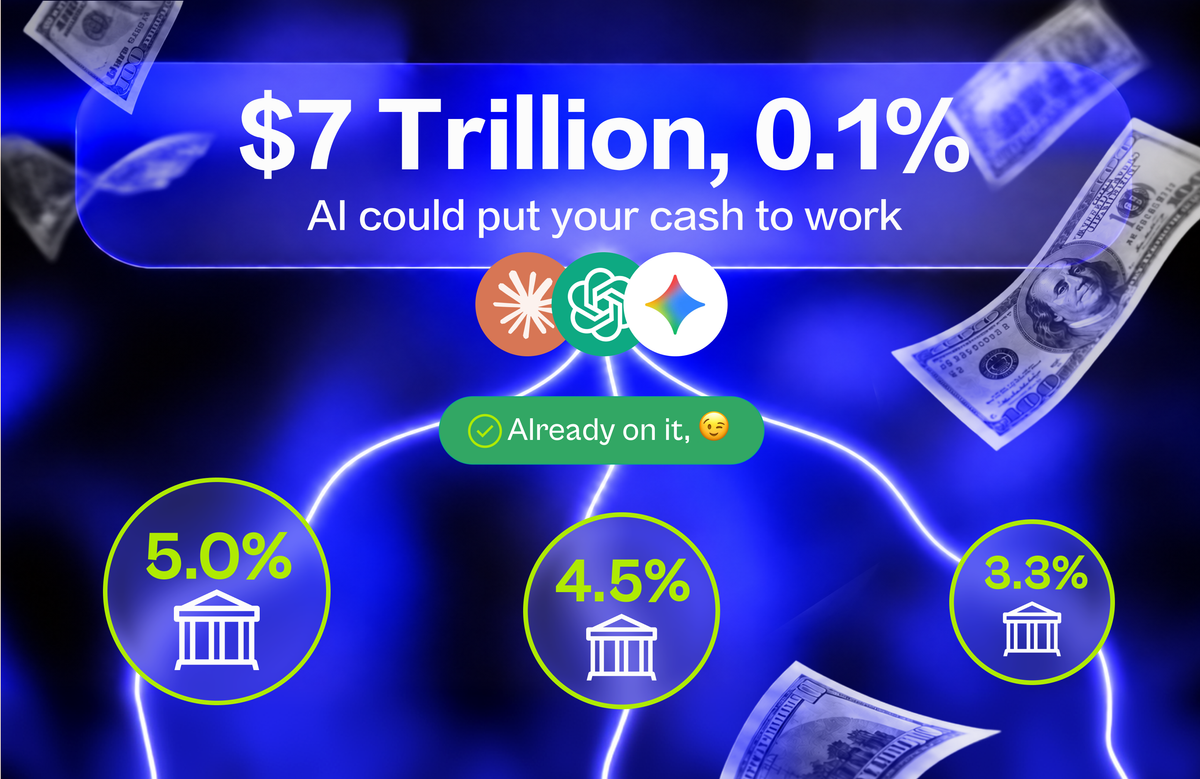
TL;DR: Apollo's chief economist says AI agents could sweep cash out of checking accounts chasing better rates. US demand deposits are about $7 trillion at 0.1%, against fintech accounts paying 3.3% to 5%. That gap is worth $224B to $343B a year. Money market funds already hold $7.94 trillion, so the migration has happened once already, slowly.
Apollo’s chief economist Torsten Sløk published a note on Sunday titled “Is an Agentic Bank Run Coming?” His argument is that AI agents, meaning assistants that act rather than answer, could soon sweep household cash out of checking accounts automatically. The national average on a US checking account is 0.1%. Sløk lists 11 fintech and online accounts paying between 3.3% and 5.0%. Adelfi pays 5.0% and SoFi 4.5%. His conclusion is that if every household ran an agent to optimise its cash, banks would lose the cheap deposits they use to fund lending. The pool is large. Federal Reserve data put US demand deposits at about $7 trillion in May.
Sløk’s note does not estimate how much money could move, or how quickly. Run his numbers against the Fed’s and the gap is worth between $224 billion and $343 billion a year, which is the interest American depositors are not earning on that $7 trillion. That figure is also what the cheap deposit base is worth to the banks. Money market funds already hold $7.94 trillion, which is more than the entire demand deposit pool. The migration has happened once already, at human speed. In the year after March 2023 about $1.1 trillion left the banking system, most of it for money market funds.
In Canada Personal chequable deposits here are about C$494 billion, big bank chequing pays around 0.10%, and the best everyday high-interest accounts pay 2.75% to 2.85%. That is roughly C$13 billion a year in foregone interest. The gap is narrower because the Bank of Canada sits at 2.25% while the Fed is at 3.75% to 4.00%. Tax narrows it again, since Canadian interest is taxed at the full marginal rate, so a 2.85% account yields about 1.32% after tax at Ontario’s top bracket. OSFI also imposed liquidity rules on banks holding high-interest savings ETF deposits back in 2023, which pushed some of those ETF rates down. Two things are worth holding onto. Meta’s Muse can read your balances through Plaid but cannot move money. Apollo’s credit arm, meanwhile, manages $849 billion lending to the same businesses banks lend to. If the big banks don’t have a cheap deposit base, they will naturally have to increase borrowing costs. Therefore the spread with private credit will get smaller and even more appealing.
AI Pricing Engine
TL;DR: Reuters reports McDonald's uses an AI engine to recommend menu prices per restaurant, based partly on what nearby customers will pay. One Big Mac was 21% more expensive two miles away. It is not surge pricing, since guidance goes out about three times a year. The CEO has told investors that pricing non-compliance comes up in contract renewals.
Reuters reported this week that McDonald’s uses an AI pricing engine to recommend menu prices for individual restaurants. It draws on transaction data from nearly 14,000 locations, plus prices at Wendy’s, Burger King and Chick-fil-A. The recommendation is based partly on local competition and partly on what customers near each restaurant are estimated to be willing to pay. Reuters found one Big Mac priced 21% higher than another two miles away. The platform is run by a firm called Tiger Analytics, and two former employees said McDonald’s supplies the rules and corporate targets that shape the output. This is not surge pricing, whatever the headlines say. Guidance goes to franchisees about three times a year, not minute by minute.
McDonald’s says the portal is a tool and not a mandate, and that franchisees set their own prices. Five franchisees told Reuters they were pressured to use it, and a June company document shows McDonald’s tracks deviations from the recommended prices in detail. Owners who ignore the suggestions described getting phone calls from corporate. In January the company made pricing part of its business standards, requiring franchisees to engage constructively with its approved pricing consultant and tools. Chief executive Chris Kempczinski told investors that pricing non-compliance can form part of the conversation around contract renewals. McDonald’s called the reporting speculative and uninformed, and notes there are legitimate reasons for two nearby restaurants to charge different prices (just look at airports).
There is a complication, and McDonald’s has already written it into the software. The pricing portal warns franchisees that they may be competitors of each other, and instructs users to follow antitrust and competition laws. That warning is there because franchisees are legally independent businesses. In November last year the US Justice Department settled with RealPage over algorithmic rent-setting, restricting how a shared pricing vendor could pool data among clients who compete with one another. The structure is similar: one vendor, many competing customers, a common model fed by shared transaction data. McDonald’s supplies the tool and the targets. The franchisee sets the price. I am waiting for someone to create an app that now tracks McDonald pricing in real time. Good news, they can only increase prices 3 times a year.
Turkey’s Enron Moment
TL;DR: Turkey is liquidating 131 investment funds holding $18 billion, affecting 455,000 investors. One fund returned 747% when it had fewer than 200 investors; the group's money market fund later held $4.6 billion for 167,000. MSCI may consult on moving Turkey from emerging to frontier status if regulators show no progress by November.
Turkey is liquidating 131 investment funds holding about $18 billion, affecting roughly 455,000 investors. The scheme behind it is visible in two numbers. Tera’s TLY hedge fund returned 747% in lira terms between January and July 2025, when it had fewer than 200 investors. The same group’s money market fund went on to hold $4.6 billion for about 167,000 people. The returns were made by buying thinly traded shares, including stakes in the funds’ own subsidiaries. The higher prices produced reported gains, which attracted new money, which could be borrowed against to buy more. One Tera fund rose over 60,000% in three years. An investment company briefly became the second-largest listed business in Turkey.
Two fund managers said in September they could not meet redemption requests. Investors pulled as much as $1 billion out in a single day, the main index fell more than 5%, and about $30 billion was wiped off the market in two days. The regulator suspended trading on September 17 and ordered the liquidations. The process has been extended to six months, and investors can now take an advance capped at 1 million lira per fund. Tera’s chairman has been jailed pending trial, along with the chairman of Pusula and three fund administrators. So has Erkan Kilimci, a former deputy governor of Turkey’s central bank who later joined Tera. The charges include aggravated fraud and membership of a criminal organisation. All are unproven.
The bigger risk is not domestic. MSCI warned in June about possible coordinated trading and said it could open a consultation on moving Turkey from emerging-market to frontier status unless regulators show progress by its November review. It has not announced a downgrade. That distinction matters, because index classification decides which funds are allowed to own you, and a reclassification forces selling by every emerging-market tracker regardless of what its manager thinks. Foreign investors have already taken $4.4 billion out of Turkish equities in twelve months, the largest exodus since at least 2015. JPMorgan says the turmoil brings meaningful downside risk to a 3% growth forecast. Inflation passed 80% in 2022 and still runs near 30%, which is why inexperienced savers were in the market at all.
Financial Astrology
TL;DR: Financial astrology is a real industry in India, and professional money managers use it. One app raised $12 million in August against 12 million registered users. Studies of Chinese and Taiwanese investors found that buying shares linked to lucky numbers produces measurable underperformance, because believers bid them up.
During Diwali, which falls in November this year, Indian stockbrokers gather for an auspicious one-hour trading session and place symbolic trades to bring prosperity. They perform rituals to Lakshmi, the goddess of wealth, whose image hangs in the lobby of the Bombay Stock Exchange. Business television hosts astrologers charting planetary movements alongside fund managers discussing earnings and interest rates. Pew Research found 44% of Indian adults believe in astrology, and Bloomberg has put the market at $7 billion a year. The app segment alone is around $390 million and growing fast. In August InstaAstro raised $12 million from venture investors. It has 12 million registered users, so the round valued each of them at about a dollar.
The practice runs through the professional market, not just the retail one. One asset manager at a large Indian fund house uses astrology for his own money, describing fundamentals as the engine and astrology as the steering. Money managers belong to WhatsApp groups run by astrologers. Purvesh Shelatkar, who ran two alternative-investment funds for wealthy clients until his sudden death on September 27, gave astrology roughly half the weight in his decisions. He once bought a steelmaker because Mars, associated with red metal, was strong in his birth chart, and the stock rose. He called astrology a fog light: unnecessary when visibility is good, useful when the road disappears. For everyone else there are online courses promising to predict market movements, at 35,000 to 45,000 rupees each.
The effect has actually been measured, in a neighbouring market. Studies of Chinese and Taiwanese investors found that buying shares linked to the auspicious number 8, and avoiding those tied to 4, produces significant underperformance. Believers bid the lucky stocks up and then overpay for them. One Indian analyst who uses an AI assistant for number-crunching at work tried trading options on astrological signals during the pandemic, and says they failed miserably. Before anyone gets too comfortable, there is the Western version. The West has its own version of this. Traders in London and New York study stock charts looking for shapes, with names like head and shoulders or rising wedges, and technical analysis has a cult-like following on those floors. Even John Pierpont Morgan, who founded the bank that still carries his name, is said to have subscribed to an astrology newsletter.
Shoppers to Own Boots?
TL;DR: Sycamore is in advanced talks to sell Boots to Canada's Weston family for about £7 billion. The family already owns Loblaw and Shoppers Drug Mart, which is Canada's version of the same business. They sold Selfridges for £4 billion in 2022. Sycamore paid $23.7 billion for all of Walgreens Boots Alliance and split it into five.
Sycamore Partners is in advanced talks to sell Boots to the Canadian branch of the Weston family for about £7 billion, or roughly $9 billion including debt. The Wall Street Journal reported it first and the Financial Times followed. Nothing is signed, and everyone involved has declined to comment. Sycamore bought Boots last year as part of its $23.7 billion takeover of Walgreens Boots Alliance, then split that company into five. Boots would be the first major piece to go. The sale covers Boots UK and Ireland, Boots Opticians, the No7 beauty business and pharmacies in Thailand, Mexico and Germany. Sycamore had also been weighing a London flotation. A private family office has outbid the stock market.
The buyer is Wittington Investments, the Weston family’s holding company. Wittington controls George Weston Limited, which owns about 53% of Loblaw, which owns Shoppers Drug Mart. Loblaw had revenue of C$61 billion in 2024 and runs more than 2,400 stores, including over 1,300 Shoppers and Pharmaprix pharmacies. By its own count, 90% of Canadians live within 10 kilometres of one of its locations. Loblaw paid C$12.4 billion for Shoppers in 2013, the largest Canadian deal of that year. At current rates, £7 billion is roughly C$13 billion.
The Westons have been here before. They sold Selfridges for £4 billion in 2022 and would now be buying Boots for about £7 billion, four years later. They also own Holt Renfrew in Canada. The family’s British side is separate and already owns a good deal of the high street, controlling Primark through Associated British Foods and owning Fortnum & Mason, Twinings and Ryvita. One other party does well out of this. Stefano Pessina, who merged Boots with Walgreens in 2012, still holds 44% of each of the five companies Sycamore carved the business into, and will share the proceeds. Wonder if Boots will get the boot (sorry I couldn’t resist) and get rebranded as Shoppers Drug Mart?
On September 29 the White House signed an executive order renaming artificial intelligence. Federal agencies are now to call it “super intelligence,” or SI. The same day, Trump and a group of AI companies signed a voluntary accord at the White House committing to internal and external reviews of the technology. He described it as almost like a constitution. Three days earlier he had said the government would not limit AI development or support calls for guardrails. The White House then published the two-page accord. Under the president’s signature, it reads “President of the Unites States.” At least we know that AI isn’t writing the accord, but at least use it to double check.
“You must not fool yourself, and you are the easiest person to fool.”
— Richard Feynman
Have a fantastic weekend. I welcome feedback and please forward this if you see fit.
Many thanks, Sam.
Market Snapshots
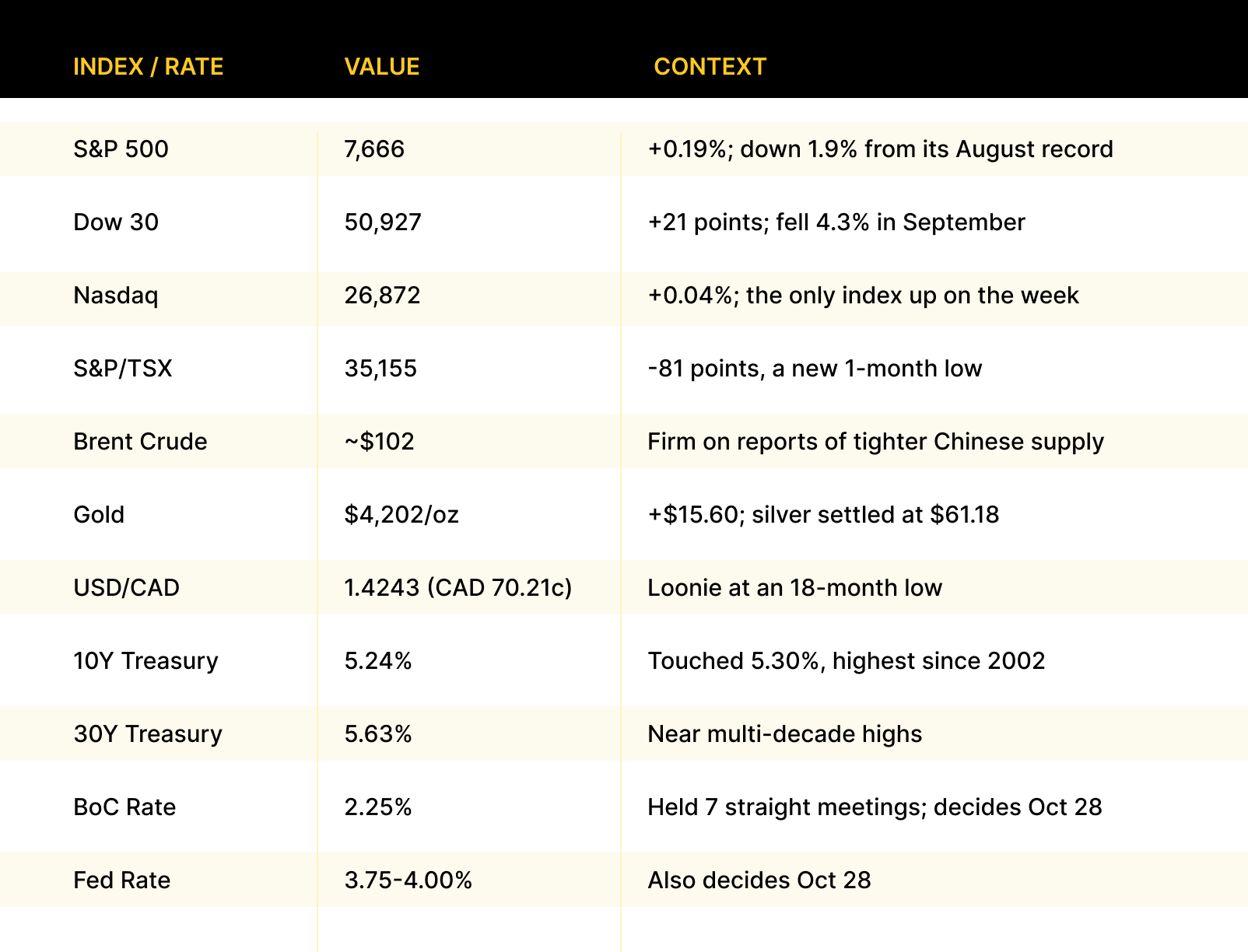
Note: the quarter that just ended was the worst for the bond market this century. The 10-year Treasury yield rose 87 basis points over the three months to September and touched 5.30% on Thursday, its highest since 2002. The 30-year sits near 5.63%. Equities diverged sharply underneath that. September took 4.3% off the Dow and 0.4% off the S&P 500, while the Nasdaq added 1.9%. Oil did not help, with Brent holding near $102 on reports of tighter Chinese fuel supplies, which keeps the inflation question open. Then on Friday morning a surprisingly weak US jobs report raised hopes the Federal Reserve will hold in October, and the Nasdaq hit a record led by Nvidia. The Dow and S&P were still heading for weekly losses. In Canada the TSX slipped to a one-month low on mining and banking weakness, and the loonie fell to 70.21 US cents, its weakest in 18 months, with the rate gap doing the work: the Bank of Canada has held at 2.25% for seven straight meetings while the Fed is at 3.75% to 4.00%. Both decide on October 28.
1 USD = 1.4243 CAD = 0.88 EUR = 0.74 GBP at Thursday spot.
Sources
JTA, The Jewish Chronicle, Times of Israel, The Telegraph, NBC News (opener); Apollo Daily Spark, Business Insider, Federal Reserve H.6, Investment Company Institute, FDIC, Bank of Canada, ratehub (bank deposits); Reuters, Engadget, Neowin, Yahoo Finance (McDonald's); The Economist, Reuters, AGBI, Turkish Minute, Daily Sabah, Bloomberg, MSCI (Turkey); The Economist, Entrepreneur India, YourStory, MarkNtel Advisors, Pew Research (India); The Guardian citing the Financial Times and Wall Street Journal, Private Equity Wire, Loblaw corporate (Boots); White House executive orders, Associated Press, Deccan Herald (closer); CNBC, Yahoo Finance, Trading Economics, Investing.com, Bank of Canada (market data).
Market data pulled Friday October 2, 2026 using October 1 closes, with Friday morning's moves noted. Live items this edition. The Boots sale is reported but not signed, and all parties have declined to comment. The McDonald's figures come from a Reuters investigation and the company disputes the characterisation. MSCI has warned it may open a consultation on Turkey's classification and has not announced a downgrade, and all criminal charges there are unproven. Meta's Muse can currently read balances but not move money, and the $224 billion to $343 billion figure is our arithmetic on Federal Reserve data rather than an estimate published by Apollo. Zara has issued no apology or explanation. Currency at Thursday spot rates.