King Farouk's $20 Coin, Fake CIA Program, Starbucks to buy Chipotle?, AI Music and Soybeans skirting tariffs

51st Edition
Greetings folks and a warm welcome to the 51st Edition of Friday Finance,
Michael Smith, a 54-year-old musician from North Carolina, was sentenced to 18 months in prison by a federal judge in New York on Tuesday. It is the first criminal case of music-streaming fraud in the United States. From 2017 to 2024, Smith used AI to make hundreds of thousands of songs. He set up thousands of fake listener accounts, and bots played his songs around the clock on Spotify, Apple Music, Amazon and YouTube. At its peak the operation ran about 661,440 streams a day, worth more than $1.2 million a year. He spread the plays across thousands of tracks so that no single song looked suspicious. “We need to get a TON of songs fast,” he wrote to his co-conspirators. He must now repay almost $8.1 million. When he pleaded guilty, the US Attorney put it this way: “Although the songs and listeners were fake, the millions of dollars Smith stole was real.” In April 2023 his AI catalogue drew 81 million streams from YouTube Music family plans. Taylor Swift’s entire catalogue drew 9.3 million. More related news on this below. Let's get right to it.
King Farouk’s $20 Coin
TL;DR: Egypt’s last king bought a $20 gold coin for $1,575 in 1944. After he was deposed, Egypt put it up for auction as one of seventeen coins in lot 185. In 2021 it sold for $18.87 million, the most ever paid for a coin.
King Farouk of Egypt became king at 16 and inherited a fortune estimated at $100 million. It came with five palaces, 200 cars, two yachts and 74,000 acres of the Nile valley. He is remembered mostly for the stories. He is said to have taken Winston Churchill’s pocket watch. He died in Rome in 1965, aged 45, after collapsing at the end of a dinner of oysters and lamb. A wire report at the time said he had $155 in his pockets. He was also a serious coin collector. In February 1944 he bought a 1933 Saint-Gaudens double eagle, a $20 gold coin, for $1,575.
The 1933 double eagle was never legally released. The coins were struck, then the United States left the gold standard and ordered them melted. A handful escaped the Mint. Farouk’s ministers applied to the US Treasury for an export licence, and the Treasury granted one by mistake. Farouk was deposed in July 1952 and went into exile. The new government took what he left behind and sold it quickly. Sotheby’s ran the sale in Cairo from February 24 to March 6, 1954. It was 2,798 lots over 11 days, including more than 8,500 gold coins. The double eagle was catalogued in lot 185, a mixed group of seventeen $20 gold pieces dated 1924 to 1933. One American collector mortgaged his house to bid.
The coin never sold at the auction. The US government asked for it back and it was withdrawn. It then disappeared for more than 40 years. It resurfaced in 1996, when a British dealer handed it to American authorities. A settlement granted legal ownership to the next buyer. Sotheby’s sold it in 2002 for $7.59 million, a record at the time, to the shoe designer Stuart Weitzman. He consigned it again, and on June 8, 2021, it sold for $18,872,250. It is the most expensive coin ever sold. Its face value is $20. Farouk paid $1,575, and it sold for about 12,000 times that. In 1954, Egypt had bundled it with sixteen ordinary $20 gold coins and offered them as a single lot. The more interesting story in my opinion is how King Farouk blew a $100M fortune and died with just $155 in his pocket. I guess he did it his way.
A Fake CIA Program
TL;DR: A former senior CIA executive pleaded guilty this week after inventing a classified program that let him sign off on his own spending. About $200 million went into Florida real estate, gold and watches. A raid on his home found 298 gold bars. When he applied for the job in 2009, he said he had been a navy pilot.
David Rush, 49, a former senior CIA executive, pleaded guilty on Tuesday to defrauding the US government in a scheme worth about $200 million. He held top secret clearance. The Washington Post reports he was a senior executive in the agency’s Directorate of Science and Technology, which builds high-tech spy tools. According to the court filing, he fabricated a highly classified program to justify buying luxury real estate in South Florida. He intended to resell it at a profit. For one property he hired an interior designer and bought $40,000 of kitchen appliances. Between November 2025 and March 2026 he also requested gold bars and foreign currency for “work-related expenses.”
The filing says Rush “effectively acted as his own approving official,” spending government money “without meaningful scrutiny.” A raid on his home in May found 298 gold bars, $2 million in cash and 35 luxury watches. Investigators also seized nearly $39 million from his bank account. He will forfeit those, along with the Florida properties and two BMWs. The charge he pleaded to is one count of wire fraud, tied to a single $45 million transfer in January. The plea deal also records something more serious. He revealed the existence of a clandestine human source to a foreign official, and passed top secret data to that official. Prosecutors said the disclosure could endanger the source’s life. Sentencing is set for January 28, and the charge carries up to 20 years.
Rush joined the agency in 2009. Court records show he was accused of lying about his education and military service on that application, including telling employers he had been a navy pilot. The plea filing says those representations were false. He had also been accused of taking paid military leave he was not entitled to after leaving the Navy (he wasn’t a pilot, but was in the Navy). Several CIA officials have been placed on leave while the agency investigates how he passed a background check, according to the Washington Post. In June a federal judge ordered him held until trial as a flight risk. The judge cited his career: “He’s in a different position than most people to flee and avoid detection by law enforcement.” So many things went wrong in so many places. I can describe this in one word SNAFU, the polite version is Situation Normal All Fouled Up.
Starbucks to Buy Chipotle?
TL;DR: Starbucks has explored buying Chipotle, the chain its own CEO used to run. At about $40 billion it would be 3.5 times the largest restaurant deal ever (Burger King’s purchase of Tim Hortons). No offer has been confirmed. Chipotle’s shares have nearly halved since Brian Niccol left.
Starbucks has been working with advisers on a possible takeover of Chipotle, according to the Financial Times. Chipotle is worth about $40 billion. A deal would be the largest restaurant acquisition ever. The current record is Burger King’s $11.4 billion purchase of Tim Hortons in 2014. That deal moved Burger King’s legal home to Canada and created Restaurant Brands International. Warren Buffett’s Berkshire Hathaway put up $3 billion of the financing. A Chipotle deal would be about 3.5x larger, before any premium. No offer has been confirmed. Starbucks declined to comment. People close to Chipotle told Semafor last week that it had not received a bid.
The common thread is Brian Niccol. He ran Chipotle for six years and rebuilt it after its food-safety crisis. Starbucks hired him in August 2024, and its shares rose 24% that day. Chipotle’s shares have nearly halved since he left. Same-store sales fell in 2025 for the first time in decades. Restaurant margins slid from 26.7% in 2024 to 23.7% in the first quarter of this year. In August a salmonella outbreak traced to a Mexican pepper grower forced Chipotle to pull jalapeños from some restaurants. Its shares fell almost 10% that day. Starbucks, meanwhile, is recovering. US same-store sales rose 7.9% last quarter, and the company raised its guidance.
The market’s first answer was clear. Starbucks fell 3.6%, to a value of $103 billion. Chipotle rose 5.7%. Starbucks has $13.3 billion of debt, $3.4 billion of cash, and negative shareholders’ equity. A deal this size would almost certainly be paid partly in new shares. Thursday’s moves made those shares worth less and Chipotle more expensive. Analysts are not convinced either. “It doesn’t seem like there’s that many synergies,” Jacob Aiken-Phillips of Melius Research told Bloomberg. Starbucks does not run a grill. In March, Starbucks sold 60% of its China business, about 8,000 coffee shops, in a deal that valued it at about $4 billion. It is now looking at paying about $40 billion for Chipotle's 4,200 restaurants. That is roughly $500,000 a store in China, against $9.5 million a restaurant at Chipotle. Let's just hope there is no cross contamination. Just in case there is, maybe long Healthcare stocks too.
AI Music
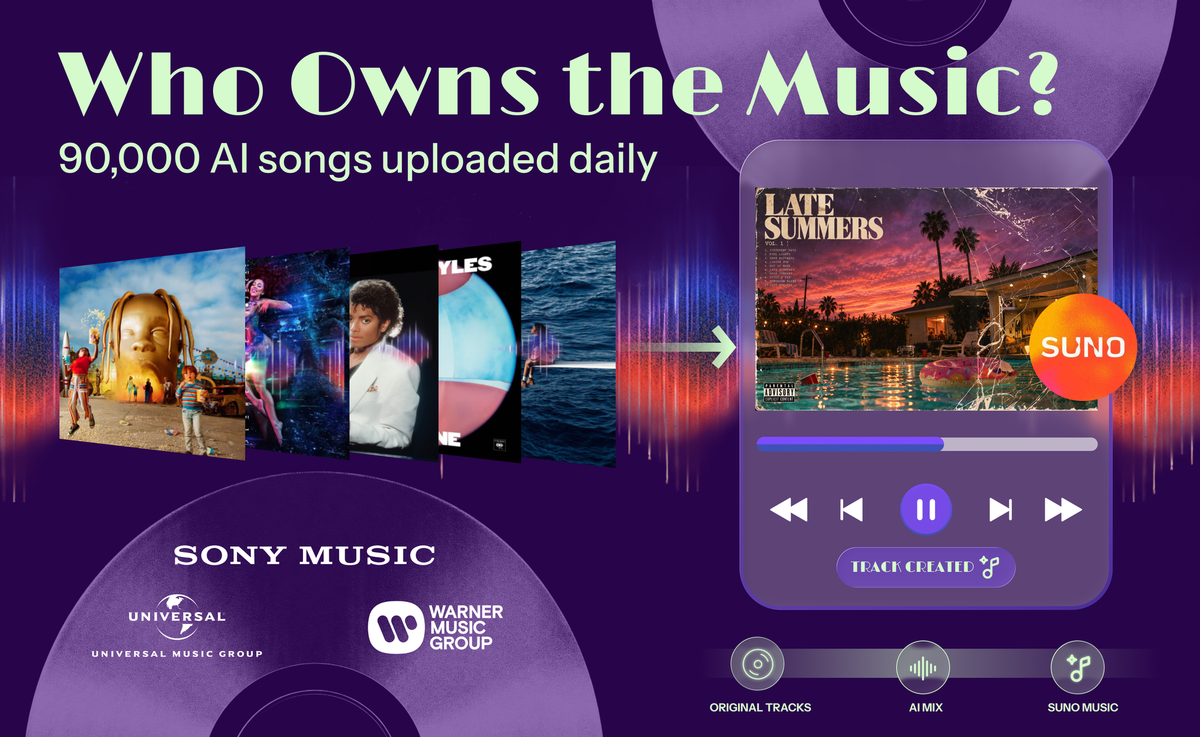
TL;DR: AI now makes about half the songs uploaded to Deezer each day. Warner Music settled with Suno, the biggest AI music company. Universal and Sony are suing it for a theoretical $9 billion, 1.7x what Suno is worth. Canada’s songwriters have now sued too, over an output called “Sk8er Boi (K-pop remix)
About 90,000 songs made entirely by AI are uploaded to Deezer every day. In June that passed half of all new uploads for the first time. Few people listen to them. AI tracks get between 1% and 3% of Deezer’s streams. In 2025, up to 85% of those streams were fraudulent, generated by bots to collect royalties. A few break through. Xania Monet, an AI singer made with Suno, signed a record deal reportedly worth up to $3 million. An AI country act called Breaking Rust topped Billboard’s country digital sales chart last November. Suno is the best-known of the AI music companies. It was valued at $5.4 billion in June, more than double its value seven months earlier. It is on pace for about $300 million a year in revenue.
The record labels cannot agree on how to respond. Warner Music settled with Suno last November and expects AI licensing revenue to start arriving this financial year. Suno’s newest models, launched in September, are trained on licensed music from Warner and others. Artists who opt in share the revenue. Warner’s chief executive, Robert Kyncl, says the courts could take years to rule, so “why would I wait?” Universal and Sony took the opposite route. On September 18 they sued Suno for a second time, over 60,202 recordings. US law allows up to $150,000 per work for wilful infringement. That puts the theoretical maximum at just over $9 billion, about 1.7x Suno’s valuation. The labels call the new licensed models “the fruit of the same poisoned tree.” Universal is not only fighting, though. It settled with Suno’s rival Udio last year and has licensing deals with Spotify and ElevenLabs.
On September 2, SOCAN, which collects royalties for Canadian songwriters, sued Suno in the Federal Court of Canada. Its claim cites 150 Suno outputs copying 137 songs. They include Joni Mitchell’s “Both Sides Now,” Tom Cochrane’s “Life is a Highway” and an output titled “Sk8er Boi (K-pop remix) (Avril Lavigne cover).” Canadian law caps statutory damages at C$20,000 a song, about a tenth of the American limit. SOCAN is also seeking C$10 million in punitive damages. In Germany, the collecting society GEMA won its case against Suno in July. In 2023 an AI-faked duet of Drake and The Weeknd, both Canadian, drew 15 million views on TikTok before Universal had it pulled. Weeks later, Vancouver-born Grimes offered anyone a 50% royalty split to use an AI copy of her voice. That is roughly the opt-in model Warner and Suno offer today. So far, none of the labels has named a major star who has signed up.
Soybeans from Niger
TL;DR: India imported 380,868 tonnes of soybeans declared as from Niger this year, up from zero. Niger grows fewer than 100 tonnes a year. Customs suspects they are Nigerian beans relabelled to dodge a 45% tariff. Of the four countries India can buy non-GM soybeans from, Nigeria is the only one that pays it.
India rarely imports soybeans. In the first seven months of 2025 it bought 1,996 tonnes. In the same stretch of 2026 it bought 909,606 tonnes, a record. The largest declared supplier was Niger, with 380,868 tonnes. A year earlier Niger had sold India none. Niger grows fewer than 100 tonnes of soybeans a year, according to Africa’s soybean millers. Its declared shipments were more than 3,800 times that. Indian customs has written to importers asking them to prove where the beans came from. Its notice put it plainly: “The production data of soybeans in Niger is very much less.”
India’s own crop fell this year. In May, soymeal prices rose 41% in a single month to a four-year high. India only allows non-GM soybeans in, and most of the world’s exports are genetically modified. That leaves a handful of suppliers: Benin, Togo, Niger and Nigeria. India lets the world’s least developed countries ship duty-free. Benin, Togo and Niger are on that list. Nigeria is not, so its soybeans pay a 45% tariff. Nigeria is also the biggest grower of the four by far, at about 1.35 million tonnes a year. At the $700 to $760 a tonne Indian buyers were paying in June, 380,868 tonnes is worth up to about $290 million. If all of it turns out to be Nigerian, the unpaid tariff would be roughly $120 million to $130 million.
Niger is landlocked. Its border with Benin has been shut since its 2023 coup, so much of its trade now moves through Nigeria. Customs cleared the cargoes on certificates of origin and plant-health certificates issued by Niger. It now wants transit permits and inland transport records. Importers say they relied on their suppliers. “It is not possible for us to physically travel to Africa to verify the origin ourselves,” one told Reuters. Importers have stopped buying beans declared as from Niger. Traders expect Togo and Benin to take over the business. Who knew the world of Soybeans was this exciting!
Under Treasury rules that took effect on September 30, wealthy donors can now put shares of their own company into Trump Accounts, the tax-advantaged savings accounts for American children. The shares have to pass through a charity first. That is where the tax break is. A founder who gives appreciated stock to a private foundation can generally deduct its full market value and never pays tax on the gain. Until now, everything in the accounts went into low-cost index funds. Donated shares must generally be held for 5 years, or until the end of the year the child turns 17. Families cannot choose the stock or, for now, refuse it. Treasury’s own rules say the children “will bear some additional risk in the form of increased portfolio concentration.” SpaceX president Gwynne Shotwell and her husband have pledged one SpaceX share each to more than 2 million children aged 11 to 17, worth about $330 million in total. Apparently the best way to teach a child about diversification is to hand them one company’s shares and hold them for five years.
“Things are not always what they seem.” — Phaedrus
Have a fantastic weekend. I welcome feedback and please forward this if you see fit.
Many thanks,
Sam.
Market Snapshots
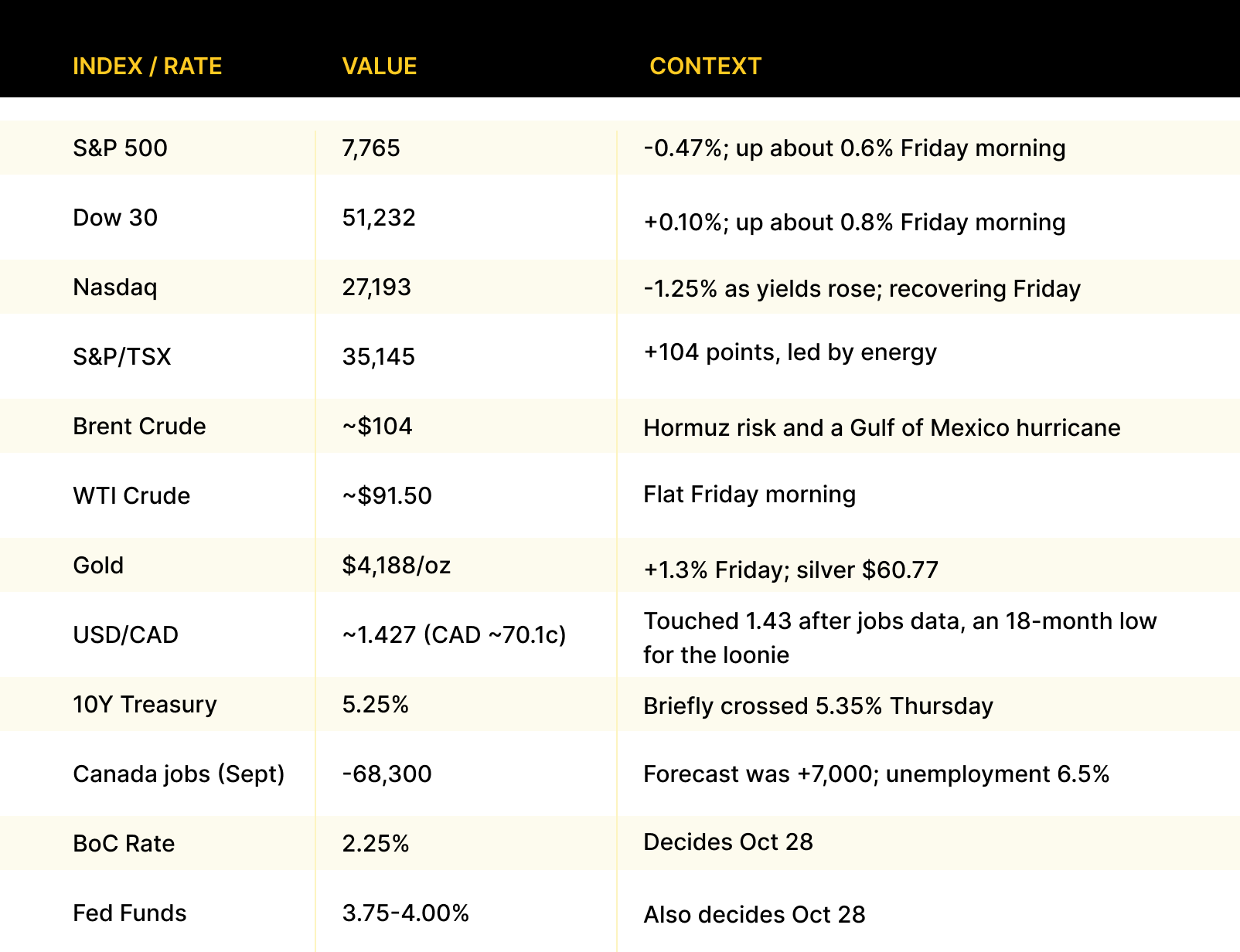
Note: Thursday was a split day. The Nasdaq fell 1.25% as rising yields hit technology stocks, while the Dow edged up. The 10-year Treasury yield briefly crossed 5.35%, near its highest in 24 years. Brent held above $100 on supply worries around the Strait of Hormuz and a hurricane in the Gulf of Mexico. Stocks recovered on Friday morning as oil eased on reports that the US would hold off on strikes on Iran before the midterms. US consumer sentiment fell to 46.3, and year-ahead inflation expectations rose to 4.7%. In Canada the economy lost 68,300 jobs in September, against forecasts of a small gain. That follows a loss of about 42,000 in August, and it wipes out the year’s net job gains. The loonie fell to an 18-month low near 70 US cents. The Bank of Canada and the Fed both decide on October 28.
1 USD = 1.427 CAD at Friday morning spot.
Sources
UPI, Coin World, NGC, Sotheby’s, Al Arabiya (King Farouk); BBC, CBS News, Fortune, NBC News, The Washington Post, CIA, US Department of Justice (David Rush); Financial Times, Axios, Reuters, Bloomberg, Semafor, Starbucks SEC filings, Restaurant Business, CNN (Starbucks and Chipotle); The Economist, Music Business Worldwide, Deezer, Variety, The Canadian Press, AFP (AI music); Reuters, Nairametrics, United Nations, Central Bank of Nigeria (soybeans); US Attorney’s Office for the Southern District of New York, WUNC (opener); Federal Register, Fortune citing The Wall Street Journal, Newsweek, Yahoo Finance (Trump Accounts closer); Yahoo Finance, BNN Bloomberg, Trading Economics, FXStreet, Fortune (market data).
Market data pulled Friday October 9, 2026 using October 8 closes, with Friday morning’s moves noted. Live items this edition. Starbucks has not confirmed any approach to Chipotle and no offer has been reported. David Rush is due to be sentenced on January 28. The lawsuits against Suno are unresolved, and the German ruling can be appealed. India’s soybean investigation is ongoing and no wrongdoing has been established. The $120 million to $130 million tariff figure is our arithmetic and assumes every tonne was mislabelled. The Taylor Swift comparison covers YouTube Music family plans in a single month. The Trump Account stock rules are temporary regulations, open for comment, and expire in 2029. Currency at Friday morning spot.