Toys R Us is back, Venezuela moves gold to the US, Iran's economy, War Risk Premiums and McDonald's is betting on chicken

49th Edition
Greetings folks and a warm welcome to the 49th Edition of Friday Finance,
Dorsia is a members-only app for restaurant reservations. A basic membership is $175 a year. The top tier is $25,175. Neither includes a table. What you buy is the right to prepay a minimum spend, which at Carbone has been $500 a head, before you see a menu. There is a cheaper route. AppointmentTrader is a grey market where people resell bookings they never intended to use, and its own site says 23,400 people traded 13,000 listings for $2.52 million last year. That is about $194 a table. New York has banned reservation resales. CNN reported this week that personal AI agents are now being aimed at the same tables, and one restaurateur described a thousand agents bidding for a single booking. This is going to get interesting, lets hope all these reservations are for real people. Let's get right to it.
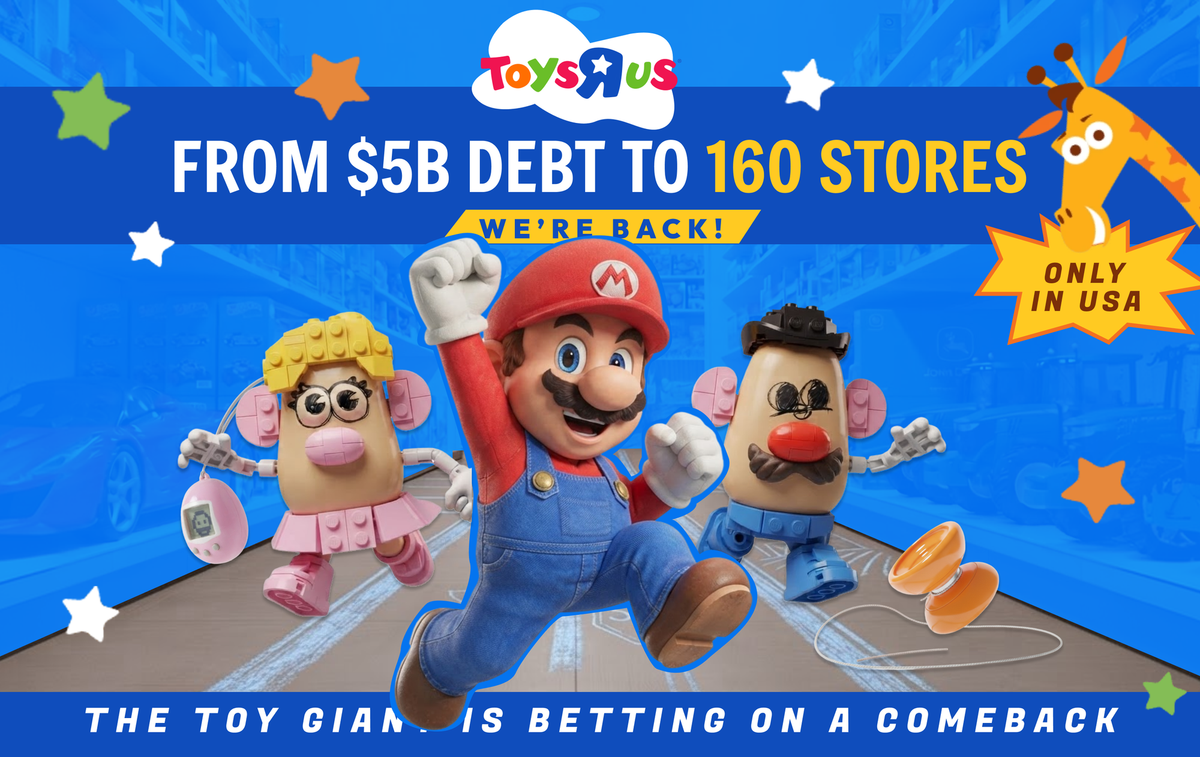
TL;DR: Toys R Us will open 120 new US stores for Christmas, taking it from 40 to 160. Toys R Us Canada filed for creditor protection in February and has gone from more than 100 stores to about 22. The original company was not killed by toy sales. It lost $36 million in 2017 while paying $400 million a year in interest.
Toys R Us said last week it will open 120 new stores in the United States for Christmas. That takes it from 40 standalone stores to 160. The brand is owned by WHP Global, which licenses the name rather than running shops itself. A Texas company, Go! Retail Group, will operate the new stores, and some will have cafés, candy shops and studios for filming content. No locations or opening dates have been released. The company says the brand already brings in more than $2 billion a year in retail sales across 37 countries. When Macy’s began selling Toys R Us products in its own stores in 2022, its toy sales in the first quarter were 15 times higher than the year before.
The original company did not die because people stopped buying toys. In 2005, Bain Capital, KKR and Vornado bought it for $6.6 billion in a leveraged buyout, meaning most of the price was borrowed and the debt was placed on the company. Before the deal, Toys R Us had about $2.2 billion of debt and about $2.2 billion of cash. When it filed for bankruptcy in September 2017 it owed about $5 billion and was paying roughly $400 million a year in interest. Its loss that year was $36 million. It was still selling 1 in 5 toys bought in America. In 2018 all of its roughly 800 US stores closed and about 33,000 people lost their jobs.
The Canadian stores were spared. Fairfax Financial of Toronto bought 82 of them for $300 million, as the only bidder at the auction. In 2021 Fairfax sold the chain to Doug Putman’s Putman Investments and kept substantially all of the real estate, plus a royalty. Putman took on 81 stores and more than 5,000 staff. On February 3 this year, Toys R Us Canada filed for creditor protection. It had more than 100 stores at the start of 2024 and about 22 left at the filing. It lost C$170 million in 10 months against C$127 million of assets, and owes vendors at least C$120 million. In April it entered a court-supervised sale process. The US brand is opening 120 stores this Christmas. Its an interesting time to enter the retail market, especially in a high tariff environment. I am sure there are many ‘excited’ parents out there.
TL;DR: Venezuela is close to moving 31 tonnes of gold, worth about $4 billion, from the Bank of England to the New York Fed. It held 373 tonnes in 2011 and 150 by 2018. It sold gold in 2019 at about $38 million a tonne. The 31 tonnes it could not reach is now worth about $129 million a tonne.
Venezuela is close to a deal to move 31 tonnes of gold from the Bank of England to the Federal Reserve in New York. It is worth about $4 billion. The bullion has been frozen since 2019, when Britain recognised Juan Guaidó rather than Nicolás Maduro, and the dispute over who controlled it reached the UK Supreme Court. Under terms reported by the Financial Times, the interim government would get legal control but would not be allowed to sell. The gold could be used as collateral for borrowing instead. The Bank of England says it still needs a further court order. Britain is restoring an ambassador to Caracas.
The 31 tonnes is what is left of a much larger pile. Venezuela held 372.93 tonnes in late 2011 and 150.22 tonnes by early 2018. That is about 223 tonnes gone in under seven years. The selling was heaviest in 2019, when the central bank sold about 9 tonnes in April for $400 million and another 15 tonnes over two weeks in May for $570 million. The money paid for imports of food and medicine. That works out at about $38 million a tonne. The 31 tonnes still in London is now valued at about $129 million a tonne. Venezuela sold the gold it could reach. The gold it could not reach has roughly tripled (we covered this in a previous edition).
The US State Department estimates the Orinoco Mining Arc (Venezuelan company) produced about $2.2 billion of gold a year between 2020 and 2025. At least 86% of Venezuelan gold is produced illegally and about 70% of it is smuggled out. That is roughly $1.5 billion leaving the country every year with no court involved. The $4 billion argued over in London for 7 years is about 2.5 years of that leak. Around 189,000 people work in mines across the Venezuelan Amazon, at nearly 2,000 identified illegal sites, much of it controlled by armed groups. Earlier this year the US issued a waiver letting Trafigura buy gold from the state miner and ship it to American refineries. It is the first legal route out in years. So the interim government ‘controls’ it but can sell it. Let me guess, they can only borrow from the US Treasury? That’s one way to solve the 10 year bond yield.
TL;DR: Iranian crude loadings have fallen about 88% since March. GDP shrank 10.1%, inflation is 69.9%, and the rial has lost more than half its value in a year. The oil market absorbed the loss. The cost turned up as American diesel at a record and a Fed that has started raising rates again.
Iran’s president addressed the UN General Assembly on Wednesday, a day after Trump told the same hall that Iran faced a choice between a deal and annihilation. The more useful news was quieter. US officials met an Iranian delegation on Tuesday, the first contact since June, with Qatar and Pakistan shuttling between the two sides. One diplomat described the talks as largely surface-level. Marco Rubio would not say how substantive they were, only that it mattered that a conversation happened at all. A framework agreed in June collapsed within weeks. The war is now seven months old.
By its own measure the economic campaign has worked. Iranian crude and condensate loadings ran at about 2 million barrels a day in March. In August they were between 220,000 and 255,000. That is a fall of about 88% in five months. Iran’s own Statistical Center reported GDP shrinking 10.1% year on year in the quarter to June 20. Twelve-month average inflation is 69.9%, and food prices are rising at nearly 2x that rate. The rial was about 1 million to the dollar a year ago and passed 2.2 million in early September. The official exchange rate is 1,624,371 and the street rate is 2,355,000. Oil was worth at least $30 billion of exports last year and about a quarter of government revenue.
The oil market absorbed it. Brent peaked near $118 in late March, fell to about $70 by July, and settled near $107 on Thursday. Iran supplies under 2% of a market producing 100 million barrels a day, and other producers filled the gap. The cost turned up elsewhere. American producer prices rose 0.4% in August as fuel costs fed into freight, taking the annual rate to 5.4%. US diesel hit a record high this month. The Federal Reserve raised interest rates on September 16 for the first time in three years, and markets now expect another before the year ends. Iran’s Economy Ministry has set up what officials call an Economic War Headquarters. Its all going according to plan, interest rates are increasing, inflation is increasing, diesel is increasing and everything else is too. More is better right?
TL;DR: The Houthis wrote to the EU saying they will not target European ships, on the same day they seized a Yemeni port. Insurance has priced the distinction. Saudi-linked tankers pay about 3% of vessel value at Yanbu and up to 7% further south, against 6-9% for the Strait of Hormuz. Container traffic is at a three-year high.
The Houthis wrote to the EU this month to say they will not target European ships in the Red Sea. They have told the United States the same thing about American ships, after Oman arranged talks. The letter reached Brussels on September 10, which was the day the rebels seized the Yemeni port of Mocha. They then captured several islands in the Red Sea and the Bab al-Mandeb. In July they declared a blockade on Saudi ports and began attacking tankers, breaking a ceasefire that had held since 2022. This month they moved to near-daily missile and drone attacks on Saudi oil facilities. France is sending soldiers and radar to defend the Saudi port of Yanbu. Britain is sending a refuelling aircraft.
The insurance market has priced the distinction precisely. A war risk premium is what a shipowner pays to sail somewhere dangerous, quoted as a share of the vessel’s value. Saudi-linked tankers calling at Yanbu are quoted around 3%, against less than 1% in early July. For ports further south, including Jizan, about 50 miles from the Yemeni border, quotes run as high as 7%. Transits through the Strait of Hormuz cost between 6% and 9%. So a Saudi port is now priced almost like the most contested waterway in the world. Four industry sources gave Reuters those figures and declined to be named.
Container traffic is doing the opposite. Transits through the Bab al-Mandeb are at their highest level since October 2023, and Red Sea container volumes have recovered to almost 30% of pre-2023 capacity. Maersk’s chief executive notes there has been no attack on a container ship in over a year, and says routing decisions are taken daily using American, British and NATO information. Tanker traffic through the strait is down to a handful of vessels a day, mostly ships without Saudi links. The marine data company Windward reports that tankers cross the Bab al-Mandeb with their GPS transponders on, then switch them off as they approach Saudi ports.
TL;DR: McDonald's US same-store sales rose 0.8% last quarter. Burger King's rose 8.5%. The response is $8.5 billion of investment, hand-breaded chicken, a returning PlayPlace and AI in the kitchens. McDonald's provides rent relief and capital. The operators pay for the remodel, every ten years.
McDonald’s held an investor day in Chicago on Wednesday and announced $8.5 billion of investment through 2036. The reason is in the second-quarter numbers. US same-store sales, rose 0.8% at McDonald’s and 8.5% at Burger King. Foot traffic in the week of September 7 fell 3.1% at McDonald’s and rose 7.1% at Burger King, with the wider quick-service category down 2.8%. So the category is shrinking and Burger King is growing anyway. McDonald’s shares are down 18% this year. Restaurant Brands International, the Toronto-listed owner of Burger King and Tim Hortons, is up 4.6%. The S&P 500 is up 13%.
Burger King reworked its chicken nuggets, so McDonald’s is piloting hand-breaded chicken, which arrives frozen, is marinated, dipped in batter and breaded by hand. Its global chief restaurant officer says the secret is to flip the chicken seven times. More restaurants join the pilot in early 2027 and the company is testing bone-in wings. The grey box restaurant design is being retired in favour of a smaller PlayPlace with a slide, a jungle gym and analog toys, though no ball pit. The kitchens and drive-throughs are being fitted with an AI system called ArchIQ, built on a Google large language model. It will also be used to keep the McFlurry machine running (hopefully).
McDonald’s is investing $8.5 billion to support the changes, partly through rent relief and capital. The operators pay to update the restaurants, on a remodel cycle expected every ten years. McDonald’s earns rent and royalties from those operators. One franchisee told Yahoo Finance they are on thin margins already, with ingredient, labour and rent costs up, and that another costly redesign is difficult with interest rates where they are. The company says the AI will deliver 250 basis points of restaurant-level efficiency, worth about $100,000 a year in cash flow for the average US restaurant. Its chief financial officer says the opportunity is clear and compelling, and that it will provide a strong return for operators and for McDonald’s. Here’s an idea, since they are bringing the PlayPlace back (great idea by the way, I loved it as a kid), why don’t they also put a mini Toys R Us inside?
The White House revoked Politico’s press passes last week and defended the decision in a letter filed in court on Tuesday. It listed six offences. One was a June article quoting a senior administration official, granted anonymity, who put the odds of a deal to end the war with Iran at 80 to 85 percent. That quote came from a press call the White House hosted. A White House aide opened the call by instructing reporters that the contents were on background and attributable to a senior administration official, and repeated the instruction six minutes in for latecomers. The media newsletter Status later reported that the official was Vice President JD Vance. The Associated Press, Bloomberg and CNBC reported the same call the same way and were not banned. Basically Vance was the inside source and the administration used that as an excuse to ban Politico. Huh? On Thursday a federal judge ordered the passes restored, ruling the ban was likely unconstitutional.
“There are no solutions. There are only trade-offs.”— Thomas Sowell
Have a fantastic weekend. I welcome feedback and please forward this if you see fit.
Many thanks,
Sam.
Market Snapshots
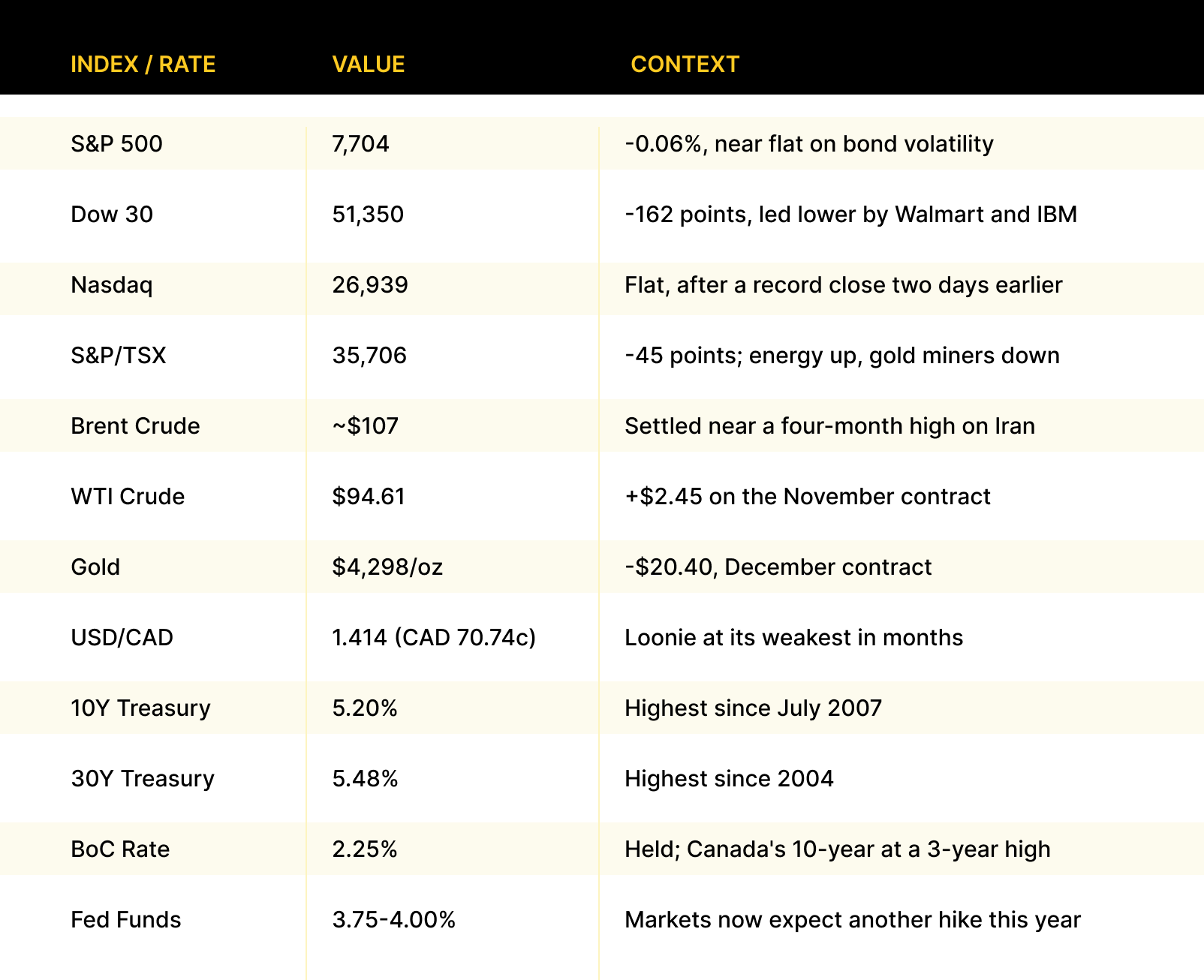
Note: the bond market did the damage again. The 30-year Treasury yield reached its highest level since 2004 and the 10-year its highest since July 2007, after the five-year crossed 5% earlier in the week for the first time since 2007. The Treasury's expanded buyback operation failed to live up to expectations, which is the third time in six weeks we have watched that particular manoeuvre come up short. Oil did the rest. Brent settled near $107 after Iran's president told the UN his country would not surrender. It had briefly pared that rally on reports the United States and Iran are exploring a phased deal to reopen the Strait of Hormuz. Higher yields and a firmer dollar pushed gold down to $4,298, and Kinross fell about 10% after cutting its production outlook for the next two years. In Toronto the index slipped 45 points as energy gains were offset by the miners, and the loonie weakened to 70.74 cents US. Canada's own 10-year yield is near a three-year high. Elsewhere, Shopify rose 2.4% on a deal to let purchases run through Meta's Muse agent, and estimates suggested Canadian retail sales rebounded in August at their strongest pace since January.
1 USD = 1.414 CAD = 0.88 EUR = 0.74 GBP at Thursday spot.
Sources
CNN Business, Business Insider, AppointmentTrader, Columbia News Service (opener); NBC News, Forbes, Business Wire, CBC News, TheStreet, Private Equity Stakeholder Project, The Week (Toys R Us); European Business Magazine citing the Financial Times, World Gold Council, Trading Economics, Al Jazeera, Bloomberg, US State Department, FACT Coalition, International Crisis Group (Venezuela); Washington Post, Al Jazeera, Statistical Center of Iran, Kpler, Vortexa, OPEC, Washington Institute (Iran); Financial Times, Reuters via Insurance Journal, Xeneta, Bimco, Windward, Dryad Global (Red Sea); Yahoo Finance, Placer.ai, McDonald's corporate (McDonald's); Washington Post, Status, Associated Press, CNBC (closer); BNN Bloomberg, Canadian Press, Bloomberg, Trading Economics, StreetStats, Zacks, Bank of Canada (market data).
Market data pulled Friday September 25, 2026 using September 24 closes. Live items this edition. The Venezuelan gold transfer is reported by the Financial Times and still needs a further UK court order. The figure Venezuela reports to the World Gold Council has not moved since 2023, so its true holding is uncertain. The US and Iran are reported to be exploring a phased reopening of the Strait of Hormuz. That would change both the oil price and the shipping premiums quoted here. War risk quotes are moving weekly and come from industry sources who declined to be named. The court order restoring press credentials on Thursday was temporary and the underlying case is unresolved. Currency at Thursday spot rates.