'Healthier' Nicotine, the new Air Force One, $50M FIFA Trophy, Chanel buys Charvet and the Internet tried to save Wendy's

37th Edition
Greetings folks and a warm welcome to the 37th Edition of Friday Finance,
A 38-year-old man in North Carolina who says he has the world’s smallest penis has raised over $12K on GoFundMe to have it enlarged, comfortably clearing his goal in the first couple of days. The procedure isn’t surgery in the traditional sense, it’s a set of semi-permanent dermal filler injections, priced somewhere north of a nose job. He insists it’s medical, not cosmetic (his measurement, for the underwriters among us, is 0.38 inches, roughly the size of a staple). The single largest donation, a full $1,000, reportedly came from a penis pump company, which is either heartfelt charity or efficient influencer marketing. Let's get right to it.
TL;DR: The FDA just granted Zyn the first-ever "modified risk" order for a nicotine pouch, letting it advertise that switching from cigarettes lowers your risk of cancer, stroke, heart and lung disease. Zyn is made by Philip Morris, the Marlboro company, which now says its goal is to STOP selling cigarettes, because the money is in the pouch. Smoke-free is already 43% of revenue. The "reduced risk" math only works if the customers are ex-smokers, not brand-new ones.
This week the FDA did something it has never done for a nicotine pouch: it gave Zyn permission to advertise itself as less likely to kill you than a cigarette. The agency’s “modified risk” order lets 20 Zyn products carry a specific claim, that switching from cigarettes lowers your risk of mouth cancer, heart disease, lung cancer, stroke, emphysema, and chronic bronchitis, even with the fine print that no tobacco product is safe. Zyn is made by Swedish Match, which is owned by Philip Morris, the Marlboro company, and the order is worth more than it looks: it hands them a piece of marketing no competitor can legally copy. Call it a regulatory moat, the government has granted one company permission to say something reassuring that the others can’t.
Philip Morris, the company that spent a century selling cigarettes, now says its goal is to stop selling them, because the money and the goodwill are both in the pouch. Smoke-free products are already 43% of its revenue and Zyn owns somewhere between 55% and 70% of the US pouch market. The old cigarette business, still throwing off cash with 8.5% pricing power even as volumes shrink, is quietly funding the switch. US Zyn shipments did fall about 24% last quarter, which sounds alarming until you learn it’s inventory normalization, warehouses destocking, not people actually buying less. Consumer purchases kept growing. The cigarette maker is trying to become a nicotine company that just happens not to sell cigarettes.
The “reduced risk” claim only holds if Zyn’s customers are former smokers switching down. If the flavors and the discreet, use-it-anywhere design recruit people who would never have touched a cigarette, Philip Morris has new customers. The part that is hard to say with a straight face is the political one: the health secretary who now oversees this, RFK Jr., called these pouches "probably the safest way" to consume nicotine, and, per NOTUS, has held as much as $1.64 million in Philip Morris stock. Fun fact the original Marlboro man, Rober Norris (not related to Chuck Norris), never smoked and later quit because he didn’t want his kids to smoke.
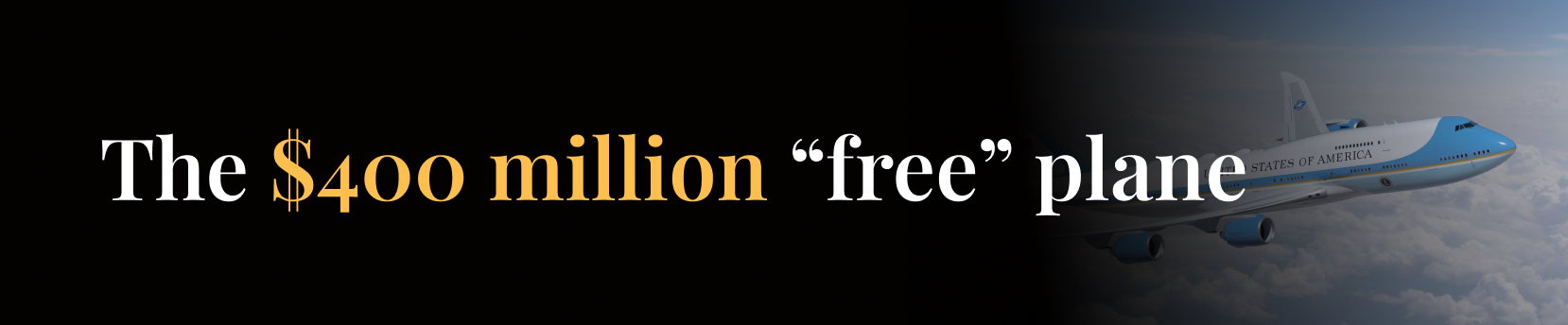
TL;DR: Trump took his maiden flight this week on the Qatari-gifted 747-8 now serving as Air Force One, which is turning out to be the single most expensive way to get a free plane. The jet was a gift, but the retrofit runs past $1 billion, the new hangar cost $320M, and part of the bill was apparently buried inside an over-budget nuclear-missile program. The reason a hand-me-down was needed: Boeing's two purpose-built jets are four years late and have cost Boeing $2.4B+ in losses.
Trump took his first flight this week on the new Air Force One, a Boeing 747-8 that Qatar gave the United States for free, which is turning out to be the single most expensive way to get a free plane. The jet itself is worth about $400M, but “gifted” is doing a lot of work in that sentence. Retrofitting a foreign-built jumbo into a secure presidential aircraft normally runs past $1 billion and takes years; a defense contractor did a stripped-down version in ten months. The plane was also too big for any existing hangar, so the Air Force built a new $320M one at Joint Base Andrews, a complex so large they had to shrink the base golf course from 54 holes to 45. They also bought matching ovens so the crew could practice cooking.
The best part is that you cannot actually find the total cost. Congressional analysts and the New York Times found the Air Force appears to have buried part of the retrofit inside the Sentinel nuclear-missile program, which is itself billions over budget, so the true price of the “free” plane is spread across classified line items nobody can add up. The Air Force secretary told Congress the retrofit was “probably less than $400M,” which is the kind of estimate you give when you’d rather not be pinned down. Somewhere in there is the cost of the plane, the hangar, the ovens, and a training mock-up, and no outside auditor can tell you what it adds to.
Boeing was supposed to deliver two purpose-built Air Force Ones under a $3.9 billion fixed-price contract Trump personally negotiated in 2018 to “save taxpayers $1.4 billion.” Instead the planes are four years late, now due around 2028, roughly when he leaves office, and the fixed-price structure has cost Boeing more than $2.4 billion in losses, so it slow-walks a job it loses money on. Force all the risk onto the contractor and the contractor stops hurrying. And when Trump leaves office, the plane, paid up and militarized on the public dime, is set to transfer to his presidential library foundation. The taxpayer buys the renovation; the residual value walks out the door. Now this is the Art of the Deal.
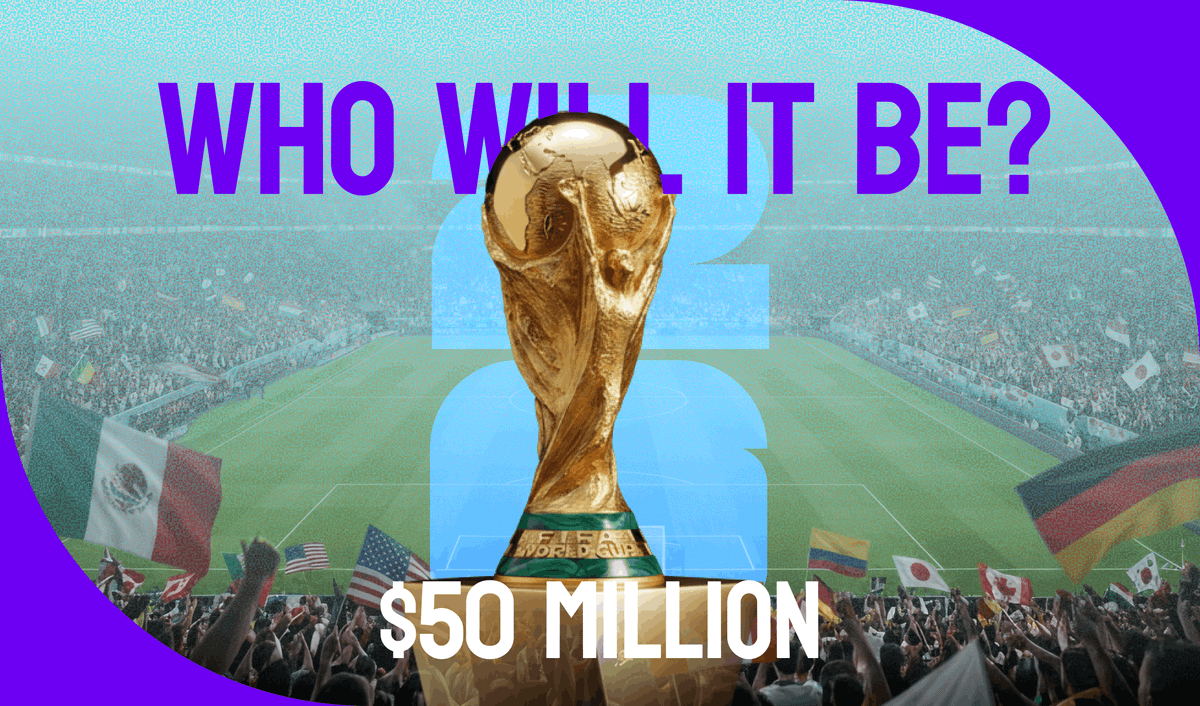
TL;DR: The team that wins this World Cup takes home $50 million, the biggest champion's cheque ever, part of a record $871 million. The growth curve is steep: the winner's prize has gone from $2.2M in 1982 to $50M now. But two asterisks: the money goes to federations, not players (who might see $1-2M after the cut), and adjusted for inflation the real jump is 7x, not 23x. The deeper tell: players generate $10.9B in FIFA revenue and the prize pool is about 6% of it. The money flows to capital, not labour.
The team that wins the World Cup on July 19 will collect $50 million, the biggest champion’s cheque in the tournament’s history, part of a record $871 million FIFA is spreading across all 48 nations. Put that next to the past and the growth curve is almost vertical: the winner’s prize has gone from $2.2 million in 1982 to $50 million now, and the entire prize pool from that 1982 tournament, just $20 million, wouldn’t even cover this year’s runner-up. As of this writing the knockout rounds are underway, all three host nations somehow still alive, and Messi’s Argentina defending the title it won in 2022 (that may change later today).
There are really two eras here. From 1982 to 2002 the champion’s prize crept from $2.2M to $9M, two decades of slow growth. Then in 2006 it doubled overnight to $20M as global broadcast and sponsorship money exploded, and it has climbed toward $50M ever since. The 48-team, three-country, 104-match expansion this year is the latest version: more matches, more TV inventory, more sponsor slots, a bigger pool. FIFA already projects a $14 billion budget for the 2027-30 cycle, so the pot at the 2030 World Cup will almost certainly clear a billion dollars.
Two points to keep the number honest. The first is inflation: that $2.2M in 1982 is about $7M in today’s money, so the champion’s prize has grown roughly 7x in real terms, not the 23x the raw figures suggest. The second is who actually gets paid. FIFA hands the $50M to the national federation, not the players; each federation then runs its own bonus deal, and a player might pocket a million or two after the cut. For a star on $20M a year at his club, that’s a rounding error; for a player from a smaller football economy, it’s life-changing.
The players are the entire product, and the prize pool is about 6% of FIFA’s roughly $10.9 billion in revenue this cycle. The rest stays with the organization. Compare that with FIFA’s brand-new Club World Cup, which paid Chelsea about $125 million last year, two and a half times what the actual World Cup champion will get, from a tournament with a fraction of the audience. And the program that compensates elite clubs for releasing their players has ballooned 423% since 2010, to $355M, growing faster than the prize money itself. Real Madrid, PSG, Manchester City, the clubs hold the leverage, because they can threaten to keep their players home.
FIFA’s pitch is inclusivity, and it’s not wrong: every one of the 48 nations is guaranteed at least $12.5 million just for showing up, and the bigger field let more African and Asian teams in. But the gap between the winner and the participant is also the widest it has ever been, $52.5M against $12.5M. FIFA’s favorite accounting method is “creative offside”, because when the money is off the books, it’s still technically in play.
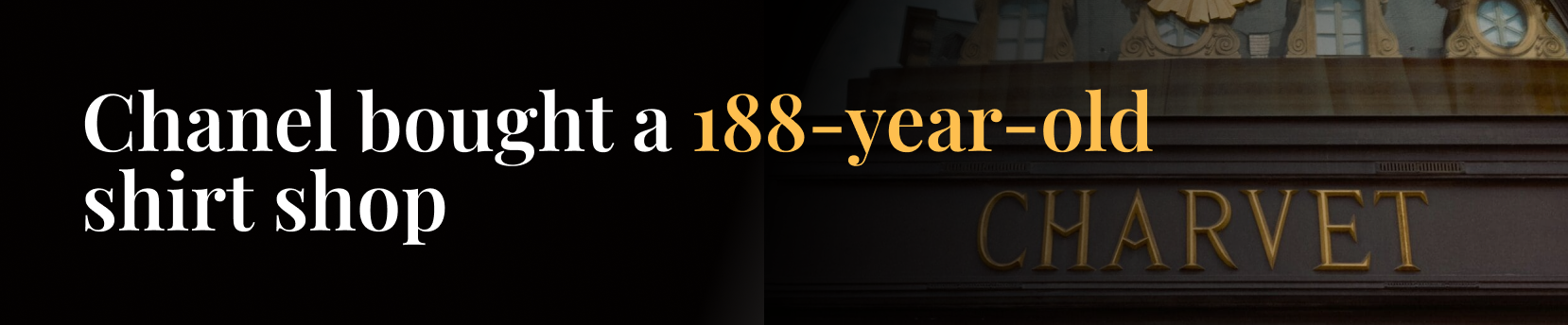
TL;DR: Chanel just bought Charvet, the world's oldest shirtmaker, which has been on the Place Vendôme since 1838 and dressed Churchill, JFK and Coco Chanel herself. The trigger was a co-branded shirt, including a $7,130 tuxedo shirt that sold out in hours. But the deal isn't about shirt revenue ($10-15M/yr). It's vertical integration: Chanel spent $700M+ last year buying up the tiny family ateliers that supply luxury's irreplaceable hand-craft, before they run out of heirs.
Chanel just bought the world’s oldest shirtmaker. Charvet has been making shirts on the Place Vendôme since 1838, dressed Churchill, de Gaulle, JFK and Coco Chanel herself, and after 188 years of family ownership it now belongs to a $19 billion fashion house. The thing that triggered the deal was a shirt, specifically the ones Chanel’s new designer had Charvet make for his debut show, including a co-branded tuxedo shirt that cost $7,130 and sold out in hours.
This isn’t about the shirt revenue, though. Charvet does maybe $10-15M a year, a rounding error for Chanel. It’s vertical integration: Chanel spent over $700 million last year alone buying up the tiny family ateliers that supply the irreplaceable hand-craft luxury depends on, because those businesses keep running out of heirs and the skills die with them. When your whole pitch is “almost nobody can make this,” the scarce thing isn’t customers, it’s the hundred people who know how to cut the collar, and the archive of 500 different shades of blue. Chanel didn’t buy a shirt business, it bought the guarantee that the shirts can still be made, and that a competitor can’t have them. It also bought the building on Place Vendôme, which on that particular square is the part the accountants actually care about.
Two editions ago we wrote about China trying to solve its vanishing master craftsmen by replacing them with $9.99 rent-a-chef robots. Chanel looked at the same problem, the artisans are dying out, and did the exact opposite: it bought the humans. LVMH builds an empire by buying brands; Chanel, privately owned with no shareholders to answer to, quietly buys the suppliers and leaves them alone. One approach treats craftsmanship as a cost to automate away, the other treats it as an asset to lock in a vault. The $7,130 shirt isn’t really the product. Also in case you’re wondering the shirt didn’t even include the black tie.
TL;DR: Last week WallStreetBets rallied around "we need to save Wendy's" and sent the stock up 42% in a day, tripping a trading halt. But the meme has grown up: Wendy's hit a 12-year low the day before, and the juicy 7.65% dividend yield is just math due to a low share price. Under the noise there's a real setup (Nelson Peltz trying to take it private). The bigger picture: retail money is sloshing around hunting a story, and 2026 has bigger ones, SpaceX at $1.75T, OpenAI (maybe) and Anthropic next.
Last week the internet decided to save Wendy’s. A since-deleted post on WallStreetBets, “we need to save Wendy’s before it’s too late,” sent the burger chain’s stock up as much as 42% in a single day, tripping a trading halt, on volume roughly 1,500% above normal, and leaving the short sellers about $105 million underwater. It was a very 2021 thing to happen. But look closer and the meme has grown up: the pros keep noting that the crowd is more disciplined now, smaller position sizes, an exit plan, “less likely to throw the whole portfolio at one pitch.”
Wendy’s hit a 12-year low the day before the squeeze, and the juicy 7.65% dividend yield that makes it look cheap is just a function of a collapsed share price, with same-store sales down about 8%. The Reddit crowd wasn’t entirely wrong, though: under the noise there’s a real setup, a credible new turnaround team and the activist Nelson Peltz quietly trying to take the whole thing private, reportedly with Gulf money. Retail sniffed out a real bone and then chewed a few dollars past it; the stock has already drifted back from its peak.
Retail money is sloshing around looking for a story, and 2026 has bigger ones than a burger chain. The SpaceX IPO just went out at a $1.75 trillion valuation, the biggest in history, and reserved a chunk for small investors three times the usual size; OpenAI and Anthropic are lining up their own mega-listings, although OpenAI’s was just reported to be slipping. Where 2021 had a thousand junk SPACs, 2026 has a handful of IPOs worth maybe $3.7 trillion between them, which is either the market reopening or the market cannibalizing its own liquidity, depending who you ask. The meme army and the IPO order book, it turns out, are now the same people, Wall Street spent a decade fearing retail and now needs it to absorb the biggest deals ever floated.
Since BMW pulled out of Russia days after the 2022 invasion, an old BMW plant in Kaliningrad has quietly kept building “BMW-shaped” SUVs from the leftover parts the Germans left behind, no license, no permission, and a 2025 build date bolted onto a 2022 design. Russian media say 145 of these bootleg Bimmers sold last year, at $153,000 to $166,000 apiece, which is a bargain next to a gray-market import. The best part is the sales pitch: because the cars have been ripped out of BMW’s software system, the sellers promise Munich can’t remotely “brick” them. They’ve turned “we cannot update your car and it may not fully work” into a premium feature.
“Innovation! One cannot be forever innovating. I want to create classics.” — Coco Chanel
Have a fantastic weekend. I welcome feedback and please forward this if you see fit.
Many thanks,
Sam.
Market Snapshots
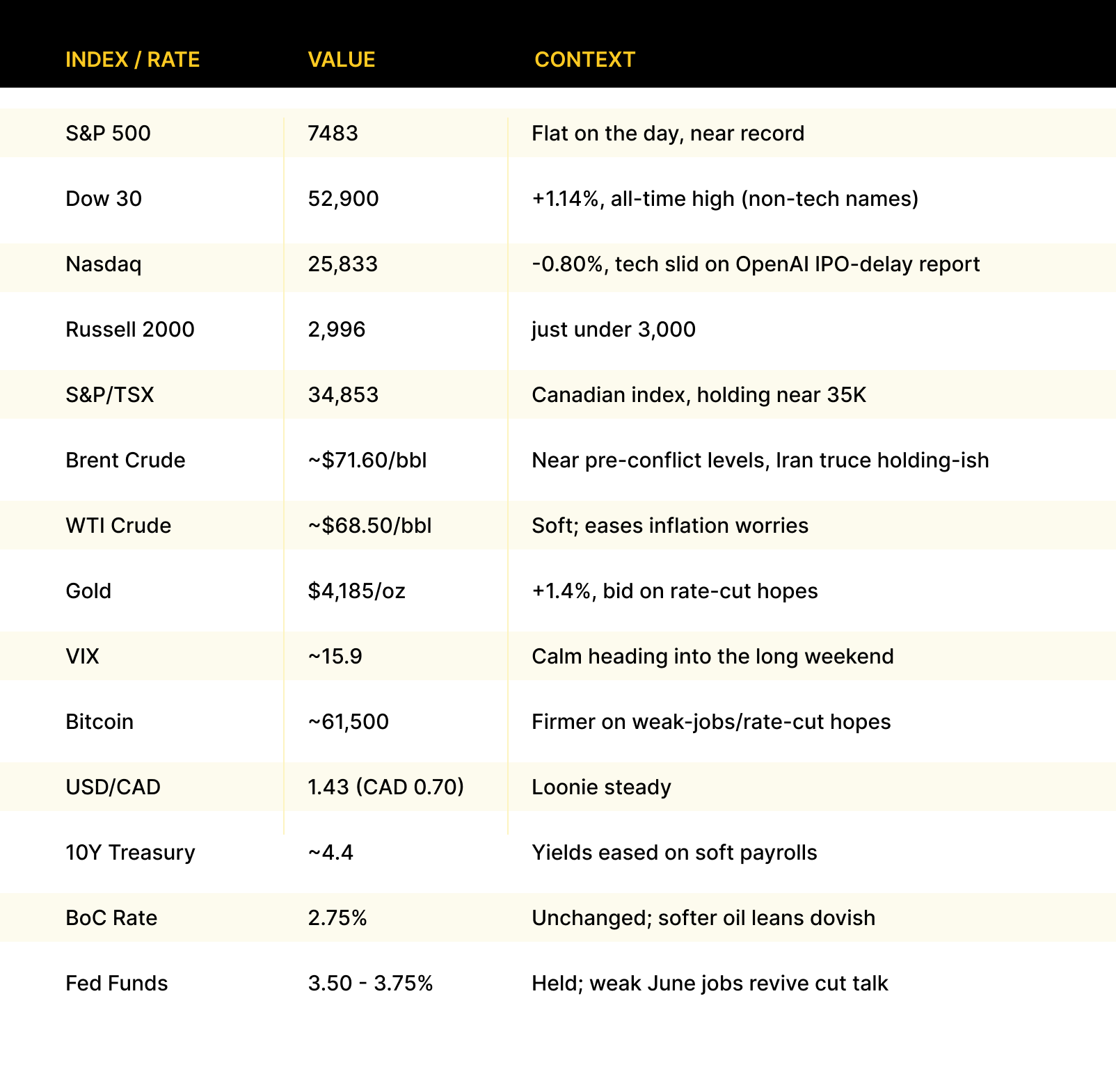
1 USD = 1.43 CAD = 0.86 EUR = 0.74 GBP at Thursday spot.
Sources
WSJ (Laura Cooper), FDA, Philip Morris/Swedish Match, CNBC, Axios; WSJ (McGraw & Weisgerber), BBC, NBC, New York Times, Breaking Defense, Defense News; Voronoi/Visual Capitalist (DAZN), FIFA, Sporting News, Statista, Al Jazeera, ESPN, Sky Sports; Business of Fashion, FT, Robb Report, Man of Many; Business Insider (Samuel O’Brient), Vanda Research, CNBC, Reuters, Forbes; RFE/RL; CNBC, Yahoo Finance, Trading Economics, TheStreet, S&P Dow Jones Indices, TMX.
Market data pulled Friday July 3, 2026 (July 2 closes; US markets closed for the holiday). Live items in this edition: the World Cup is in its knockout rounds (final July 19, no champion yet); the Zyn FDA order and the Air Force One flight are days old; the Wendy’s squeeze has already cooled; the GoFundMe total and the Kaliningrad car figures were current at press. Currency at Thursday spot rates.