Forced LA Lakers sale, The Eddie Murphy Rule, Venezuela wants its gold back, Transit passengers on the move and 'Situational Awareness'

43rd Edition
Greetings folks and a warm welcome to the 43rd Edition of Friday Finance,
There is a messaging app called Carrier Pidge that delivers your texts at the speed of an actual carrier pigeon, 110 mph, timed off the real distance between you and whoever you are writing to, which puts Los Angeles to New York at about 22 hours. It also gives every message a 0.2% chance of never arriving at all, because the bird gets lost, and it publishes that number as a feature. The bigger one, Roost, went from 10,000 to 300,000 users in about five weeks after a mother posted that her daughter was using it to write to friends in Elizabethan English. Roost sells you the birds, $0.99 to $10 apiece, and because each species flies at its real-world speed, the item store is a price ladder for how long you are willing to wait. Thirty years of engineering went into removing latency from messaging. This one put it back and charges for the fast animals. We have come full circle, next the rotary phone. Let's get right to it.

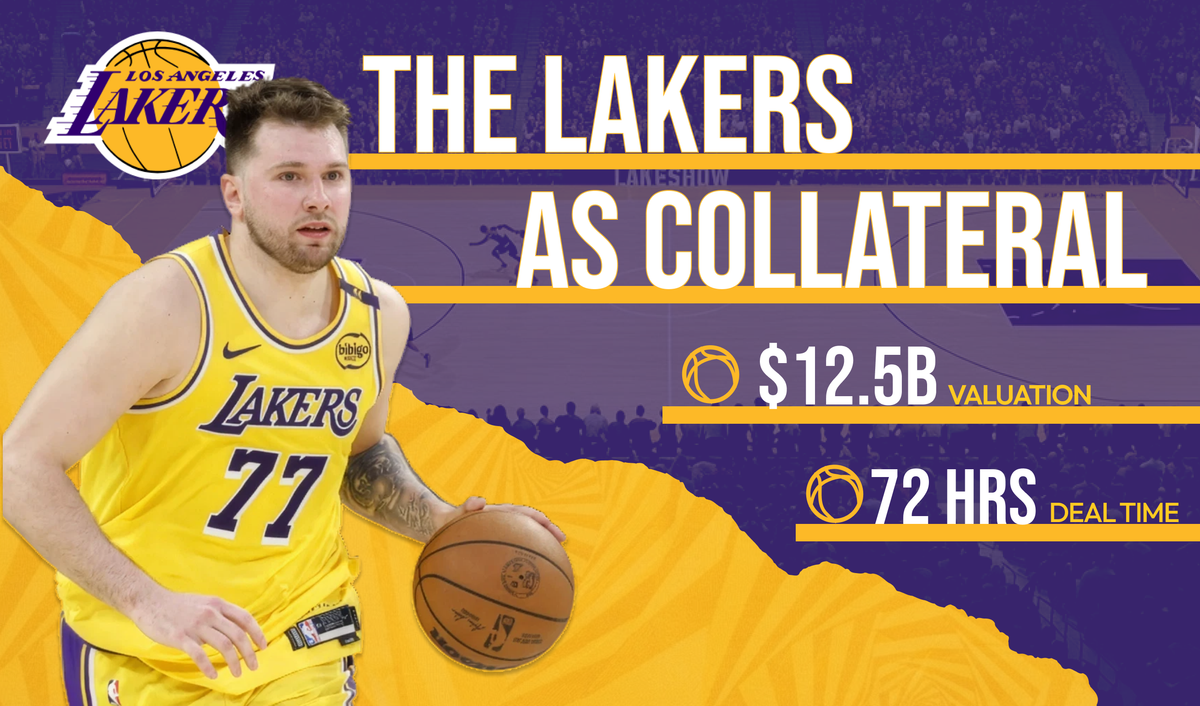
TL;DR: The most expensive transaction in sports history took 72 hours, with no auction and no indication the Lakers were for sale. They weren't. A Delaware regulator ordered Mark Walter's insurers to unwind almost all Walter-related investments by year-end, and he needed cash. Kushner and Iger are worth about $6B combined and are buying a $12.5B asset, which the NBA's own rulebook makes possible.
The most expensive transaction in the history of sport took 72 hours. Josh Kushner called Mark Walter’s camp over a weekend, and by Wednesday he and Bob Iger had agreed to buy control of the Los Angeles Lakers at a $12.5 billion valuation, the highest price ever paid for any team. There was no auction, no bankers running a process, and no indication the Lakers were for sale, because they were not. What there was, according to the Wall Street Journal, was a seller who needed cash. Federal prosecutors in Manhattan and the SEC are examining how billions in loans tied to Walter’s conglomerate ended up on the books of his insurance companies after passing through a third entity, and the Delaware regulator overseeing those insurers has told him to dispose of or restructure almost all Walter-related investments by the end of this year. His company says it is confident the matters will be resolved favourably. Either way a regulator set a deadline, and deadlines are where negotiating leverage goes to die.
Kushner and Iger are worth roughly $6 billion between them and are buying a $12.5 billion asset. The answer sits in the league’s own rulebook. The NBA caps team debt at $475 million but allows institutions to hold up to 30% of a team’s equity, with no single fund above 20%, which means more than $3.5 billion of this can come from funds like Kushner’s Thrive. The Buss family’s roughly 15% stays where it is, taking the actual transaction down to something under $10.6 billion at the absolute most, and the cap table is not public. Sportico’s read on last year’s sale is the useful precedent: the $10 billion headline was really less than $6 billion of consideration once you counted the retained stake and the financing. The record is a valuation. The cheque is a different and much smaller number.
What Walter is really selling is not a basketball team but collateral. He had pledged other assets to finance the Lakers purchase last year, so letting the team go releases them and may speed the remediation his insurers have been ordered to complete, and he has separately signalled interest in selling his minority stake in Chelsea. There is a neat irony in how he got here, because Walter built his fortune on the observation that annuity savers’ steady premiums were well matched to long-duration investments in sports, fast food and technology. That is the insurance float model, and it works beautifully right up until a regulator decides your long-duration investments are a little too closely related to you. He bought the Lakers a year ago at a then-record $10 billion valuation. So its not just the roster is needs rebuilding.
TL;DR: A 21-year-old timed the Super Bowl anthem rehearsal from a public sidewalk and won $50,000 betting on its length. He broke no rules. Bloomberg found roughly $200M of flagged trades on Polymarket in six months, with the top 1% of wallets taking over half the money and 57% of them created within a day of trading. The cleanest category was financial markets, the one with actual insider-trading law.
In February a 21-year-old flew to San Francisco, stood outside the Super Bowl for twelve hours until he could hear the national anthem rehearsals, and timed each run-through with a stopwatch. He then bet more than $50,000 on Polymarket that the anthem would come in under 117 seconds. It ran 104. He broke no rules whatsoever, and the internet accused him of insider trading anyway, which is a useful illustration of how unsettled everyone is about where the line sits. The actual cases look nothing like a kid with a stopwatch. Bloomberg Businessweek, working through 34,000 transactions flagged by the analytics firm Polysights, found roughly $200 million of suspicious trades in the first half of this year, with daily volume peaking in late February on a spike in Iran-related bets, which is to say the week the war started. Polysights scores trades on eight measures and flags anomalies rather than proving anything; some of those traders may simply have been right.
The top 1% of profitable flagged wallets captured more than half the money, and 57% of those wallets were created less than 24 hours before the trades were placed. One account made $370,000 betting yes on a US-Iran peace deal at odds as low as 6%, from a wallet opened two hours earlier. Nobody opens an account two hours before the best trade of their life because they are unusually good at forecasting. Another 38 connected addresses bet with a 98% win rate on American moves in Iran and Venezuela, made $1.6 million, and cashed out through the same Coinbase deposit account. The more revealing finding is where the flagged money was not: the cleanest categories in the entire analysis were financial markets and the economy, the one domain with ninety years of insider-trading law attached to it. Everything else, military action, elections, committee decisions, award shows, sits in a gap where a small group knows the answer and no statute clearly applies. The capital went to the thinnest legal coverage rather than the best odds.
Then there is the category where the market stops observing the world and starts editing it. A think-tank employee was fired after allegedly altering an interactive conflict map that a Polymarket contract settled on, French authorities are investigating whether someone tampered with a weather station to win a bet on the temperature in Paris, and markets on whether an object would be thrown onto a basketball court encouraged spectators to throw one. When a contract settles on a real-world data source, that source becomes an attack surface. Enforcement is arriving: prosecutors charged an Army master sergeant over bets on a Venezuela raid in the first case of its kind, using a Dodd-Frank provision nicknamed the Eddie Murphy Rule after the film Trading Places, and this month a Google employee was charged with making more than $1 million betting on what people were searching for. He has pleaded not guilty. Robin Hanson, the economist regarded as the field’s godfather and an adviser to both platforms’ founders, has argued for years that surfacing hidden information is the entire point, and that insiders are simply the people who have it. I promise not to talk about Polymarket for at least the next 3 editions.

TL;DR: Venezuela's government and opposition agree on almost nothing, but both now want 31 tonnes of gold back from the Bank of England. The gold Caracas could reach was sold cheap for food. The gold it couldn't reach doubled in value. The freeze was the best trade the country made in a decade, and a foreign custodian made it for them. Every other central bank has noticed.
Venezuela’s government and its opposition agree on almost nothing, which makes this week’s joint statement notable. After two weeks of US-backed talks they have both asked for the same thing: the return of about 31 tonnes of gold, worth roughly $4 billion, sitting in the vaults beneath Threadneedle Street. The stated purpose is reconstruction after the June earthquakes, two of them, magnitude 7.2 and 7.5, thirty-nine seconds apart, which killed more than 6,000 people. The statement builds in transparency and audit mechanisms, and an opposition figure explained why with unusual candour: so that the money does not get stolen by the government they have just signed the statement with.
The freeze dates to 2018, when Britain stopped recognising the government after a disputed election, and what followed was less a financial dispute than a constitutional one. Under what English lawyers call the One Voice doctrine, when the government declines to recognise a head of state the courts must take the same position, so in 2020 the High Court found that only the board appointed by Juan Guaidó could direct the bullion, and in 2021 the Supreme Court agreed. Venezuela never stopped owning the gold. It lost the ability to give an instruction the Bank of England would accept, which turns out to be the only part of ownership that pays.
When the 31 tonnes were frozen in early 2019 they were worth about $1.9 billion. They are worth roughly $4 billion now, an increase of about 110% earned entirely by sitting still. Over the same stretch the gold Caracas could reach was disposed of steadily. Total reserves fell from around 360 tonnes in 2014 to a fraction of that, sold to Turkey, the United Arab Emirates and others, frequently for food imports, with the World Gold Council counting net sales of 179 tonnes since 2022 alone. The metal the state controlled was liquidated near the lows. The metal a foreign custodian refused to release is the only part that compounded. There is a historical sting too, because Hugo Chávez repatriated roughly 160 tonnes from foreign vaults in the early 2010s precisely to avoid this, and the portion he left in London is the portion that got frozen.
The case for holding it rested on there being two rival claimants and no way to know which was legitimate. That is no longer the situation, since there is one request now, signed by both sides, and the Foreign Office’s position is that the British government is not a party to the case at all. What remains is not a legal obstacle so much as an institutional one, and the honest objection is not that the claim is invalid but that nobody trusts the recipient. That is fair enough: Delcy Rodríguez is an unelected former vice-president governing with Washington’s backing, the opposition’s most popular figure is excluded from the talks and stuck in Washington, and there is no guarantee that $4 billion released for reconstruction reaches reconstruction. Distrust is an argument for conditioning a release through escrow, tranches and audited disbursement, which is what the joint statement proposes.
The reason this matters well beyond Caracas is that the Bank of England vaults something like 400,000 gold bars on behalf of central banks around the world, the largest concentration anywhere outside the New York Fed. That business rests on a single proposition, which is that London gives it back, and Venezuela is now the worked example of what happens when it does not. The response is measurable. Since the middle of last year the Banque de France has sold 129 tonnes of gold it held in New York, for around $15 billion, and bought replacement bullion to store in Paris. Germany is again debating repatriating the roughly half of its reserves held abroad, having once waited five years to get 300 tonnes back from the Fed and never received the original bars. Central banks bought 863 tonnes last year against a long-run average nearer 473, most of it emerging markets.
Venezuela is carrying about $240 billion of sovereign debt and running the largest restructuring in history, so $4 billion is roughly 1.7% of the problem, useful for disaster relief and irrelevant to solvency, and it sits alongside a $350 million IMF drawing in July and a request for $4.6 billion in special drawing rights. Monthly inflation ran at 19.9% in July against 13.8% in June, with annual inflation estimated around 575%. Set against roughly €200 billion of Russian sovereign assets frozen across Europe, the question every reserve manager is now quietly pricing is whether Western financial infrastructure is neutral plumbing or an instrument of policy. It cannot be both, and the countries choosing where to store their reserves have noticed. Let’s hope that the gold doesn’t end up in Qatar like the oil revenue and that it actually goes to reconstruction.
TL;DR: Incheon is now the world's busiest international airport, 25 years after opening, and it got there largely because Dubai's traffic fell two thirds in a single month when the Iran war began. Nothing about Dubai got worse. The passengers simply stopped routing through it. Half of what Incheon gained is borrowed and will go home; the other half is a tourism boom that stays.
Seoul’s Incheon airport has become the world’s busiest for international passengers, handling 38.4 million in the first half of the year, ahead of Heathrow on 37.79 million and Changi on 34.53 million, according to preliminary figures the airports body will finalise next month. It is the first time Incheon has topped the table in the 25 years since it opened. It got there largely because Dubai, which had led or contested the ranking for more than a decade, is expected to fall out of the top five entirely. When the Iran war began in late February the Gulf hub all but closed, and Emirates suspended every flight in and out on March 7 after an aerial interception over the airport. Dubai’s international traffic went from 7.4 million passengers in February to 2.5 million in March, a fall of two thirds in a single month, and by June had recovered only to 4.7 million, still a third below where it started.
Nothing about Dubai got worse. The runways, the terminals, the airline and the staff were exactly as good in March as in February, and Emirates was flying again within days. The passengers simply stopped routing through it, because the revenue Dubai built its business on is the most footloose money in aviation. A transit passenger neither begins nor ends their journey in your country; they are there only because your airport happened to be the most convenient place that week to change planes, which is a wonderful business until your geography turns from an advantage into a risk. European and Asian carriers responded by flying people directly between the two regions instead, and Incheon’s European transit traffic rose 63% to 210,000. Dubai was at its peak weeks earlier: December was its busiest month on record at 8.8 million passengers, January 3 brought a record 324,000 in a single day, and in January it overtook Atlanta to become the world’s busiest airport by seat capacity. It won that title eight weeks before losing two thirds of its traffic.
What Incheon gained splits into two quite different things. The rerouted transfers are borrowed and will go home the moment Gulf routes feel safe again, because they were never loyal to Seoul in the first place. The other half looks durable: foreign travellers made up a record 44.4% of Incheon’s passengers in the second quarter, Korea had its best first quarter on record with 4.76 million arrivals led by China and Japan, and bookings to Seoul from Canada, Asia and Australia jumped 25% after the release of an animated film about K-pop demon hunters. That is demand with a destination attached rather than a connection to catch, which is the difference between a shopping centre’s passing footfall and its anchor tenant. It helps too that Incheon finished the fourth phase of its expansion in November 2024 and now flies to 158 destinations with 101 airlines, more than Hong Kong, Shanghai Pudong or Tokyo Narita. The margin over Heathrow was about 610,000 passengers, or 1.6%. The capacity was already built when the luck arrived.
TL;DR: A 24-year-old with no trading background was handed $45B on the strength of a 165-page essay, returned 439% in six months, then lost 67% in July and was force-sold to Citadel at a reported 10% discount. The two numbers are the same fact. Because the book was levered, his lenders rather than his thesis decided when the trade ended.
Leopold Aschenbrenner published a 165-page essay in 2024 arguing that machine superintelligence would arrive before the decade was out, launched a hedge fund named after it, and by early July was managing about $45 billion with a team of roughly twelve people. He was 22 and had never worked as a trader when investors began handing him hundreds of millions. Through June the fund had returned 439%. In July it lost 67%, its prime brokers came calling, and on July 30 it sold its roughly $16 billion public equity book, most of it to Ken Griffin’s Citadel, at a reported discount of around 10%, which is about $1.6 billion of value moving across a table in a single transaction. Assets fell from $45 billion to about $10 billion inside a month. He wrote to investors that they had been let down, took full responsibility, and said the fund would stop borrowing to amplify its stock bets.
You cannot return 439% in six months without either luck or borrowing unsustainable sums, and from the outside those look identical until the month they do not. Reported leverage ran as high as 400%, and what that buys is not just amplified losses but a change in who decides when the trade is over, because a margin call runs on the lender’s clock rather than on your thesis. Aschenbrenner’s argument was that AI infrastructure would transform the economy over years, and it may yet. It made no difference. A week before the forced sale he had written to investors describing the selloff as one of the best entry points since early 2025 and inviting them to add capital from August 1. He was liquidated into the dip he was recommending.
More than 80% of managers in Bank of America’s latest survey called long global semiconductors the most crowded trade in the market, so this was the consensus position with borrowed money attached. The holdings themselves, SK Hynix, Micron, CoreWeave, Nebius and the rest, each lost more than half their value between their recent peaks and the morning Citadel stepped in, his short positions in software moved against him at the same time. Griffin’s edge was not a better forecast about memory chips; it was having cash.The part worth sitting with is not the 24-year-old, who took his shot and owned the outcome, but the professional allocators who read a 439% return as a track record and a widely-shared essay as due diligence, then wired $45 billion to twelve people. A fund that nearly died in July is still up about 80% on the year. Interestingly this was all happening while Leopold was getting married.
In 1979 a designer named Richard Berg published a board game called The Campaign for North Africa, still generally regarded as the most complicated ever made. It recommends ten players, runs to 111 turns across a map nine and a half feet long, and takes roughly 1,500 hours. Before you can work out how far a tank moves you must calculate how much of your fuel evaporated that turn: 3% for most armies, but 7% for the British early on, because they shipped petrol in 50-gallon drums instead of jerry cans and the drums leaked more. Supply trucks consume supplies while transporting supplies, so the logistics chain can partly eat itself just by existing. Two people are currently two years into a game meant for ten, having magnetised every counter and rebuilt the bookkeeping as an automated spreadsheet, and report that they still do not understand what the camels do. The war in North Africa lasted about three years. At a sensible pace, the game takes 20.
"All models are wrong, but some are useful."— George Box
Have a fantastic weekend. I welcome feedback and please forward this if you see fit.
Many thanks,
Sam
Market Snapshots
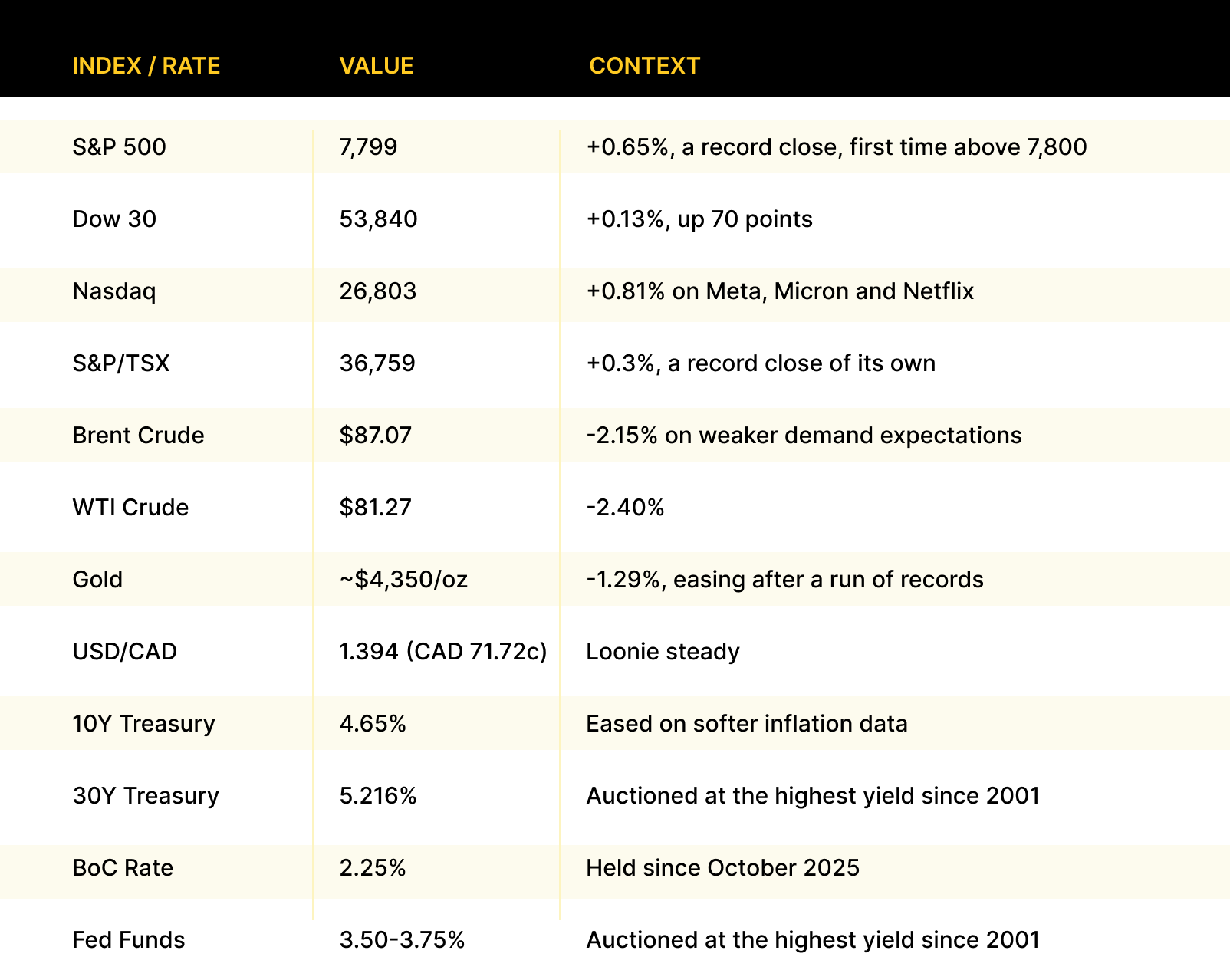
Note: the mood flipped this week. A fortnight ago markets were pricing roughly even odds that the Federal Reserve would hike in September, an extraordinary thing to write in a cutting cycle. Then July inflation came in tame on both sides of the ledger, consumer prices in line and wholesale prices up 4.7% against expectations of 4.9% and June’s 5.5%, and the hike trade unwound. The S&P 500 closed at a record above 7,800 for the first time, the VIX touched a 2026 low, and Treasury yields eased. The bond market has not entirely relaxed, though: the Treasury sold 30-year debt at 5.216%, the highest yield at auction since 2001, with soft demand, which is the price of financing a deficit rather than a statement about inflation. Toronto set a record of its own at 36,759 on financials and miners, and the loonie held near 71.7 US cents. Oil fell back to $87 on weaker demand expectations even as Iran restated that the Strait of Hormuz stays restricted until its conditions are met. The Bank of Canada remains at 2.25%.
1 USD = 1.394 CAD = 0.88 EUR = 0.75 GBP at Thursday spot.
Sources
TechCrunch, GamesBeat, Dexerto, Apple App Store listings (opener); Wall Street Journal, Sportico, CNN, CBS Sports, Variety, Reuters (Lakers); Bloomberg Businessweek, Reuters, CFTC and DOJ filings, ABC News, Forbes (prediction markets); Financial Times, CNN, MercoPress, bne IntelliNews, Al Jazeera, World Gold Council, Investing News Network (Venezuela gold); Financial Times, Airports Council International, Yonhap, the Guardian, Korea Tourism Organization, Gulf News, AFP (Incheon); The Economist, Reuters, CNBC, Inc., Bank of America Global Fund Manager Survey, Aswath Damodaran (Situational Awareness); Kotaku, Wargamer, Open Culture, Boing Boing (closer); CNBC, Motley Fool, Trading Economics, Globe and Mail, Investing.com, Bank of Canada (market data).
Market data pulled Friday August 14, 2026 using August 13 closes. Live items this edition: the Lakers deal is a signed agreement that still requires NBA Board of Governors approval and is a long way from closing, and the reported figures on player contracts and net worth are estimates rather than filings; the Venezuelan gold’s dollar value moves with the gold price, and the Bank of England has not responded publicly to this week’s joint statement; the airport rankings are preliminary and subject to final validation next month; charges against those named in the prediction-market cases are unproven and the individuals have pleaded not guilty, while the analytics used flag anomalies rather than establish wrongdoing. Currency at Thursday spot rates.