X 'Bank', Tax data crossing borders, Cocaine Supply Glut, Don't blame Taco Bell, Milliseconds for sale


41st Edition
Greetings folks and a warm welcome to the 41st Edition of Friday Finance,
Arizona State, the largest public university in the country, will now sell you a four-year Bachelor of Arts in being an influencer. The Cronkite School’s new content-creation degree teaches personal branding, audience analytics and podcast production, and the capstone requires you to grow a real following, with real followers, before they hand you the diploma. There is something ironic about paying tens of thousands of dollars over four years to get a degree when it's the one industry that exists specifically because it needs no education, no gatekeeper, no permission, just a phone and an audience. Goldman Sachs figures that industry hits $480 billion by 2027, which is the actual reason the degree exists. Let's get right to it.
TL;DR: X launched a bank account this week paying 6%, higher than any bank in America and higher than the Fed. Three things aren't what they're called. It's not a bank, it rents one (Cross River). The 6% isn't a yield, it's a marketing subsidy no safe asset can fund. The "$10M of FDIC insurance" covers the bank failing, not X failing, which is the failure that would actually cost you.
This week X launched X Money, a bank account inside the app, with a metal Visa card, real-time transfers, early paydays, and a 6% yield that is higher than any bank in America pays and higher than the Federal Reserve itself. The first thing to know is that it is not a bank. X rents its banking permissions from Cross River, a New Jersey lender that quietly powers half the fintech industry, while X Payments holds money-transmitter licenses in 41 states and X Corp just runs the screen. Chartering an actual bank takes years and a pile of capital; renting one takes a contract, which is why Klarna, Wise and others spent years fighting regulators while X skipped the queue. There is also, after a decade of Musk hyping Dogecoin and an “everything app,” precisely zero crypto in it. It is, in a nice irony, Musk returning to X.com, the online bank he founded in 1999 that became PayPal.
Safe assets pay about 3.6% right now, the best high-yield savings account in the country pays maybe 4.5%, and the FDIC national average is 0.38%. So 6% sits roughly 240 basis points above the risk-free rate, which means no safe investment can fund it and someone is subsidising every dollar; on a billion dollars of deposits, that gap is about $24 million a year out of X’s own pocket. X has 570 million users and a subscription base, so it can afford to lose money on deposits to pull them into the everything-app, the way a restaurant loses money on a loss-leader. The deposit is the bait. The thing being bought is you, your engagement and your default payment method, and, as Senator Elizabeth Warren pointedly asked in a letter Musk still hasn’t answered, possibly your data.
X advertises “up to $10 million” of FDIC coverage, 40 times the norm, achieved by sweeping your balance across a network of partner banks. There are two catches. First, X’s own FAQ admits the sweep does not guarantee your money stays under the $250,000 limit at any single bank, and anything over that is uninsured. Second, and this is the one that matters, FDIC insurance covers the bank failing, not X failing, and a bank failing and an app failing are not the same event. The bank actually holding your deposits, Cross River, is carrying an active 2023 FDIC order for unsafe practices that nobody mentioned in the launch. Because your account now lives inside a social network, the same company that can suspend your posts can, in principle, gate your money, which is a genuinely new way to be exposed. Your bank account and your posts now share a terms of service. Be careful what you say.

TL;DR: A quiet 2024 UK tax rule turned digital platforms into a global reporting machine, and OnlyFans reports to Britain because its parent is UK-based. Britain then auto-shares that income data with 40+ countries. In Ukraine, where the work is a criminal offence, that handed prosecutors a ready-made list, and the state now wants to tax income that declaring it is a confession to. The same pipe reports your Airbnb and Uber earnings too.
Since January 2024 a quiet British tax rule has required digital platforms, eBay, Airbnb, Uber, Etsy and OnlyFans among them, to hand HMRC a full dossier on every seller: name, address, date of birth, bank account and exact annual earnings. OnlyFans reports to Britain because its parent company is based there, which means it reports on its creators everywhere. The important part is the next step: under the OECD framework Britain adopted, HMRC automatically shares that data with the 40-plus countries running the same rules. So a creator’s verified income now travels from a UK platform to a foreign tax authority without anyone requesting it, and it travels whether or not the money ever leaves the account. Tax enforcement used to follow the money. Now it follows the data, which is faster, cleaner and indifferent to borders.
In Ukraine this turned into something darker. When Britain shared OnlyFans earnings data with Kyiv, it handed the state a ready-made list of creators in a country where producing that content is a criminal offence carrying up to three years, or seven for repeat cases. The tax service duly demanded the income be declared and taxed at 18% plus a military levy, which puts the creator in an impossible position: declaring it is a confession to the crime, and not declaring it is evasion. Thousands of audits later, models have paid roughly $2.8 million in back taxes, a figure one Ukrainian outlet estimates is about 5% of the real total, implying a tax base north of $50 million the state both wants to tax and threatens to jail. One model was billed on more than $250,000 she says she never earned, because the platform reports the gross that subscribers paid, before its own 20% cut and the agencies’ share, and the burden of proving the difference falls on her.
The courts have been the check. Of roughly 94 cases, about a third have been thrown out, mostly because the tax service mailed its notices to old addresses, but on a principle worth noting: judges ruled the imported British data is only grounds to open an audit, not proof of income. Without bank records and contracts, a number that crossed the border is a lead, not evidence, so the infrastructure globalised the detection while enforcement stayed stuck in the local post. There is now a live bill to decriminalise the industry and simply tax it, pitched, remarkably, as a way to fund the war, which is a tidy summary of the whole mess: a country discovering that its own criminal code stands between it and a revenue stream its people already lead the world in. The same system now reports the Airbnb host, the Vinted seller and the Uber driver across 40 countries, from the first payment, with no threshold.
TL;DR: An Irish officer polices a million square kilometres of Atlantic with two or three ships, and intercepts maybe 10% of the cocaine crossing to Europe. It's a commodity business in glut, prices down, purity up, and the money is in the middle: intermediaries who run the logistics and sell seizure insurance capture a 1,000% markup. Port seizures are falling, which reads like winning and isn't, the trade just moved offshore where nobody can see it.
On a naval base off Cork, an Irish officer watches satellite feeds of a million square kilometres of Atlantic with, on a good day, three ships. Two, usually. Eight of Ireland’s vessels exist on paper, but staffing, repairs and rough seas leave him a fraction of that to police an ocean more than ten times the size of the country. He reckons European enforcement intercepts maybe 10% of the cocaine crossing to Europe. The people he is chasing are running a business, and they are winning it.
Because that is what this is now, a commodity business in oversupply. Latin American production has quadrupled in a decade: European street prices fell about 18% over ten years while purity rose 44%, which is what a glutted market looks like, cheaper product, better quality, more of it. The UN thinks supply may soon outstrip demand. When you are sitting on a surplus you cannot store forever, you expand the market, and cocaine has stopped being a rich partygoer’s habit and spread, in the words of one UN official, across every age group and layer of society, teenagers included. Europe’s cocaine market is now worth an estimated €15 billion, roughly triple a decade ago, and by the UN’s reckoning the continent is now the drug’s primary destination on earth.
The growers make little and the street dealers make little; the money is in the middle. As one EU analyst puts it, moving cocaine from Latin America to a European street multiplies your investment by around 1,000%, and most of that is captured by intermediaries who don’t so much touch the product as coordinate it. They run the logistics, they broker the contacts, and they sell insurance against seizure. Strip away the substance and it is a freight-forwarding and underwriting business, a supply chain with a risk desk, that happens to deal in cocaine. The cartel isn’t really a producer. It is a logistics firm with an actuarial table.
If you intercept 10% of shipments and the markup is 1,000%, losing one load in ten is a rounding error, you clear ten times your money on the nine that land. At those rates seizure is not a deterrent, it is a spoilage cost the business budgets for, the same way a grocer prices in bruised fruit. The maritime patrol agency seized a record 92 tonnes from small boats last year and estimated that 700 tonnes got past it, up more than 40% on the year before. The catch went up and the miss went up faster. To actually change the math you would need to raise the loss rate several-fold, which is what two ships across a million square kilometres cannot do.
The official scoreboard is misleading. Seizures at the big ports have collapsed, Antwerp down 68% in the first half of this year, which reads like a win and isn’t. As Belgium started X-raying far more containers, the trade simply moved offshore, to smaller ports and to mid-Atlantic drop-offs where mother ships hand cargo to speedboats, or sink timed containers that float their load to the surface for collection. The seizure number fell because the drugs got harder to see, not because there were fewer of them. The number that didn’t fall was consumption: cocaine residue in European wastewater rose more than 20% last year. When your success metric and your reality metric point in opposite directions, you are measuring the wrong thing.
Every expert quoted lands in the same place. Enforcement wins are local and temporary, one official calls it a “waterbed effect,” push down here and it bulges up there, and the one intervention that might actually shrink the market, treating demand, is the one nobody funds, because addiction treatment doesn’t photograph like a hundred-tonne bust. In Ed 35 we wrote about Colombia’s record harvest. This is where it went, and Europe is fighting it almost entirely on the expensive, losing side of the ledger.
TL;DR: A parasite on iceberg lettuce cut Taco Bell traffic 31% and knocked 8% off Yum Brands. But Taco Bell didn't grow or wash the lettuce, one supplier, Taylor Farms, did, and it makes 40% of America's salad kits and feeds Walmart, Costco and McDonald's too. Yum's SEC filing named cyclospora as a top risk. The market punished the category, not the culprit: chains that never touched the lettuce fell harder.
A parasite on iceberg lettuce took a toll on Taco Bell. Foot traffic fell about 31% the day US health officials named the chain, roughly 1,900 people got sick across nine states, and Yum Brands shed about 8% of its value, some $3 billion. Except Taco Bell didn’t grow, wash or contaminate anything. The lettuce came from Taylor Farms, a produce giant that makes something like 40% of the salad kits sold in America and also supplies Walmart, Costco, McDonald’s and Jack in the Box, and the same recalled lettuce turned up in Walmart bags across 28 states. This was never a Taco Bell problem.
Interestingly Yum saw this coming, in writing. Its most recent SEC filing names food-borne pathogens, cyclospora among them, by name, as a top risk factor, and warns plainly that leaning on third-party suppliers puts contamination “outside of our control.” The risk section everyone treats as boilerplate had the exact parasite in it. That is the real lesson of sourcing from one giant: it is cheaper and cleaner right up until the giant ships a bad lot, at which point the efficiency you bought reveals itself as concentration risk.
Chipotle, which had nothing to do with the recall, watched sales slip as customers swore off lettuce entirely, and one salad-heavy chain fell about 24% in a month, worse than the parent of the chain that was actually implicated. The market didn’t punish the culprit; it punished the category, selling “lettuce” rather than “Taylor Farms.” Meanwhile Yum’s reported quarter was excellent, net income doubled to $853 million. Next quarter is going to be explosive, not in a good way.
TL;DR: Tomorrow Trump Media starts selling trading firms a real-time feed of Truth Social's top posts, the President's included, in milliseconds, for $100,000 a month. The product isn't the post, which goes public anyway, it's the head start. It's the entire high-frequency trading model: pay to shave milliseconds. The wrinkle critics flag: the family selling the feed also controls the most market-moving account on it.
Tomorrow, Trump Media starts selling Wall Street a faster way to read Truth Social. The product, Truth API, delivers posts from the platform’s ten most influential accounts, the President’s chief among them, to trading firms in milliseconds, ahead of anyone refreshing the app. It costs $100,000 a month, or $60,000 if you sign for three years, and five high-frequency trading firms had signed up before launch. Speed of information is the main product. This is the entire high-frequency trading business in a sentence: the same firms that pay for co-located servers and microwave towers to shave milliseconds off exchange data will now pay to shave milliseconds off a social-media post.
The posts genuinely move markets, which is what makes the feed a business rather than a novelty. Trump’s April 2025 post pausing tariffs sent indices up within minutes; last month, in the first sixty seconds after two of his posts about Iran, more than two million shares of energy and industrial stocks changed hands. Against moves like that, $100,000 a month is a rounding error: front-run the crowd by even a few hundred milliseconds on a single such event and the annual fee pays for itself many times over.The product has almost no marginal cost, the posts already exist, so the company is selling the same free thing at different speeds and keeping the spread. It is the cleanest business it has floated after cycling through streaming, fintech and a bitcoin treasury.
Two things sit underneath it. The first is that this formalises a two-speed market: the feed is only worth $100,000 a month because other people get the same post slower, so the product’s entire value rests on someone being on the wrong side of the delay. It is not insider trading, the posts are public, but it puts a price on the gap between “public” and “public to you.” The second is the part critics fix on: the family that controls the company selling the feed also controls the single most market-moving account on it, since the President owns about 41% of Trump Media through a trust. Defenders point out that X and Reddit sell data too, which is true; the novelty here is that the group generating the market move and the group selling fast access to it are, for the first time, the same house. Nothing to see here.
This week FIFA, a Swiss non-profit that supposedly holds the World Cup in trust for its 211 members, decided to sell part of it. The plan is to spin the tournament’s commercial rights into a new company, FIFA Forward Enterprise, valued at $20 billion, and sell about a fifth to private investors for $4.2 billion, with the lead stake going to a fund run by Josh Kushner, brother of the President’s son-in-law. Members who vote yes by September get $20 million each; members who vote no get less. Two editions ago we called FIFA the house that owns the game and takes no risk. It turns out even the house has a cap table now. Then Europe’s 55 football associations voted 55-0 to boycott every FIFA competition until the idea is dead, Concacaf joined them, and FIFA insisted “nobody is selling football.” It matters because Europe supplied six of the last eight quarterfinalists and the reigning champion. A World Cup you can buy a piece of is worth $20 billion. A World Cup nobody shows up to is worth nothing. All Infantino has to do is to shake hands and fly around the world watching football. I just don’t know how he messed that up.
“Things are seldom what they seem; skim milk masquerades as cream.” — W.S. Gilbert
Have a fantastic weekend. I welcome feedback and please forward this if you see fit.
Many thanks,
Sam.
Market Snapshots
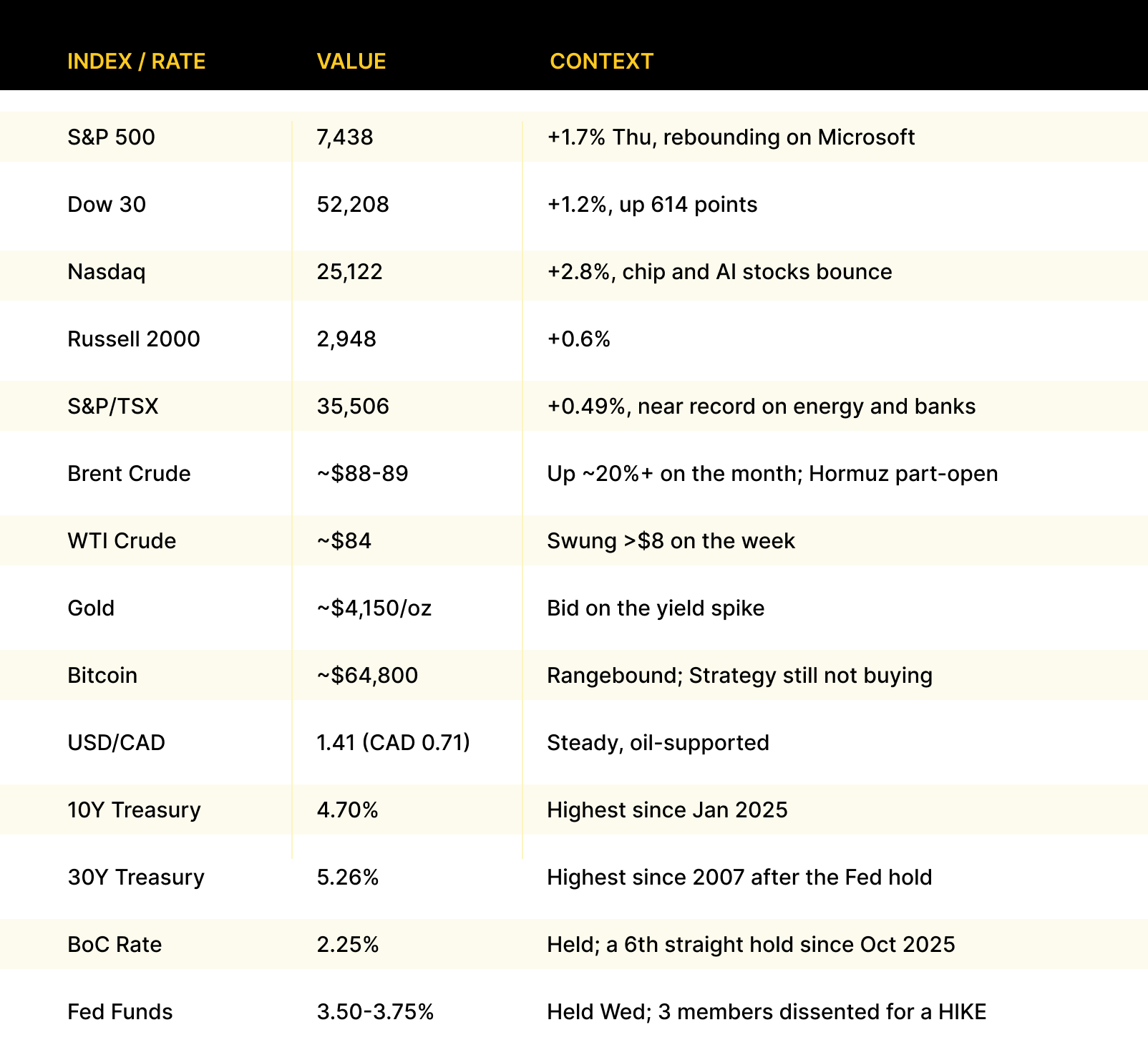
Note: a wild week with two engines. The Fed held on Wednesday, but three of twelve members dissented wanting a hike, and the bond market read the hold as losing the inflation fight, sending the 30-year yield to 5.26%, its highest since 2007, and the 10-year to a January-2025 high. That triggered a sharp selloff. Then Microsoft reported Azure cloud revenue up 43%, past $100B for the first time, and the AI trade came roaring back: the Nasdaq jumped 2.8% and chip stocks rallied. The split screen was the story, Microsoft rewarded for AI spending and Meta punished for it (down ~8-9% on the lowest free cash flow since 2022) in the same 24 hours. Oil stayed volatile on the US-Iran war, with Brent up more than 20% on the month even as tanker traffic through Hormuz partially recovered. Canada was insulated again: an index heavy in energy and gold sat near record highs while US tech whipsawed. The Bank of Canada held at 2.25% for a sixth straight meeting.
1 USD = 1.41 CAD = 0.88 EUR = 0.75 GBP at Thursday spot.
Sources
ASU degree page, AZFamily, Dexerto, Goldman Sachs, the Today show (opener); AP, TheStreet, The Next Web, American Banker, Senator Warren’s office (X Money); Telegraph, Kyiv Independent, Forbes Ukraine, gov.uk, ICAEW, STEP (OnlyFans/HMRC); FT, EU Drugs Agency, UNODC, Global Initiative, Europol (cocaine); CNN, Axios, CNBC, Forbes, Consumer Reports, FDA, Yum SEC filings (Taco Bell); Bloomberg, NBC, Axios, Time, Reuters, TMTG statement (Truth API); Reuters, CNN, ESPN, Sportico, CBC, Forbes (FIFA closer); CNBC, Reuters, Trading Economics, Yahoo Finance, Motley Fool, Bank of Canada (market data).
Market data pulled Friday July 31, 2026 (July 30 closes). Live items this edition: the US-Iran war and oil price are moving hourly, with Brent swinging several dollars intraday and Hormuz traffic only partially recovered; the FIFA/UEFA standoff is developing, with a September members’ deadline and Concacaf now joining the European boycott while FIFA says “nobody is selling football”; X Money’s 6% is treated as a promotional rate absent a published Truth-in-Savings disclosure; the Ukraine tax figures are estimates and the decriminalisation bill is not yet law; Truth API is scheduled to go live August 1. Currency at Thursday spot rates.