Nord Stream Pipeline (porn) Pirates, Nose Job as a Subscription, China's Humanoid Workforce, AI and Philosophy, GTA is $80 (cheaper in real terms)


36th Edition
Greetings folks and a warm welcome to the 36th Edition of Friday Finance,
Two weeks ago a gang walked into a Philadelphia warehouse and drove off with 1,800 cases of bourbon, around 10,800 bottles, worth more than $500K. They didn’t pick a lock or pull a gun. They appear to have just impersonated a trucking company, shown up with the right-looking paperwork, and had the whiskey handed to them. This is the fastest-growing kind of heist in America: “strategic cargo theft,” where the criminals clone a carrier’s identity, forge a bill of lading, and let the warehouse load the truck for them. Between 2022 and 2024, while overall cargo theft rose 93%, this fraud-based version rose about x15, and the single most-stolen category isn’t electronics, it’s food and drink, because a pallet of bourbon has no serial number and sells itself. Who needs a gun when you can have a forged bill of lading? Let's get right to it.

TL;DR: A new book by WSJ correspondent Bojan Pancevski lays out the inside story of the 2022 Nord Stream sabotage: a handful of Ukrainians on a rented yacht, on a shoestring budget, destroyed a $20B pipeline system and helped trigger a European energy crisis that cost €700B to manage. The account is denied by Ukraine and unconfirmed by any court. But the economics are the real story: the cheapest possible inputs against the most expensive possible outputs, a permanent rewiring of how a continent buys energy.
A new book by Wall Street Journal correspondent Bojan Pancevski lays out the inside story of what may be the most lopsided trade in modern geopolitics. In autumn 2022, according to his account, a handful of Ukrainians on a rented 50-foot yacht, working on a shoestring budget, destroyed the $20B Nord Stream pipeline system and helped trigger a European energy crisis that cost something like €700B to manage. The caper reads like a thriller: the divers practised in flooded quarries, hid explosives in their oxygen tanks, dived to a depth that kills trained frogmen, and at one point planned to pose as the crew of an aquatic porn film if German police stopped them. They were caught because a marina onlooker filmed the skipper docking and caught their beige Citroën van, which police then ran through 5,000 speed-camera images. Ukraine denies sanctioning it, and no court has yet confirmed who did it, so treat the spy-novel details as the book’s telling, not the verdict.
Nord Stream carried roughly a third of Europe’s Russian gas; Germany got about 65% of its gas from Russia before the war. Two explosions on the Baltic seabed made sure that umbilical cord could never be reattached, even if a future German government wanted to, and the current chancellor has called building the thing a “mistake” in the first place. The bill came due immediately. Governments spent hundreds of billions cushioning households and industry, European industrial gas prices ran 4.5x American ones, and BASF started closing plants. Gazprom, which posted a record $29B profit in 2021, swung to back-to-back losses, because the gas it used to sell west cannot be redirected to China without a pipeline that does not exist. The gas just stays in the ground.
The cheapest possible inputs, a boat rental and some dive gear, against the most expensive possible outputs, the permanent rewiring of how an entire continent buys energy. Germany swapped Russian dependence for Norwegian gas and American LNG, locking in structurally higher costs for its industry. There is a second-order tell here too, which is that the attack quietly repriced the cost of protecting every undersea pipeline and data cable on earth. Once you have shown that a yacht and a dive team can do this much damage, everyone has to insure against it. Whoever actually did it, the trade has already paid off in full. I think the most interesting story here is what was the script for the aquatic themed porn film?

TL;DR: Nose jobs are down 10% worldwide, and not because people made peace with their noses. A "liquid nose job", a few syringes of filler, runs $1K in under an hour versus $12K and weeks of recovery for surgery. The catch: filler only adds volume, it can't make a nose smaller, and it wears off in a year so you pay again. That last part is the business. Aesthetics pulled off the move every software company dreams of: it turned a one-time purchase into a subscription.
Nose jobs are down about 10% worldwide, and it is not because people suddenly made peace with their noses. You can now get a “liquid nose job,” a few syringes of filler, for around $1K in under an hour with no downtime, versus $12K and a fortnight of looking like you lost a bar fight for the surgical version. The catch is that filler only adds volume, so a liquid nose job cannot actually make a big nose smaller, it just adds material to fool the eye, and it wears off in a year so you get to pay again. There were nearly 8M Botox procedures last year and another 6M filler jobs against roughly 1M surgical nose jobs, so the needle now outsells the scalpel something like x14.
That last part, the wearing off, is the whole business. Aesthetics has turned a one-time purchase into a subscription. The injectable wears off by design, which makes it the printer-ink of the human face, cheap to start and impossible to stop. A $12K surgical nose was a one-time capital expenditure that you owned; a $1K filler is a recurring bill that expires. The clinics prefer the trade-down, because a customer who re-ups every year for a decade is worth far more than a one-and-done patient. AbbVie’s Allergan, Galderma, Merz, the arms dealers of the face, riding a $59B market.
Worried about surgeons losing business? Don’t, because Ozempic has created another business opportunity. The weight-loss drugs strip fat out of your face along with everything else, the dreaded “Ozempic face,” so fat-grafting procedures jumped about 50% in a year as people pay a surgeon to put fat back. Every industry is following the SaaS business model. Now even your face is on subscription, hopefully they’ll work on abs next.
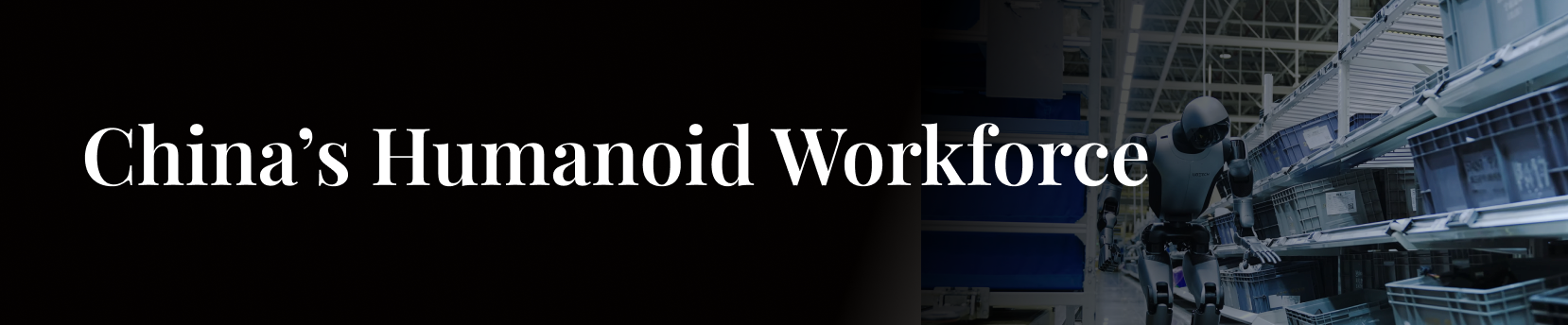
TL;DR: China's working-age population peaked at 1 billion last decade and is projected to fall to 300 million by 2100. Beijing's answer is to manufacture its way out, swapping labour it won't have for capital it can build. It installed more industrial robots last year than the rest of the world combined and makes 90% of the world's humanoids. This week Morgan Stanley doubled its 2026 humanoid forecast for the second time. Income shifting from labour to capital, inside a state that claims to represent workers. Irony at its best.
In the workshops of a Sany truck plant in Hunan, the chatter of human workers has been mostly replaced by the whirr of robots, and the company is now trying to automate the last, most human stage of assembly with humanoids. The reason is a number that should concern any economist: China’s working-age population, which peaked at about 1 billion last decade, is on track to fall to roughly 300 million by 2100. That is not a slowdown, it is a collapse, and it is China’s single largest economic headwind, possibly the thing that stops it ever becoming the world’s biggest economy. The root cause is the birth-rate crater left by the old one-child policy, and it hits growth, consumption, the government budget, and the country’s ability to service its debt all at once.
Beijing’s answer is to build its way out, swapping labour it won’t have for capital it can manufacture. Last year China installed more industrial robots than the rest of the world combined, and it makes around 90% of the world’s humanoids. This week Morgan Stanley doubled its forecast for Chinese humanoid shipments for the second time this year, to 50,000 units, on the way to a projected $15B market by 2030 and, eventually, a $5T global one by 2050. The cost curve is already bending the way it did for EVs: parts prices fell 16%, and Unitree’s $16K robot already undercuts Tesla’s theoretical $20K one. Beijing put a Rmb 1tn ($147B USD) fund behind the effort and ordered state firms to install at least 10,000 of the machines in commercial settings this year.
The trouble is that automation may kill jobs faster than the demographic decline removes workers, which makes the transition more dangerous. This month the founder of JD.com warned that robots will “sooner or later” replace his 700,000 delivery drivers. China already has high youth unemployment and a 320M-strong gig workforce with no permanent jobs. The group most exposed is the one the Party worries about most: college graduates, often only children whose families spent everything on their education. One hotel chain has already automated its way to a staff-to-room ratio of 0.1, meaning a 100-room hotel runs on about 10 people instead of 30 to 80.
Labour’s share of national income has traditionally been about two-thirds; as robots do more of the output, that share shifts to capital. A Peking University economist puts it plainly: if capital produces most of the output, capital earns most of the income, and the tax system has to be rebuilt to redistribute it. Academics are floating ideas that include cutting income tax, raising corporate tax, and levying actual “duties on robots.” This is Piketty’s r > g (rate of return on capital > growth rate of the economy, wealth starts to concentrate at the top) problem, and it lands inside a state that runs capitalism while claiming to speak for workers. The cabinet has already called for an “early warning” system for AI-related job losses, which is government-speak for knowing the bill is coming.
Humanoids are still bad at both ends: too clumsy for the simple, repetitive jobs mechanical arms already do, and too slow for the genuinely hard ones, like crossing a messy living room. They can't feel the texture of fabric, and they tap out after a few hours on a charge. Closing the gap needs, by one estimate, tens of millions of hours of training data, which is why one firm now sells a backpack-and-gloves kit so human workers can generate that data while they train their own replacements. Capture a craftsman’s ability once, license it forever, and the value migrates from the worker to whoever owns the model. The steam engine put craftsmen out of work too, one economist notes, before it gave us railways, factories, and a new middle class. China is betting, at enormous scale, that history repeats itself.
TL;DR: For 15 years the advice was "learn to code." It may have been exactly wrong. The New York Fed says recent philosophy grads now have a lower unemployment rate than computer-science grads, 3% vs 6%, with philosophy now below finance. The coders are the nervous ones. AI labs are hiring philosophers, not as decoration: the labs have split along a 200-year-old fault line in moral philosophy (explained in the writeup), and they're productizing their values. The skeptics call some of it "ethics-washing."
For 15 years the advice to anyone studying the humanities was blunt: learn to code. It turns out that may have been exactly wrong. According to the New York Fed, recent philosophy graduates now have a lower unemployment rate than computer-science graduates, somewhere around 3% versus 6%, with philosophy now sitting below even finance. The coders are the nervous ones now, partly because AI is automating the entry-level coding jobs that new graduates used to break in on. Interestingly AI labs themselves are hiring philosophers, and not for diversity. They have worked out that a lot of what makes a model good, or bad, is philosophy.
Train a model on the Socratic method and it stops being a sycophant (insincere flatterer who praises powerful or influential people to gain advantage or approval) and starts pushing back; teach it to know what it doesn’t know and it hallucinates less. The labs have even split along a 200-year-old fault line in moral philosophy. Anthropic’s Claude leans deontological, hard rules, no lying even for a good cause, while OpenAI’s ChatGPT and Google’s Gemini lean consequentialist, weigh the costs and benefits and act, which is also, not coincidentally, how the software in a self-driving car decides the least-bad way to crash. IBM will even sell you a model with a dial to set your own balance between “individual agency” and “social harmony.” Ethics has become a product spec.
The skeptics have a point worth keeping. An Oxford ethicist warns of “ethics-washing,” that hiring philosophers is partly a way to make customers believe your AI is more virtuous than the next one, and you can’t really check. Nobody should run out and get a philosophy PhD to chase this either; the postings may be gone before the diploma arrives. The technology that was supposed to make human judgment obsolete has, for now, made it one of the scarcer things on the market. As one philosopher put it, it is the best time to be in the field since Aristotle tutored Alexander the Great. Not sure about philosophy but in researching this article I learnt a lot of fancy new words and concepts.

TL;DR: Rockstar revealed this week that Grand Theft Auto VI will cost $80 (with a $100 Ultimate Edition), and the internet howled about greed. $80 is, in real terms, a discount. A $60 game in 2005 would be $96 today. AAA games had $60 sticker for 15 years while real prices quietly fell 40%. Meanwhile budgets exploded: GTA 6 cost an estimated $1-1.5B to make, 3x GTA V in real terms.
Rockstar revealed this week that Grand Theft Auto VI will cost $80 when it launches in November (hopefully), with a $100 “Ultimate Edition,” and the internet did what it does, which is howl about greed. $80 is, in real terms, a discount. A $60 game in 2005 would be about $96 in today’s money, which means GTA 6 at $80 is cheaper than the games your teenage self bought, and a lot cheaper than a $60 SNES cartridge back in 1992. AAA games sat at a $60 sticker for roughly 15 years, an almost suspiciously round number while real prices quietly fell by something like 40%. Even Take-Two’s boss admits it, saying the company charges “way, way, way less” than the value it delivers.
The sticker price stopped being where the money was made. Studios made up the gap with microtransactions, season passes, and “live service” games that are free to download and then nibble your wallet forever. That model is now cracking, Sony’s big live-service bet Concord shut down two weeks after launch, so the sticker is finally moving. Meanwhile the cost to make these things has gone vertical: GTA V cost about $265M in 2013; GTA 6 is estimated at $1B to $1.5B, roughly three times as much in real terms, which would make it the most expensive entertainment product ever assembled. Real prices down 40%, real budgets up 200%, and the only way that math closes is by selling you the $80 game as a doorway to the $100 edition and the subscription stapled to it. Every pre-order, naturally, comes with a free month of GTA+.
So even buying a video game is now a gateway to a recurring bill, which is the same trick the cosmetic clinics and the robot-renters in this very edition are running. When your game is also a cultural event with no real substitute. The wallet was never the constraint. The round number was. The only people who seem unbothered are the markets: analysts spent the week raising their Take-Two targets, on the theory that a few million people about to pay $80 without blinking (myself included).
A while back, someone on X wondered aloud how much money OpenAI burns on electricity because people say “please” and “thank you” to ChatGPT. Sam Altman answered his own bill: “Tens of millions of dollars well spent, you never know.” He was half-joking, it’s not an audited figure, but the math isn’t crazy: every “please” is more words, more words are more tokens, more tokens are more compute, and at over a billion queries a day, even good manners show up on the power bill. The best part is why people do it. In one survey, 67% of Americans said they’re polite to the chatbot, and nearly a fifth of them admitted it’s because they want to be on the right side of the machines when the uprising comes. As one person put it, you just want to make sure Skynet remembers you were polite as it decides whether to use you as a battery. Tens of millions of dollars, in other words, is what humanity is spending to tip the robots in advance.
“Politeness is the art of choosing among one’s real thoughts.”
— Adlai Stevenson
Have a fantastic weekend. I welcome feedback and please forward this if you see fit.
Many thanks,
Sam.
Market Snapshots
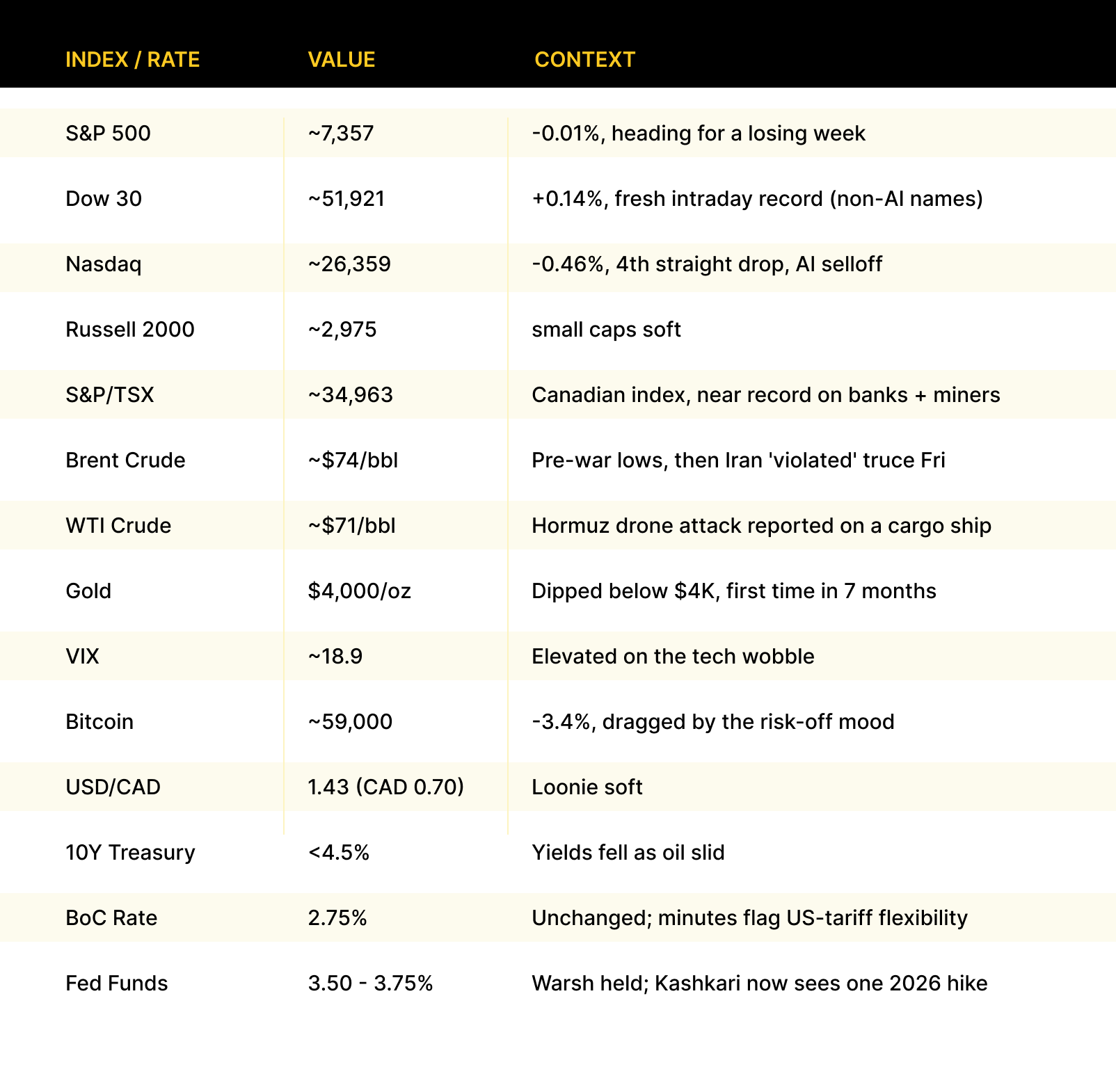
1 USD = 1.43 CAD = 0.86 EUR = 0.74 GBP at Friday spot.
Sources
The Telegraph (Colin Freeman), “The Nord Stream Conspiracy” by Bojan Pancevski, Atlantic Council, IEA, Bloomberg, Clean Energy Wire; ISAPS Global Survey, ASPS, Custom Market Insights; FT Big Read (Joe Leahy, Tina Hu, William Langley, Shihuan Chen), Morgan Stanley, CNBC, SCMP, UN, International Federation of Robotics, Conference Board, Peking University Guanghua; The Economist, New York Fed, NBC, Wired, Forbes; Kotaku (Ethan Gach), Northeastern Global News (Cody Mello-Klein), Business Insider, GameSpot, Take-Two; Sam Altman (X), Entrepreneur, Business Standard, EPRI, Goldman Sachs; CNBC, Yahoo Finance, Trading Economics, S&P Dow Jones Indices.
Market data pulled Friday June 26, 2026 (June 25 closes). Two stories in this edition broke this week and may move further: Morgan Stanley’s China humanoid forecast (June 24) and the GTA 6 pricing reveal / pre-order open (June 24-25). The Nord Stream account is from Pancevski’s book and is denied by Ukraine and unconfirmed by any court. Currency at Friday spot rates.