Billionaires fund shows about themselves, the vague Iran deal, cocaine boom, Guinness outperforms and the $30B in smuggled gold

35th Edition
Greetings folks and a warm welcome to the 35th Edition of Friday Finance,
Let me start by saying what a win for Canada yesterday, the city is still buzzing. A man in Chennai, India now has a memecoin ticker tattooed across his forehead, and he is not getting paid for it. The job came through Pump.fun, a crypto platform that rolled out a feature last week with the slogan: "Pay ANYONE to do ANYTHING." A 21-year-old in Florida offered about $3,000 for the forehead tattoo, the man did it and posted the video, and then the promoter refused to pay, because he had intentionally misspelled the ticker in his own bounty and the tattoo advertises nothing. His comment "I was certain someone from a third world country would do it." It supposed to read "$bountywork." instead it says "$boutywork." Let's get right to it.
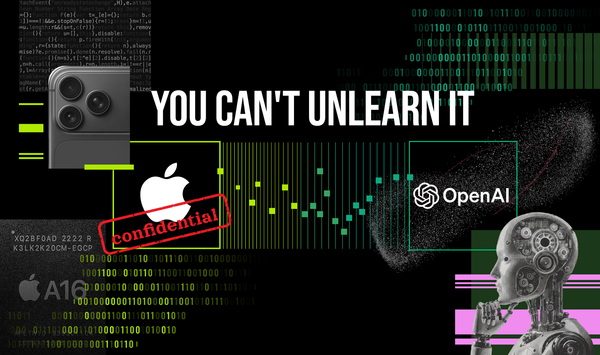
TL;DR: Peter Thiel's Founders Fund launched "MAFIA the GAME," a video series in which its portfolio founders play the deception party game on camera at the same San Francisco bar that hosted the 2007 PayPal Mafia photo. The roster: Sam Altman, Palmer Luckey, Dylan Field, and a dozen others; Founders Fund partner Trae Stephens won, as the mafia. The real story underneath the party is a land grab: Founders Fund (~$17B AUM, fresh $6B fund) is producing a game show, OpenAI bought the talk show TBPN for a reported low hundreds of millions, and a16z backed a media company called MTS. The people who fund the technology are buying the channels that explain it.
The hottest party game in Silicon Valley reportedly started with the phrase “Let’s go kill some people.” Founders Fund, Peter Thiel’s venture firm, has launched “Mafia the Game,” a slickly produced video series in which tech’s most powerful people sit around a table and try to deceive and eliminate each other at the classic social-deduction game. Sam Altman was drawn and quartered. Anduril’s Palmer Luckey was stoned to death. Figma’s Dylan Field was found riddled with bullets in his basement. It is filmed at Tosca Café in San Francisco, the same spot that hosted the 2007 photoshoot of the original “PayPal Mafia,” which is a nice touch given who is at the table. Mike Solana, the Founders Fund marketing chief who hosts it, told one outlet his motivation plainly: “I’m so f***ing bored with VC content.”
Thiel himself has played and lost badly, because, as Solana put it, “everyone tried to kill him immediately because they were terrified of him… he was immediately witch-burned.” Trae Stephens, who won as a member of the mafia, took a shot at fellow player Bryan Johnson, the longevity obsessive we wrote about two editions ago: “We should listen to what Bryan says because he can’t die.” But the reason a venture fund is producing a game show at all is the part worth underlining. Venture capital is in a land-grab for media, racing to own the channels that cover it rather than be covered by them. OpenAI bought the tech talk show TBPN earlier this year for a reported low-hundreds-of-millions, ahead of its own IPO. Andreessen Horowitz bankrolled a rival show called Monitoring the Situation. Founders Fund, which just closed a $6B fund, is the entertainment entry in the same race.
The tell is who is sitting at the table. The players, Anduril, Figma, OpenAI, Flexport, are Founders Fund portfolio companies. A venture firm is making flattering content about its own investments and packaging it as a game show, which is either brilliant marketing or the most expensive home movie ever made. The timing is not subtle either: with OpenAI, Anthropic, and a freshly public SpaceX all needing public goodwill around their listings, owning the media that covers you is just vertical integration of your own PR. A Stanford game theorist quoted in the coverage made the only point that really matters here: when people play these games in front of a camera, they aren’t revealing themselves, they’re signalling. Which means the deception starts well before the cards are dealt. Maybe like the IPOs themselves?
TL;DR: On Wednesday night, Trump (in Versailles) and Iran's Pezeshkian (in Tehran) signed a 14-point memorandum to pause their four-month war, the first time in 47 years that American and Iranian presidents signed the same document. The deal is vague on everything that matters and built on a nuclear pledge identical to the 2015 one Trump tore up in 2018. But the oil is flowing again: Brent went from $71 before the war to above $115 at the peak, and is back near $78 now. The war premium has been priced out.
As of Wednesday night, the war we’ve been writing about since Edition 21 has a ceasefire, of sorts. Donald Trump, at a dinner in Versailles, and Masoud Pezeshkian, in Tehran, signed a 14-point memorandum of understanding to pause their four-month war, the first time in 47 years of hostility that American and Iranian presidents have put their names to the same document. The terms: the Strait of Hormuz reopens with free passage “for 60 days only,” a 60-day window opens for a final nuclear deal, US sanctions lift, and Iran can sell its oil. It is, as the Economist put it, both historic and anticlimactic, barely a dozen paragraphs, vague on every detail that matters, and Iran hadn’t even confirmed the full text by the next morning.
Two things deserve attention. First, the pledge that Iran will “never build a nuclear bomb” is word-for-word the one in the 2015 deal Trump tore up in 2018, so markets have seen this movie and know verification is the challenge. Second, the much-touted “$300 billion reconstruction fund” is already vapor: Trump publicly walked it back, saying the US is “not investing 10 cents,” and Gulf states are in no rush to fund a country that spent recent months bombing them. What is not vague is the oil. Brent went from about $71 a barrel before the war, to above $115 at the peak when Hormuz was effectively shut and the IEA was warning of the biggest oil shock in history, and it is back near $78 now and falling, the lowest since early March. A 60% spike and a near-complete round trip in under four months. Tankers are already re-crossing the strait.
Trump took his victory lap on Truth Social, calling the people who say he wasn’t tough enough, “when the Stock Market Just Hit A RECORD HIGH, and Oil prices ‘tumbling’ down,” either “jealous, bad people, or stupid.” The uncomfortable truth under the triumph is that this deal isn’t held together by trust, it’s collateralized by oil. Trump needs gas prices down before the November midterms; Iran needs the revenue to survive an economic crisis. That mutually assured destruction is more durable than any handshake. The strait is open “for 60 days only,” and Trump is already threatening to “bomb the hell out of” Iran if it breaches. The war premium has been priced out. Let’s just hope that the US and Iran signed the same version of the agreement.
TL;DR: Colombia tripled its cocaine output in a decade, hitting a record 2,664 tonnes in 2023, roughly 29 times what it produced in 1990 at Escobar's peak. The cause: agricultural productivity. Better coca varieties, drones, doubled yields, industrial labs. All that supply crashed the price by half in 2022, and instead of a shakeout, the producers found new customers in Europe. The Marxist rebels have been replaced by businesses that run like multinationals and have diversified into illegal gold. Colombia votes Sunday on how to handle it
Colombia tripled its cocaine output in a decade, and the most striking thing about it is how boring the explanation is. This is not a story about cartel kingpins, it is a story about agricultural productivity. Growers switched to plague-resistant, low-fertilizer coca varieties that can be harvested more often, started using drones to spread fertilizer, and built industrial-scale labs (the military found one in Putumayo that could process five tonnes a month). Yields per hectare have doubled. Output hit a record 2,664 tonnes in 2023, up 53% in a single year, roughly 29 times what Colombia produced in 1990 when Pablo Escobar was at his peak. The land under coca rose about half between 2018 and 2023, helped along by a 2015 court ruling that largely banned aerial fumigation.
All that supply crashed the price of coca by at least half in 2022. Instead of a production shakeout, the producers went and found new demand. Europe now consumes almost as much cocaine as the United States; EU countries seized 419 tonnes in 2023, a seventh straight record, and a single bust in Düsseldorf netted 35.5 tonnes worth €2.6B. A Belgian judge warned his country risks becoming a “narco-state” as the ports, police, and judiciary get infiltrated. “US consumption is stable but Europe continues to grow,” as one analyst at the International Crisis Group put it. When productivity triples your supply and crashes your own price, the fix is not to make less, it is to find more people to sell to.
The groups doing this are not Marxist rebels. When the FARC, who once controlled an estimated 60% of the trade, demobilized under the 2016 peace deal, the vacuum filled with profit-driven organizations. The biggest, the Clan del Golfo, reportedly runs with a management structure like a multinational, with divisions for recruitment and supervising labs. “It is a synthesis of all the conflicts we have had in Colombia in the last 40 years,” says one Bogotá think-tanker. They have also diversified. Many moved into illegal gold mining as the gold price soared, using the same smuggling routes to export cocaine and import the mercury the mining needs (hold that thought for our last article). Others extort migrants at the Darién Gap. About half of Colombia’s municipalities now host an armed group, and the number of people in them roughly doubled since 2018.
On Sunday, Colombians vote in a presidential run-off that is, in large part, a referendum on how to handle all this. Abelardo de la Espriella, a Trump-endorsed hardliner, promises a militarized crackdown and a “Plan Colombia 2.0”; Iván Cepeda, a leftist, favours more negotiation. De la Espriella narrowly led the first round, 43.7% to 40.9%, and is slightly favoured. But the uncomfortable lesson sitting under the politics is a commodity-market one, not a moral one. Prohibition is what keeps the margins fat enough to make the whole enterprise worth the bullets. Neither candidate has a policy that changes the yield per hectare. That begs the question is it time to legalize?
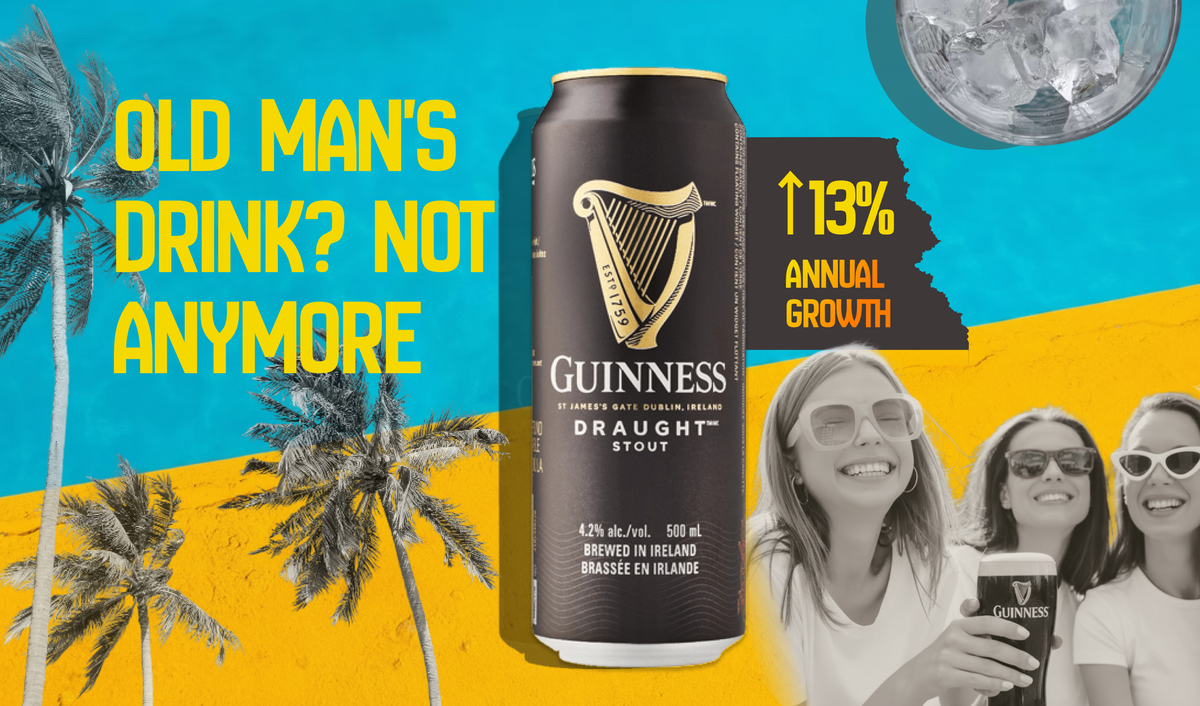
TL;DR: Americans are drinking less than at any point in 90 years of Gallup tracking, 54% in 2025, down from 62% in 2023. The industry is in retreat: Diageo's North American sales fell 9.4% last quarter, US spirits down 15.4%. And then there's Guinness, which grew 13% last year, became the best-selling beer in British pubs (one in nine pints), and had to ration kegs at Christmas. The 267-year-old stout is the rare brand getting bigger as its category dies, by turning its weaknesses into moats.
Americans are drinking less than at any point in the nearly 90 years Gallup has tracked it: 54% in 2025, down from 62% two years earlier, with a majority now saying even moderate drinking is bad for you. The whole industry is in retreat. Diageo’s North American sales fell 9.4% last quarter, US spirits down 15.4%, and the world’s biggest brewers are watching volumes shrink. And then there is Guinness, which grew 13% last year, became the single best-selling beer in British pubs at one in every nine pints poured, the top draft in New York and Boston, and had to ration kegs at Christmas because it could not brew fast enough. The 267-year-old stout is getting bigger as its category dies.
Guinness took its biggest weakness, a pour that takes almost two minutes versus seconds for a normal pint, and turned it into “Good things come to those who wait”, a ritual so codified there are rules for how to wash the glass. It changed itself from “old men in a bar in winter” to young people in summer, to the point the brand says Guinness is now as big in Ireland in summer as at Christmas. It also turned the very trend killing the category into a growth engine: Guinness 0.0, the non-alcoholic version, is now the UK’s number-one no-alcohol beer, and on one online grocer it outsells the original.
The UK retail surge cooled in mid-2025 once the promotions paused and prices rose, so some of the boom was scarcity and price. But the through-line is the oldest lesson in branding. When your category is a commodity, racing to the bottom on price, the winning move is to be the one thing nobody can rush, copy, or get enough of. €1 billion Diageo is sinking into new Irish breweries means this is a durable trend, not a fad, the same cap-rate-or-fad question we keep running into. The man who signed Guinness’s 9,000-year lease in 1759 was, it turns out, underwriting demand a little more confidently than the rest of us.
TL;DR: Gold has broken record after record, around $4,180 an ounce now, up nearly a thousand dollars on the year, on central-bank buying and nervous money. The part nobody puts in the brochure: a record price is a record incentive to move it off the books. More than $30 billion of illicit gold flows around the world each year against a $380 billion legal trade, roughly one bar in twelve. It doesn't stay in the shadows. It gets refined, stamped, and sold into the same supply chain that backs your gold ETF
There is an old rule about value: the moment something is worth enough, someone works out how to take it without paying for it. Gold has spent two years proving it. The metal broke through record after record, around $4,180 an ounce now, up almost a thousand dollars on the year, as central banks hoarded it, inflation refused to behave, and nervous savers gave up trusting everything else. That is the rally everyone explains. The part nobody puts in the brochure is that a record price is also a record incentive to move the stuff off the books. More than $30 billion of illicit gold now flows around the world each year, against a legal trade of about $380 billion, so the shadow market is roughly one bar in twelve.
SwissAid reckons 435 tonnes, more than a tonne a day, was smuggled out of Africa in 2022 alone, most of it into Dubai, where it is melted into clean bars and loses its history. The methods are low-tech: South African miners swallowing gold hidden in condoms, Hong Kong customs finding bullion disguised as air-compressor parts, a one-kilo bar worth about $134,000 that fits in a coat pocket. India shows how mechanical it is: cut the import duty and smuggling falls, double it and the grey market roars back, because the metal does not care about borders, it follows the spread. Under Swiss law the place gold is last processed counts as its origin, so a bar arriving from Dubai is never traced back to the pit.
Smuggled gold does not stay in the shadows. It gets refined, stamped, and sold into the exact same supply chain that backs your fund, your wedding ring, and your favourite miner’s balance sheet. We met one end of this chain in the cocaine article, where Colombian gangs diversified into illegal gold and used the same routes to ship coke out and mercury in. This is where that gold ends up: laundered through a refinery into something that looks spotless. Gold is the only asset where the risk premium is basically “I don’t trust banks, print money, or my own portfolio.”
On Sunday, on the South Lawn of the White House, on his 80th birthday, the President watched UFC fighters collect their bonuses in his family’s cryptocurrency. World Liberty Financial, the Trump family venture, sponsored a $250,000 “Performance of the Night”, paid entirely in USD1, its dollar-pegged stablecoin, while the broadcast read out what was essentially an ad: “USD1 is a digital dollar, send money faster and cheaper, available on leading exchanges.” Crypto.com chipped in another million in its own token, pushing the night’s bonuses to $1.65 million. The SEC had already flagged USD1 as a stablecoin affiliated with the sitting president’s family. Every single fight ended in a knockout, which is the only thing about the evening that wasn’t, in some way, an advertisement.
“The house doesn't beat the player. It just gives him the opportunity to beat himself.”
— Nick Dandolos ("Nick the Greek")
Have a fantastic weekend. I welcome feedback and please forward this if you see fit.
Many thanks,
Sam.
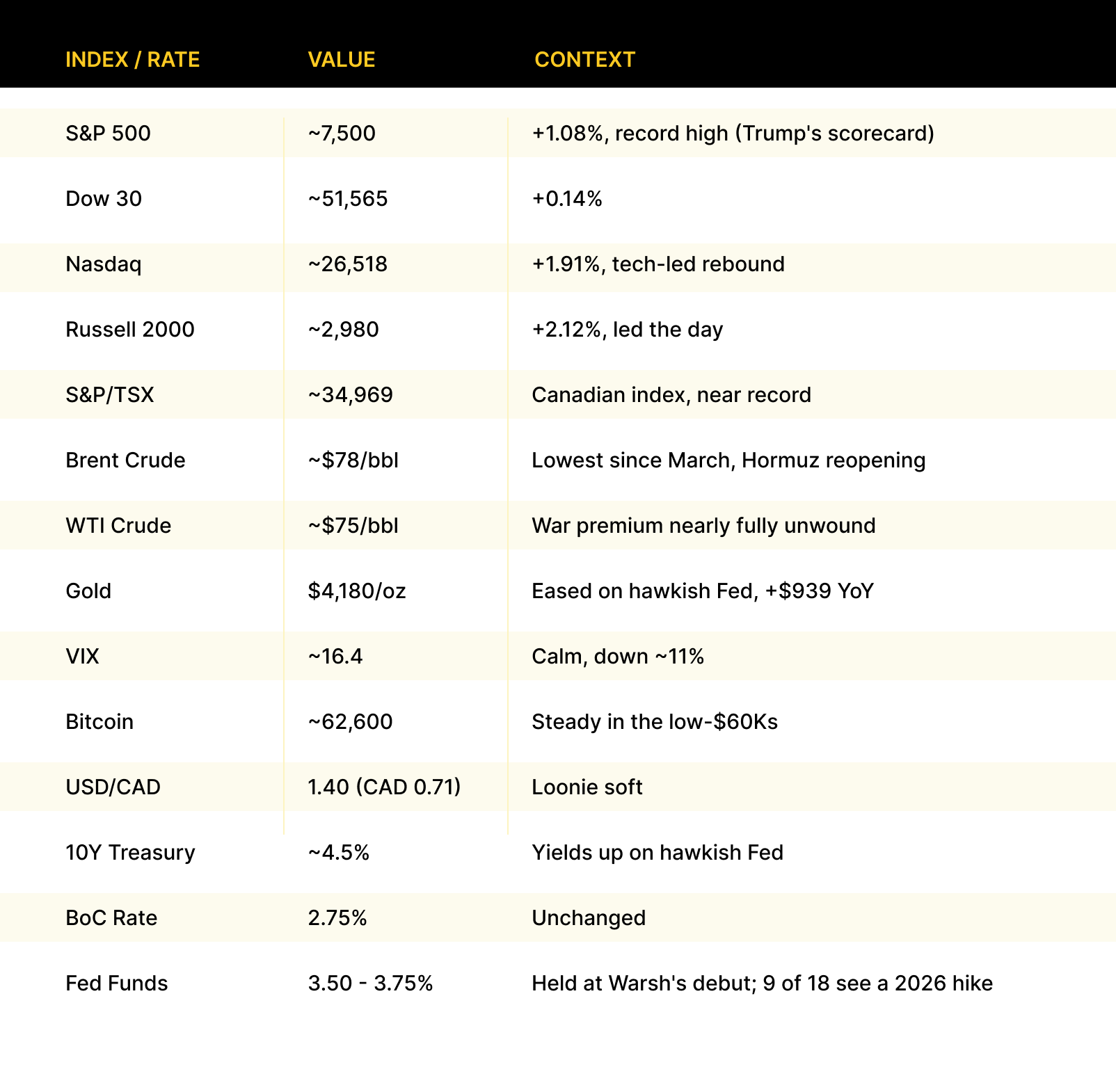
Market Snapshots
Sources
CNN, Washington Times, Wall Street Journal (Molly Reinmann), TechCrunch, Newcomer, CNBC, OpenAI, The Economist, NBC, CBS, Al Jazeera, RFE/RL, Reuters, Trading Economics, Congress.gov (CRS), Foreign Affairs (Geoff Dyer & Joe Daniels for the FT), UNODC, EU Drugs Agency, ICG, AS/COA, Bloomberg Businessweek (Anna Peele), Diageo, Marketing Week, The Grocer, Gallup, The Spirits Business, TheStreet (Tobi Opeyemi Amure), SwissAid, AP, OECD, Business Standard, US Treasury, Fortune, World Gold Council, Yahoo Finance, S&P Dow Jones Indices.
Market data pulled Friday June 19, 2026 (June 18 closes). Three live items as of publication: the Iran truce is days old and fragile (oil + status may move); Colombia's presidential run-off is Sunday June 21; gold is wobbling on Fed signals. SpaceX, referenced in Art 1, listed last week. Currency at Friday spot rates.