North Korea is booming, Longevity as an asset class, 3 IPO's want $200B, Swiss population cap and $43K seats for the Knicks

34th Edition
Greetings folks and a warm welcome to the 34th Edition of Friday Finance,
This week the Trump family began selling UFC commemorative coins priced from $249.99 to $11,999.99, timed to a championship fight on the White House South Lawn this Sunday, which is both Flag Day and the president’s 80th birthday. The top-tier gold medallion comes with a portrait of Trump and UFC boss Dana White and is, per the website, “designed by President Trump.” A one-ounce gold coin at twelve grand is about x3 the melt value of the gold inside it, so you know exactly what the other eight grand is buying. The website also helpfully warns that other people’s Trump coins “might be unlawful.” The Trump Organization isn’t minting or selling these, just licensing the sitting president’s face, while Dana White covers the entire $60 million event and says he’s “eating the whole thing.” Somehow I doubt he’s being benevolent. Let's get right to it.
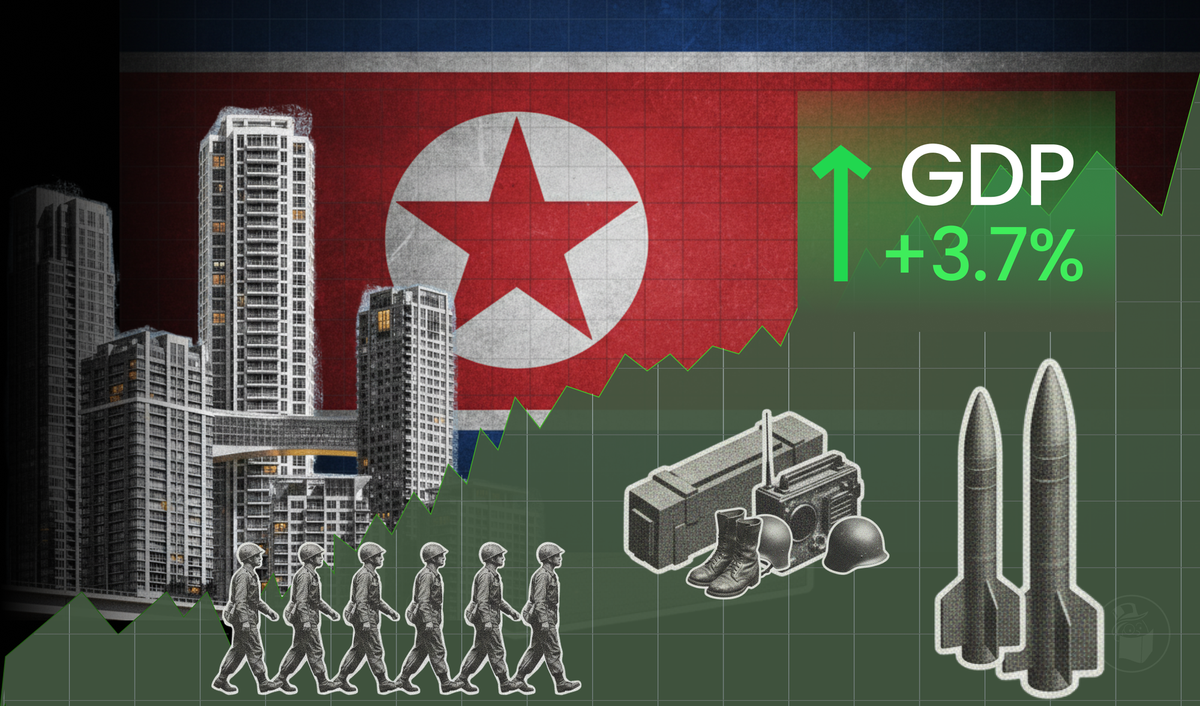
TL;DR: North Korea, the most heavily sanctioned country on earth, just posted 3.7% growth, its fastest in eight years, per South Korea's central bank. Pyongyang now has an Uber clone, BMW dealerships, brick-oven pizza, and built more homes last year than Los Angeles. How? Three revenue lines: selling weapons to Russia for the Ukraine war (over $10 billion), renting out 15,000 soldiers, and stealing $2.02B in crypto in a single year. Xi Jinping flew in this week to underline the point. The only catch: half the country is still malnourished.
The sanctions regime built to strangle Kim Jong Un into giving up his nukes has instead coincided with the best economy he has ever run. North Korea’s GDP grew 3.7% in 2024, its fastest pace in eight years, according to South Korea’s central bank, which builds the estimate from spy-agency data. Visitors describe a capital transformed: a ride-hailing app called Samhung with real-time car tracking, QR-code payments, pet stores, an internet-gaming cafe, and dealerships selling BMWs. The regime built 10,000 new homes in Pyongyang last year, more than Los Angeles or Chicago, and the country now shines about three times brighter at night than it did five years ago. One tour operator was taken to dinner on a skybridge with glass floors a hundred feet up; the bill for five came to $150.
The growth has three engines, and all of them are grim. The first is the war: North Korea has earned over $10 billion selling munitions to Russia since mid-2023, per the INSS think tank in Seoul, and sent more than 15,000 soldiers to the Ukrainian front, roughly a third of whom were killed or wounded. Much of the payment arrives as military technology, which is why the North’s new warships and drones suddenly resemble Russian designs. The second is China, where monthly trade just hit an 8 year high and which supplies the components behind the entire digital economy. The third is theft: state-backed hackers stole $2.02B in cryptocurrency in 2025 alone, the most on record, including the $1.5 billion Bybit raid that was the largest crypto heist in history. That single year of stealing equals roughly 6% of the entire economy.
The whole premise of sanctions was that economic pain would force denuclearization; instead the regime found three streams and ran them at scale, with two UN Security Council veto holders happy to look away. Xi Jinping chose Pyongyang for his first foreign trip of the year, and both Beijing and Moscow are now openly calling to relax sanctions. The deeper point, though, is that GDP growth and broad welfare are not the same thing. This is a Pyongyang-elite boom in a country where nearly half of the 26 million people are malnourished, where distributing a South Korean drama can be punished by death, and where Kim has spent the good years re-centralising control and crushing the very black markets that kept ordinary people fed. Ain't no party like a Pyongyang party because a Pyongyang party is mandatory. You won’t see me on the skybridge though.
TL;DR: Equinox has a 1,000-person waitlist for a $40,000-a-year longevity membership. What used to be a once-a-year physical, bloodwork, hormone panels, a metabolic test, is being rebuilt as a permanent real-estate category. Wellness real estate is the single fastest-growing slice of a $6.8 trillion wellness economy, expanding about 15% a year. Developers noticed: THE WELL is selling branded residences in Miami, Life Time is putting longevity clinics inside its gyms, and Six Senses and SHA are turning clinical longevity into $5,000-a-week hospitality.
The clearest signal that something has shifted is the waitlist. Equinox launched a $40,000-a-year longevity membership, called Optimize, and has more than 1,000 people waiting to pay for it, on top of the regular gym fee. It pairs personal training with bloodwork and 100-biomarker diagnostics from a lab-testing partner. Its exec chairman put the thesis in four words: “Health is the new luxury.” The idea is that what used to happen once a year in a doctor’s office is becoming a continuous lifestyle, and lifestyles need buildings.
The Global Wellness Institute puts the wellness economy at $6.8 trillion in 2024, heading for $9.8 trillion by 2029, and within that, wellness real estate is the single fastest-growing sector, expanding about 15% a year and on track to double in five. (You may see a $600 billion “longevity market” figure floating around; it traces back to a 2019 bank forecast that even longevity investors call largely made up, so ignore it.) The growth is showing. THE WELL is building branded residences in Bay Harbor Islands, Miami, with more than 22,000 square feet of wellness amenities baked into the building: bath house, saunarium, cold and infrared therapy, hyperbaric chambers. The pitch is “what if your health had a single address?”
The hospitality side is moving faster than the residential one. Life Time, the gym chain, is opening longevity clinics called Miora inside its locations, offering peptides, hormone replacement, and GLP-1s next to the treadmills. SHA Wellness charges north of $5,000 a week for clinical longevity programs and is expanding from Spain into Mexico and the UAE, and Six Senses is opening a longevity resort on the Palm in Dubai. The actual innovation here isn’t medical, it’s financial: these projects staple a high-margin recurring subscription, membership, diagnostics, drugs, onto a real estate asset. It’s a condo that behaves like a software company. For everyone on real-estate how do you determine a cap rate of this? Or do you use a SaaS model with a DCF? Let’s just hope stock market continues to soar, otherwise these wellness centres could end up being Padel Ball courts.
TL;DR: SpaceX went public today at a $135 share price, opened at $150, and is worth around $2 trillion, the largest IPO in history. OpenAI and Anthropic are lining up behind it. Together the three could raise roughly $200 billion in months, against a 2025 US IPO market that raised $45 billion all year. A growing camp on Wall Street thinks investors are selling other things to fund the chase, and points at Bitcoin sliding below $62,000 as the tell. The underwriters say the market can absorb it. Both might be right.
SpaceX priced its IPO at $135 a share, opened at $150 this morning, and immediately hit a market value around $2 trillion, the largest public offering ever and instantly one of the eight biggest companies in America, ahead of Broadcom, Tesla, and Meta. It raised about $75 billion. Behind it, OpenAI and Anthropic are both expected to list, with Anthropic already filed confidentially. Add them up and the 3 could raise something like $200 billion in a matter of months. The entire US IPO market raised $45 billion in all of 2025. So the obvious question, the one a growing number of strategists are asking out loud, is where the other $155 billion comes from.
One increasingly popular answer is that it comes out of everything else, that investors are quietly selling down existing positions to free up cash for the deals everyone suddenly has to own. Bank of America’s Michael Hartnett warns the listings will push tech past 48% of the S&P 500, a concentration last seen before some of history’s interesting crashes, and frames the whole cycle as “a large-scale transfer of accumulated risk from early investors to the public market.” The cleanest live example sits in crypto: Bitcoin slid below $62,000 this week, and the Nasdaq drifted lower into the listing, with analysts pointing to investors raising cash for the IPO chase. TheStreet’s Rev Shark put the worry plainly: “The classic worry is that a massive IPO drains liquidity from the broader market and signals a market top.”
The other side has a case too, and it’s not just the bankers talking their book. SpaceX is floating only about 4% of its shares, so the actual cash pulled out of the market on day one is far smaller than the $2 trillion headline suggests; the drain, if it is one, leaks out over years as lock-ups expire rather than in a single gulp. And Gavekal points out that S&P 500 companies issued roughly $1.7 trillion of stock in the year to last September, about $140 billion a month, which makes even a $200 billion run of IPOs absorbable on paper. So treat the liquidity-drain thesis as a credible mechanism rather than a proven fact: markets being soft the same week three mega-IPOs land is correlation, not a verdict. Time will tell, but the world has welcomed its first trillionaire. To put that into perspective if you had a trillion seconds to live you would be alive for 31,709 years.
TL;DR: This Sunday, Switzerland votes on whether to become the first country to cap its own population, at 10 million, from about 9.1 million now. The paradox is hard to miss: Switzerland has the sixth-highest GDP per capita on earth, and roughly 30% of its residents were born abroad. It is rich because it imported the skilled workers who built its pharma and finance industries, and is now voting on whether to cap the input that produced the output. In Ed 33, we wrote that Europe's only quick fix for its pension math was importing migrants. Switzerland is voting on banning its own fix.
On Sunday, under its system of direct democracy, Switzerland votes on a proposal from the right-wing Swiss People’s Party to become the first country in the world to cap its own population, at 10 million. It sits at about 9.1 million now. The mechanism has two triggers: at 9.5 million the government must act, tightening asylum, family reunification, and residence permits, and at 10 million it would be forced to tear up the free-movement agreement that underpins its entire relationship with the EU. The campaign is the most expensive referendum in Swiss history, with both sides declaring more than 15M francs, and it’s polling like close; the final surveys lean toward rejection, but a knife attack in Winterthur days before the vote has injected late uncertainty, and immigration votes there have a habit of under-polling the yes side.
Switzerland has the sixth-highest GDP per capita in the world, and about 30% of its residents were born abroad, with more than 73% of immigrants coming from the EU and neighbouring states. It got rich precisely by importing the skilled workers who staff its pharma labs, its banks, and its hospitals, and it is now voting on whether to cap that very inflow. In Ed 33, we wrote that Europe’s only quick fix for its collapsing ratio of workers to pensioners was importing migrants. Switzerland is about to vote on banning its own fix. It is the same demographic trap, approached from the opposite end: the rest of Europe can’t attract enough workers, and the Swiss are considering a constitutional ban on letting too many in.
The vote probably won’t even bite for years; on current projections Switzerland won’t hit 9.5 million until after 2030. But that misses where the real risk sits. The moment this passes, Switzerland’s 120-plus bilateral agreements with the EU are thrown into question, and markets price uncertainty now, not in 2030. As one ETH labour economist put it, acceptance would immediately call the EU agreements into doubt, and the legal questions “would not wait for the population counter to hit 10 million.” There’s precedent for the mess: a 2014 SVP immigration initiative passed and then had to be watered down to preserve the EU relationship, which left everyone angry. A country famous for getting rich by being open to the world is now holding a referendum on being a little less open. The question is what happens if the population organically grows past 10M? Do they go full Spartan?
TL;DR: The cheapest seat to watch the Knicks in the NBA Finals at Madison Square Garden runs about $4,000. Courtside hit $43,000, and the priciest ticket sold went for around $65,000, more than the Super Bowl. The Economist calls the Knicks "New York, and capitalism, at its best." The twist: this is a deeply team-first team. Jalen Brunson left $113 million on the table so the Knicks could afford other stars under the salary cap. They're up 3-1 on the Spurs, one win from a first title since 1973.
The cheapest seat to watch the New York Knicks play in the NBA Finals at Madison Square Garden costs about $4,000. A courtside one runs $43,000, the priciest ticket sold went for around $65,000, and the average sold price sat near $7,700, higher than this year’s Super Bowl. The get-in price behaves like a live order book: it jumped from roughly $7,100 to $9,300 after a single Knicks win. This is for a basketball game, in the city The Economist just called the capital of American socialism, under a mayor-elect who ran as one. New York is, by the numbers, gloomy about capitalism in the abstract, and absolutely euphoric about this very capitalist spectacle, because the Knicks haven’t won a title in 53 years.
Jalen Brunson, the point guard now hailed as the king of New York, left $113 million on the table when he re-signed in 2024, declining the maximum so the Knicks could afford other stars under the league salary cap. His offense is a five-man, pass-everything, “from each according to their ability” system that ran off 13 straight playoff wins. His teammate Josh Hart, who publicly griped that $8,000 tickets were keeping real fans out of the building, says his ego “got burned out of my heart a long time ago.” Asked why he doesn’t demand more of the offense like other stars, Brunson said: “First, I’m not a star. Second, I want to win.”
The salary cap is, functionally, a redistribution mechanism tied to a free market, and Brunson’s $113 million sacrifice is a capital-allocation decision: spread the money, build the better team, winning will compound things. On Wednesday the Knicks pulled off the greatest comeback in Finals history, erasing a 29-point deficit to win Game 4 on a tip-in with 1.2 seconds left, and they now lead the series 3-1 with a chance to clinch in San Antonio. The ticket prices, meanwhile, are pure scarcity pricing on the ultimate fixed-supply asset: 19,812 seats, a 53-year drought, and a city that would pay almost anything to be in the room. Outside, thousands watch free in Bryant Park under an Empire State Building lit blue and orange. Lets just hope New York doesn’t turn into Paris if they win.
The hottest competitive event in China right now is sitting in a fake classroom in a shopping mall and trying to eat a bowl of rice soup, without a pretend teacher catching you. In Ningbo last month, more than 2,000 people, from schoolchildren to retirees, entered the city’s first “Steal A Bite of Paofan” contest. Get caught chewing and you stand for 30 seconds; three strikes and you’re out. Adults who graduated a decade ago signed up to relive the thrill of eating illegally in class, and the champion, a man in his 30s, won a single one-gram grain of golden rice worth about $195. The organizers reported that the children were “comparable to professional players,” and that not a single one of them was caught. Basically the opposite of me in school.
"We don’t stop playing because we grow old; we grow old because we stop playing." — George Bernard Shaw
Have a fantastic weekend. I welcome feedback and please forward this if you see fit.
Many thanks,
Sam.
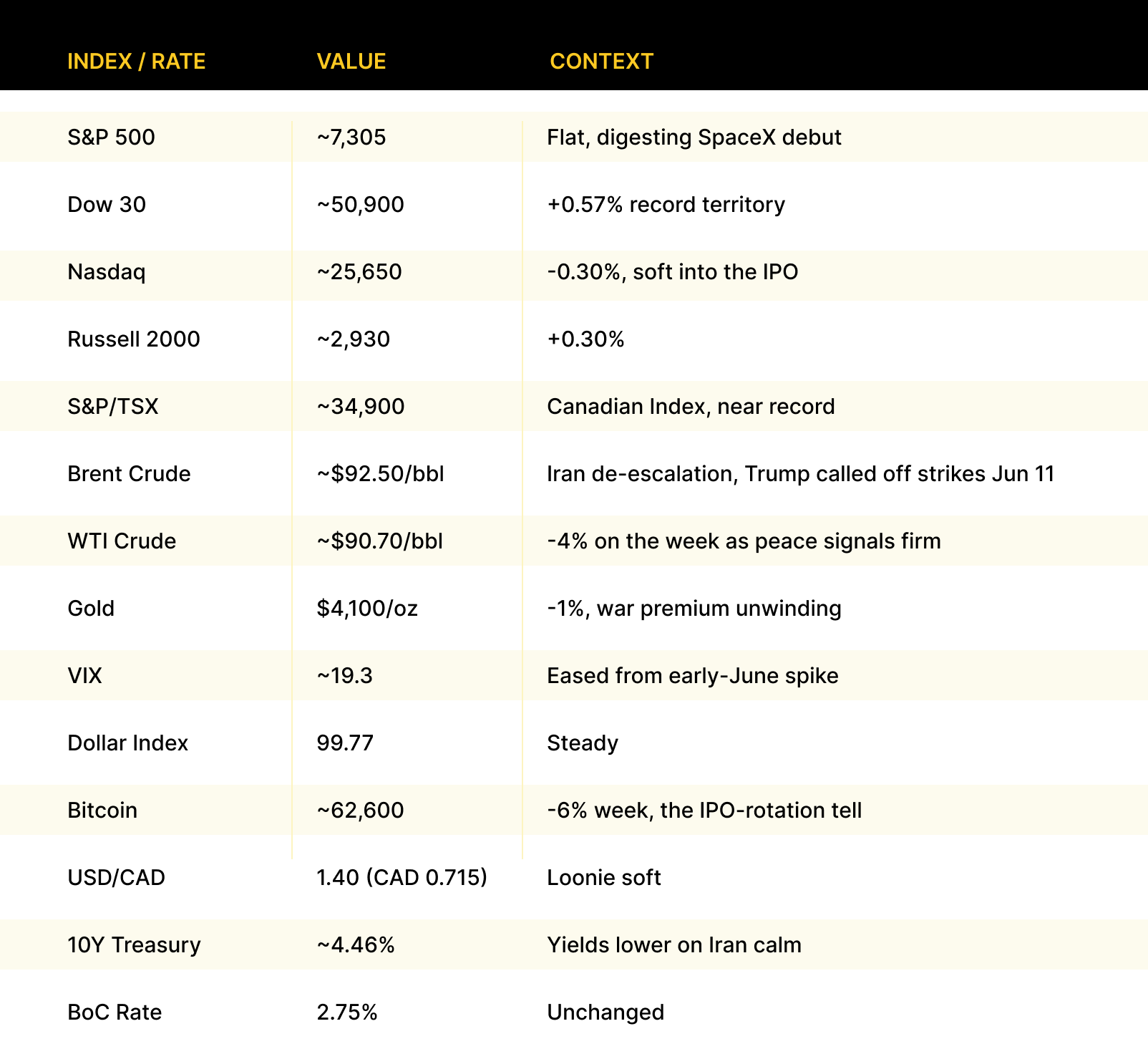
Market Snapshots
Sources
CNN, Washington Times, Yahoo Sports, Sports Business Journal, The Wall Street Journal (Dasl Yoon, Timothy W. Martin), Bank of Korea, INSS, Chainalysis, Reuters, CNBC, Bloomberg, The Economist, CNBC, Fortune, TradingKey, Bank of America (Michael Hartnett), Gavekal Research, TheStreet, Financial Times (Mercedes Ruehl), SWI swissinfo, gfs.bern, LSE EUROPP, ESPN, ABC News, Front Office Sports, TickPick, Vivid Seats, Gametime, CNBC, The Straits Times, AFP, Asia News Network, CNBC, Global Wellness Institute, Entrepreneur, Trading Economics, Investing.com, Yahoo Finance.
Market data pulled Friday June 12, 2026 at noon PT. SpaceX figures as of the morning’s debut. NBA Finals series 3-1 Knicks ahead of Game 5 (Sat June 13). Swiss referendum Sunday June 14. Currency at Friday spot rates.