Economics of morality, Flip Flop Mafia, Saudi Arabia retreating from Sports, Pan Am is a hotel brand and the $4.25M deli platter

32nd Edition
Greetings folks and a warm welcome to the 32ND Edition of Friday Finance,
Trump’s financial disclosure dropped this month and it shows roughly 3,700 trades in Q1 2026, about 40 per day. Among the 36 largest positions, each between $1 million and $5 million: Nvidia, Apple, Amazon, Oracle, Microsoft, Boeing, and Kura Sushi USA, a conveyor-belt sushi chain with 91 locations. It was the only restaurant to get an investment that size. Cheesecake Factory got between $15,000 and $50,000. Japanese internet users immediately floated a theory: someone confused “Kura” with Fujikura, the Tokyo fiber-optics company that has been riding the AI boom and would fit the rest of the tech-heavy portfolio. One Yahoo Finance Japan user asked whether Trump has “any interest in sushi, I always picture him eating steak and hamburgers every day.” Kura Sushi stock rose 6% on the news. Kura Oncology, an unrelated biotech that merely shares the “Kura” name, rose 9% on pure confusion. Fujikura fell 45% over the week so maybe it was the right call. Remember when Trump was going to have a press conference at the Four Seasons, but was in a parking lot instead? Let's get right to it.
TL;DR: Alvin Roth won the Nobel Prize for market design and built the kidney exchange that now accounts for 30% of US living-donor transplants. His new book, "Moral Economics," is about "repugnant transactions": deals where the buyer and seller are both willing but a third party wants to stop them. The framework explains a lot. Iran is the only country with a legal kidney market, and it eliminated its transplant waitlist by 1999. Rhode Island accidentally legalised indoor prostitution for six years, and reported rapes fell 31%. Every prohibition has a price tag.
Alvin Roth won the 2012 Nobel Prize for market design, the study of how to build markets where price alone can’t do the matching: school placements, medical residencies, organ donations. He designed the kidney exchange that lets incompatible donor-recipient pairs swap, and it now accounts for roughly 30% of US living-donor transplants. His new book, "Moral Economics," is about what he calls "repugnant transactions": deals where the buyer and seller are both willing, but someone else, not directly harmed, wants to prevent it. His opening question is why it’s easy to score heroin in an unfamiliar town but nearly impossible to hire a hitman. Both are illegal. The difference is that one has a willing market everyone tolerates and the other gets you a conversation with an undercover cop.
Iran is the only country on earth with a legal, regulated kidney market. It grew out of the Iran-Iraq War, when sanctions left the country without enough dialysis machines. The government pays roughly $4,500 per kidney, and Iran eliminated its transplant waitlist by 1999. Meanwhile the US has more than 99,000 people on the kidney waitlist, 4,481 die waiting every year, and the country spends nearly 1% of the entire federal budget on dialysis. In 2009, Rhode Island accidentally legalised indoor prostitution because lawmakers didn’t read a bill carefully. Economists Scott Cunningham and Manisha Shah studied the six-year window: reported rapes fell 31% and gonorrhoea cases fell 24%. When the state re-criminalised it in 2009, both went back up.
Roth’s framework is that morality is a real constraint, but it carries a measurable cost. California banned horsemeat by referendum in 1998, so Kazakhs in America are directed to Uzbek restaurants in Philadelphia or told to drive to Quebec. Europe forbids surrogacy but permits sex work; America does the reverse; California allows paid sex only if it’s filmed for pornography. Americans can be paid to donate blood but couldn’t join COVID vaccine challenge trials, while British donors get a biscuit for blood but are allowed to risk their lives testing a jab. In Ed 31, we covered the Enhanced Games, where athletes take FDA-approved, WADA-banned substances for a $1 million world-record bonus. That is a repugnant transaction with a Cayman Islands mailing address. The founder calls it “Formula One for the human body,” which is exactly Roth’s point: you don’t change a repugnance (I am really having problems with this word) norm with evidence, you change it by reframing the activity. Acting was repugnant in Rome for 2,000 years until someone called it a skill instead of body rental. To be fair some acting is repugnant, still scarred with how Game of Thrones ended.

TL;DR: Roughly 8,000 exotic and high-end cars have been stolen since spring 2024 through vehicle transport fraud, about 30 a day, totalling more than $1 billion in losses. Criminals phish login credentials for load boards like Central Dispatch, claim a Lamborghini for transport, then re-post it to an unsuspecting driver who delivers it straight to them. A GPS jammer, a VIN swap, and an hour later the car is retitled or in a shipping container to Dubai. Shaq lost a Range Rover. Kris Bryant lost a Lamborghini. The industry calls them the flip-flop mafia. The FBI issued a formal alert last month.
When Sam Zahr, director of operations at a Detroit luxury rental company, bought a grey Rolls-Royce Dawn convertible with orange interior in Miami, he did what everyone in the industry does: he posted it on Central Dispatch, the largest online load board for shipping vehicles, owned by Cox Automotive. A transport company called, agreed a price, and showed up on January 17 in a Dodge Ram. Zahr filmed the driver loading the car and took photos of everything. The Rolls was supposed to arrive in Detroit by January 21. It never showed up. When Zahr called his contact at the transport company, the man said he had no idea what Zahr was talking about and that they mostly ship Coca-Cola products. “That’s the scary part about it, you know?” Zahr said.
He had been caught by a scheme that has stolen roughly 8,000 exotic cars since spring 2024, around 30 a day, more than $1 billion in losses. It works like this: a phishing email steals a broker’s login for a load board. The criminal claims a high-end car for transport, then re-posts it, a practice called double-brokering, to a different, unsuspecting driver, with a new destination that routes the car into the criminal’s hands. The legitimate driver delivers a stolen car without knowing it. Once they have the vehicle, a GPS jammer kills the tracking, the VIN gets swapped, the computers get wiped, and the fobs get reprogrammed, all in about an hour. “If you steal the car at one o’clock today, you can have it completely done at two o’clock today,” one investigator said. The car is retitled and resold domestically, or loaded into a container bound for Dubai or West Africa, often before the owner files a police report.
Shaquille O’Neal lost a $180,000 custom Range Rover when the transport company was hacked. “They’re saying it’s probably in Dubai by now,” an employee told him. Ray J had two Mercedes Maybachs vanish enroute to New York. An Atlanta dealer spent months chasing a stolen Rolls-Royce, then found it in the Instagram feed of a Mexican pop star. He never got it back. Colorado Rockies third baseman Kris Bryant’s grey Lamborghini Huracán was supposed to go from Colorado to Las Vegas. Police tracked the truck with licence-plate cameras and found the car at a Vegas auto shop run by a man named Dat Viet Tieu, whose Jeep contained multiple fake VIN stickers and key fobs to other stolen vehicles. After his release on bail, police followed him to a Caesars Palace parking garage and watched him spend three hours reprogramming a key fob to a stolen GMC Sierra. When they finally arrested him at Nora’s Italian Restaurant, a detective said, “Obviously, we meet again.” Tieu replied: “I’m not surprised.”
After Zahr's Rolls disappeared, Detective Ryan Chin traced the cooperative driver, who had no idea he was moving stolen cars. The driver was booked to transport an orange Lamborghini Urus, supposedly from a Naples dealership to California, but the people who hired him had rerouted the delivery to a strip mall in Aventura for 4PM. Chin set up a sting. The driver unloaded the Lamborghini and waited. A green Rolls-Royce Cullinan worth $400,000 pulled in with two men and a teenager, who sat on the tailgate counting cash. Then a Bentley Continental GT arrived, its driver took the cash, walked over, handed the transport driver his $700 fee, and took the keys to the Lamborghini. That was the moment of the handoff. A dozen officers swooped in. "They had nowhere to go. We surrounded them."
The industry term is the "flip-flop mafia": partly because the people who show up to take the cars are “wearing flip-flops and slides,” and partly because they “flip” from one carrier registration to another to stay ahead of regulators, racking up violations under a US Department of Transportation. “Wash, rinse, repeat,” one broker said. Central Dispatch has added two-factor authentication and removed more than 500 accounts, but some brokers have abandoned load boards entirely and gone back to working the phones. In Ed 30, we wrote about the shadow fleet: 1,000 ghost tankers run by a Moldovan company with an anime Telegram avatar. This is the same story in a different industry. A digital platform built for efficiency and trust, exploited by organised crime to move physical assets across borders faster than anyone can track them. As one defence lawyer argued of his clients in the Florida case: “All they ever had was three schmucks sitting outside of the Lamborghini.” Gone in 60 Seconds 2, will be interesting to say the least.
TL;DR: Saudi Arabia’s Public Investment Fund, worth roughly $1 trillion, is cutting off LIV Golf after the 2026 season. It put more than $5 billion into the league since 2022 and never saw a return. This is part of a broader retreat: in recent weeks the PIF has sold its soccer team Al-Hilal, distanced itself from a Tom Brady flag football venture, and announced it’s cutting international investment from a 30% target to 18-20%. The lesson: even a $1 trillion sovereign wealth fund has a budget.
Saudi Arabia’s Public Investment Fund told the golf world this month that it will fund LIV Golf only through the end of the 2026 season. The PIF, chaired by Crown Prince Mohammed bin Salman, has poured more than $5 billion into LIV since it launched in 2022 as a rival to the PGA Tour, signing players like Jon Rahm (reportedly $300-450 million), Phil Mickelson, and Bryson DeChambeau to nine-figure contracts and funding more than $400 million in prize money a season. It has never turned a profit. Revenue was a reported $82 million against billions in spending. The fund’s statement was blunt: the investment “is no longer consistent with the current phase of PIF’s investment strategy” and cited “current macro dynamics.” Yasir Al-Rumayyan, the PIF governor who launched LIV alongside Greg Norman, is stepping down from his role with the league.
The golf decision is part of a much larger retreat. In a matter of weeks, the PIF has sold its marquee soccer team Al-Hilal, distanced itself from a flag football venture with Tom Brady, and pulled LIV funding. Al-Rumayyan says the fund is “reassessing its priorities,” shifting away from sports and “moonshot bets” toward traditional investments. Most importantly, the PIF is cutting its international investment allocation from a target of 30% down to 18-20%, redirecting capital back toward domestic Vision 2030 projects. The reason is simple: the Saudis are, relatively speaking, short on cash. Vision 2030 is enormously expensive, the Neom megacity has run far over budget, and even with the Iran war pushing oil higher for most of the spring, the kingdom needs roughly $90 Brent to balance a budget loaded with these commitments.
The lesson is that even a $1 trillion sovereign wealth fund has a budget constraint. The “infinite Saudi money” narrative that reshaped golf, soccer, boxing, tennis, Formula 1, and esports over the past decade is hitting a wall. For years the PIF was the buyer of last resort for any global trophy asset, and critics called the whole project “sportswashing,” using sport to launder a reputation on human rights. That connects to our first article this week: LIV was itself a repugnant transaction, with players taking Saudi money over the objections of families of 9/11 victims, all reframed as “growing the game.” When the fund everyone assumed had bottomless pockets starts selling its soccer team and cutting its golf league loose, the more interesting signal isn’t about golf. It’s about the actual state of Saudi finances.
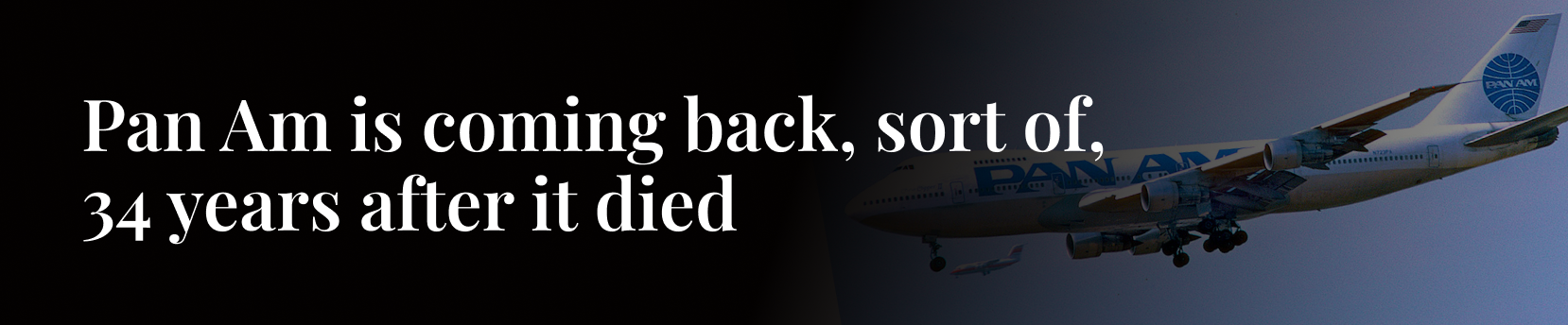
TL;DR: Pan Am, the airline that defined the golden age of jet travel before collapsing in 1991, is attempting a comeback. A new entity has applied to the FAA for an air operator certificate, partnered with Amadeus for technology, and is running $60,000 charter flights retracing original transatlantic routes. Pan Am Hotels are opening through Hilton. But for the scheduled airline it’s seeking a license to run, there’s no fleet, no regular routes, and no pricing announced. The more interesting question is whether the brand is worth more as a hotel chain than as an airline. TWA already proved it might be.
Pan American World Airways defined what flying used to mean. Founded in 1927, it pioneered the Boeing 707 jet age, the 747 jumbo, and even economy class, flew to 86 countries at its peak, and put 14-person dining rooms with full waiter service on its 1930s Clipper flying boats. It was the blue globe logo, the crisp uniforms, the upper-deck lounge. Then deregulation, competition, the 1988 Lockerbie bombing, and fuel costs caught up with it, and Pan Am ceased operations on December 4, 1991. The brand has been licensed and traded ever since. Now a new entity, launched in 2024 and headquartered in Miami like the original, has applied to the FAA for a Part 121 air operator certificate, the same license held by Delta, United, and American, and signed a technology deal with Amadeus for reservations and operations.
Beyond the charter program, there is no fleet announced, no scheduled routes, and no launch date for commercial service beyond “2026”. What the company does have is a set of $60,000-per-seat charter flights retracing Pan Am’s original transatlantic routes, a 12-day round trip from JFK with stops in Bermuda, Lisbon, Marseille, London, and Shannon. It also has hotels: a Pan Am Hotel opening through Hilton near Los Angeles in mid-2026, and Pan Am-branded suites and lounges already operating in Berlin and Vienna. The vision being sold is a “seamless, high-end travel ecosystem,”.
Is the Pan Am brand worth more as a hotel chain than as an airline? Starting an airline is one of the worst businesses on earth, with 2-3% margins in good years and a graveyard of failed revivals, from Eastern to Braniff. But TWA found the answer. The airline is dead forever, yet the TWA Hotel at JFK, which opened in 2019, is a success. Pan Am appears to be running both plays at once: pursue the high-risk FAA certification while building low-risk, high-margin hotels. If your market test for “can we be an airline again” costs $60,000 a seat, you are not testing airline demand. You’re testing nostalgia demand. That’s a completely different business, and it might be the better one. Sometimes the brand is worth more doing something other than the thing that made it famous. Like Blackberry.
TL;DR: JPMorgan fired a Beverly Hills broker who managed $1 billion in client assets over a $642.50 deli platter his assistant expensed for a client gathering. The bank called it a personal Super Bowl party and terminated him "for cause." The broker said the meeting was pre-approved, and his lawyer noted the food wasn’t even ordered on Super Bowl Sunday. A FINRA panel awarded him $4.25 million, ordered the termination expunged from his record, and changed the reason to "voluntary." That’s a 6,614x return on a sandwich platter.
Brent Bodner managed $1 billion in client assets as a JPMorgan broker in Beverly Hills. In February 2024, his assistant expensed a $642.50 deli platter of sandwiches and wings for a gathering at his home that included a client and a prospective client. Bodner says the meeting was pre-approved as business hospitality. JPMorgan investigated, decided it was a personal “Super Bowl party” rather than a business event, and terminated him “for cause,” filing a U5 notice that flags a code-of-conduct violation visible to every firm in the industry. His lawyer’s rebuttal was simple: the food wasn’t even ordered on the day of the Super Bowl.
The “for cause” label is the part that matters, and it’s why this is really a finance story rather than a sandwich story. When a bank fires a broker for cause, the broker forfeits deferred compensation, unvested stock, and transition packages, which for someone running a $1 billion book can run into millions of dollars. A “for cause” U5 also follows a broker for the rest of their career, visible to every firm that runs a background check. Bodner filed a wrongful-termination and defamation claim with FINRA, seeking $30 million. In May 2026, a three-member FINRA panel awarded him $4.25 million, ordered the termination notice expunged, and changed the stated reason from “for cause” to “voluntary.” The expungement is the real verdict: it says the panel viewed JPMorgan’s justification as retaliatory rather than legitimate.
The deli platter cost $642.50. The award was $4.25 million. That is a 6,614x return on a tray of sandwiches and wings, which is a better multiple than anything in Trump’s 3,700 Q1 trades. JPMorgan did $73.66 billion in revenue last quarter, so the award is a rounding error, roughly 0.006% of three months’ sales. The whole point of a “for cause” firing is to part ways with an expensive broker while clawing back the deferred comp you owe them. FINRA just demonstrated that if you try that over a $642 platter, you can end up paying far more than you saved, and getting publicly told your reason was fake. Bodner, for the record, took his $1 billion book to Wells Fargo. JPMorgan says it “vehemently disagrees” with the decision and is “disappointed.”
A woman from Rome went skiing in the Dolomites and asked for tap water at the restaurant of a five-star hotel. The waiter offered her €7 bottled mineral water instead. She sued, arguing that “water is a natural resource and a universal human right” and that refusing tap water was like finding no sheets on the bed or no soap in the bathroom. She sought €2,700 for emotional distress and economic damage. She lost in Rome. She lost on appeal. And this week, seven years after the 2019 ski season in question, Italy’s highest court ruled that hotels are under no obligation to serve tap water. The hotel’s lawyer noted she could have gotten water from her own room, just not at the restaurant table. European hospitality litigation is quietly becoming its own asset class.
"A bank is a place that will lend you money if you can prove that you don’t need it." — Bob Hope
Have a fantastic weekend. I welcome feedback and please forward this if you see fit.
Many thanks,
Sam.
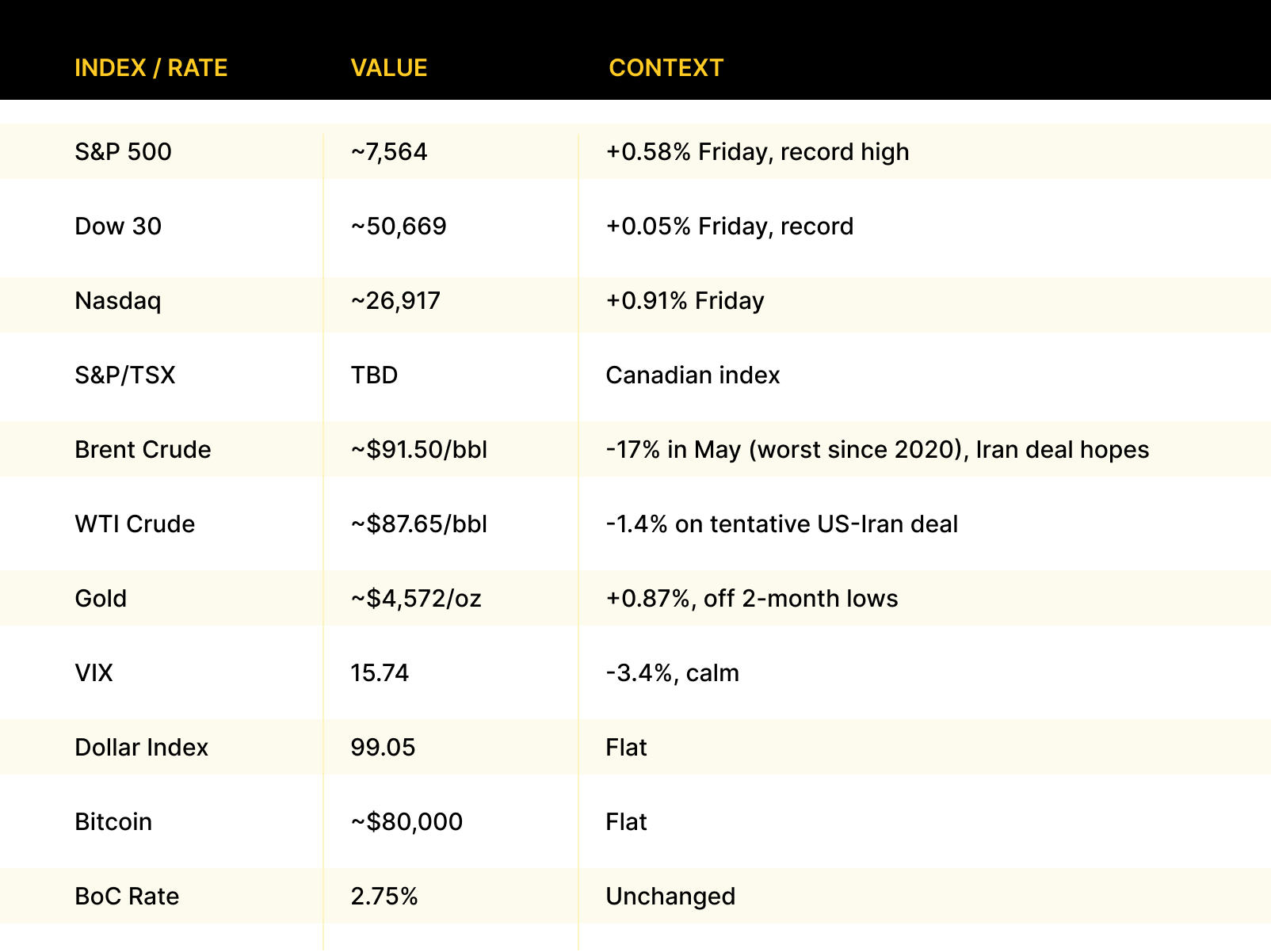
Market Snapshots
Sources
MIT Technology Review (Craig Silverman), The Economist, NPR, Bloomberg, Yomiuri Shimbun, Wall Street Journal, CNBC, Financial Times, GOLF.com, Washington Times, ABC News, Golf Channel, Sports Business Journal, Money in Sport, CNN Travel (Griffin Shea), Simple Flying, Amadeus, Financial Advisor Magazine, ThinkAdvisor, AdvisorHub, NY Post, BBC (Harry Sekulich), Corriere Alto Adige, Fast Company, Gizmodo, Futurism, Hagerty, CargoNet, FBI IC3, NICB, Stanford Report, Marginal Revolution, Cunningham & Shah (2014), TheStreet, Trading Economics, Investing.com, Wikipedia.
Stock data pulled Friday May 29, 2026 at noon PT. Currency at Friday spot rates.