$100K before you buy the car, GTA Holiday, Pentagon Oil Co, $499 toothbrush, Apple Vs OpenAI

46th Edition
Greetings folks and a warm welcome to the 46th Edition of Friday Finance,
Researchers at Southern Illinois University have made cookies out of plastic bottles. The process breaks down PET and discarded corn stalks using water and oxygen at high temperature and pressure, feeds the resulting carbon to genetically engineered yeasts, and 3D prints what comes out into a vanilla-scented biscuit, with the vanilla engineered from plant waste and the vitamin A derived from ethylene glycol, the same molecule used in antifreeze. There is no plastic left in the cookie, and the lead researcher’s explanation for the whole project is that plastic is carbon and food is carbon. Nobody has eaten one yet, because the team is still waiting on institutional approval for human testing. They have run aroma tests, though, and most participants said they would be willing to eat the cookies if food resources were limited. The future is starting to look very bright. Let's get right to it.
TL;DR: A certificate allowing you to put a small car on a Singapore road cost S$128,501 this month, before you buy the car. Singapore did not tax cars, it capped the number and auctioned the right, twice a month, so the price is pure scarcity rent on road space. It works: 667,000 cars for 6.1 million people, against 1.9 million in Maryland.
At a dealership in Singapore this month, a one-year-old BMW X5 was listed at about US$352,000, a new Toyota Yaris Cross at US$152,000, and a seven-year-old BMW 4 Series with 56,000 miles at nearly US$70,000. A new Honda Civic runs to about US$165,000 against roughly US$26,000 in the United States, which is more than the median Singaporean household earns in a year. None of those numbers are really about cars. Since 1990 Singapore has capped the number of vehicles allowed on its roads and auctioned the right to own one, twice a month, in a public bidding exercise, and the certificate lasts ten years. At the second August auction the small-car certificate closed at S$128,501, about US$101,000, near July’s record, against S$35,710 in August 2020. That is 3.6 times higher in six years, and it is what you pay before choosing a car.
What makes this different from a tax is that Singapore fixed the quantity rather than the price. Most governments set a duty and let the number of cars find its own level; Singapore set the number of cars and let the price find its own level, which turns the certificate into a tradable permit and its price into scarcity rent on road space. Nobody chose S$128,501. It is what 6.1 million people will pay each other for a fixed supply of road, auctioned every fortnight. The certificate is also a leasehold, ten years, attached to the vehicle, worth nothing at expiry, so every car in Singapore depreciates on two clocks at once and the second one usually dominates. One driver quoted by the Wall Street Journal is scrapping a Nissan she bought secondhand for US$71,000 because renewing the certificate for five more years would cost US$50,000. Another sold a nearly ten-year-old Audi for US$13,000 in the months before its certificate lapsed, to salvage some residual. It is a very Singaporean arrangement, given most housing there is sold on 99-year leases too.
Singapore has about 667,000 cars for 6.1 million people, where Maryland has roughly 1.9 million for a similar population, and roads still occupy 12% of the country’s land. Trains run every two minutes at peak and disruptions are rare enough that ministers apologise for them, funded in part by the auctions themselves, one of which raised over S$339 million in a single exercise this month. The flaw is in the categories. Because the small-car certificate is defined by engine size and power rather than by price, high-powered electric cars slip under the threshold, so buyers put the most expensive vehicle they can into the cheapest box, and certificates meant for small cars have sometimes cost more than the ones meant for large ones. A transport economist told the paper that people now treat buying a car like timing the stock market, studying past prices and chart patterns. The dealer in the story sells 10 to 15 cars a month, against 30 to 40 a decade ago.

TL;DR: A US Army battalion is offering a four-day pass to soldiers who re-enlist before Grand Theft Auto VI comes out on November 19. The bigger number belongs to everyone else: competing publishers have moved their release schedules around that date, and the game's two delays cost the wider industry an estimated $2.7 billion in revenue.
A memo went out at Fort Stewart in Georgia on July 28 offering soldiers in the 9th Brigade Engineer Battalion a four-day pass if they re-enlisted before November 14, timed so the pass would land on the release of Grand Theft Auto VI. The battalion’s public affairs officer said a new career counsellor had suggested that supporting the troops’ actual interests might help hit the re-enlistment target. It is a small thing that says something larger, which is that the Army could not move the wage, so it paid in time instead, and priced a retention decision against a video game release date. The game arrives on Thursday November 19 at $79.99, thirteen years after the last one, and Take-Two has guided to net bookings of $8.0 to $8.2 billion for the year to March 2027, against $6.72 billion the year before. Roughly 20% growth, attributed to one title on one Thursday.
Competing publishers have deliberately spaced their fourth-quarter releases away from November 19, accepting worse windows rather than launching into it, and Ampere Analysis estimated that the game’s two delays cost the wider industry about $2.7 billion in revenue that would have been earned had it arrived in autumn 2025 as planned. That is money lost by publishers with no stake in the game whatsoever, because their own schedules had been built around a date that moved twice. One product is now setting the release calendar for an entire sector, which is a form of market power that does not appear in any market-share statistic. Sony and Microsoft are both expected to ride a second wave of console sales into the holiday quarter on the back of it.
Take-Two has never disclosed a development budget or a single pre-order number. The widely repeated $2 billion bundles development with marketing, live-service infrastructure and the cost of the delays; the $3 billion version has no filing behind it at all. What exists instead is a range of forecasts: DFC Intelligence models 40 million units in the first year, Piper Sandler 35 million by April 2027, and Konvoy Ventures 85 million within 60 days. Professional analysts looking at the same product with the same public information are 2.4 times apart. The sceptics have a case too, since global games spending was about to triple when GTA V launched in 2013 and that tailwind will not repeat, which is why the rollout is staged across console now, PC in 2027 or 2028, and the online mode later still. In Ed 36 we wrote that the $80 price was cheaper in real terms than it looked. For the record I won’t be taking time off, but I am hoping my phone rings a little less during that time.
TL;DR: Congress gave the administration $171M to refill an oil reserve that needed $20B, so it built a structure around Congress instead. The Department of War now holds a 35% equity stake in a private Venezuelan oil company, with veto rights over its board. The two governments are describing different deals: Washington says 100-year concessions, Caracas says 25 years.
The US Strategic Petroleum Reserve needed about $20 billion to refill, according to the energy secretary. Congress appropriated $171 million, which is under 1% of that. So the administration went around the appropriation entirely. Venezuela’s interim authorities granted a privately held company called North American Blue Energy Partners 100-year concessions over 17 oil fields holding roughly 65 billion barrels, and the company in turn granted the US Department of War’s Office of Strategic Capital a 35% equity stake in its corporate parent. The State Department gets the right to buy a fifth of the output at production cost, plus first refusal on the rest, and the US government holds veto authority over board appointments, with a majority of directors required to be American citizens. The White House describes the arrangement as securing energy dominance for the next century at zero cost to the United States.
The numbers are enormous. Those 65 billion barrels amount to roughly 1.4 times the entire proven reserve base of the United States, and they represent only about a fifth of Venezuela’s total. Against that, the reserve itself is in poor shape: more than 128 million barrels have been released to blunt the closure of the Strait of Hormuz, leaving about 286 million barrels against an authorised capacity of 714 million, the lowest level since the autumn of 1982. A White House official says that if the company scales as planned, the US could add 50 million barrels a year, which is roughly eight and a half years to refill on the administration’s own best case. Federal researchers have found the 60 Gulf Coast salt caverns can no longer be drawn down or refilled at the rate they were designed for. Rystad Energy reckons it would take more than $183 billion over more than a decade to get Venezuelan production to three million barrels a day.
There is also the awkward fact that none of this oil can go into the reserve. Venezuelan crude is heavy and the caverns hold light to medium, so the plan is a swap: American refineries, configured for heavy barrels, buy the Venezuelan oil and hand the government lighter crude in exchange, which one adviser likens to trading in an old car against a new one. The stranger detail is that the two governments are describing different agreements. Washington disclosed 100-year concessions. Venezuela’s interim president describes a 25-year bilateral arrangement, insists her country retains ownership and sovereignty, and says the first phase could generate $209 billion for Venezuela. The precise entity in which the Department of War holds its stake has not been clearly identified either: the White House calls it the corporate parent, the company calls it the company, and reporting describes a new private vehicle being created. The State Department’s right to buy oil at cost is real, and nobody has identified the money it would use. I wouldn’t be surprised if all the new board have last names starting with ‘T’ or ‘K’.
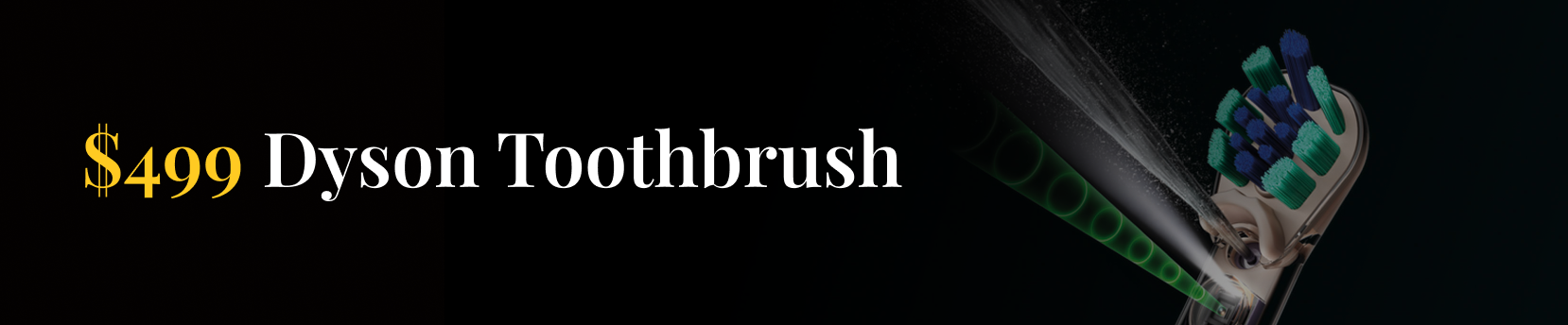
TL;DR: Dyson has launched a $499 toothbrush with a camera in it. Foam blocks the lens, so Dyson advises pairing it with its own non-foaming toothpaste, which makes the camera less a feature than an enforcement mechanism. It is Juicero with better engineering, and Dyson has run a version of this experiment before with $949 air-purifying headphones.
Dyson has released a toothbrush with a camera in it. The CameraJet went on sale on Tuesday at $499, rising to about $568 depending on the bundle, and contains a 100,000-pixel macro camera that analyses 28 images a second, spots the gaps between your teeth and fires a one-millisecond burst of mouth rinse at each one within a tenth of a second. There is an app that shows live footage from inside your mouth while you brush. Dyson says it took six years, more than 600 engineers, 30 dental professionals, 16 million lines of code and a machine-learning model trained on 470,000 images of teeth. Dental floss costs about three dollars.
The interesting part is buried in the product listing, where Dyson advises pairing the device with non-foaming, SLS-free toothpaste and mouth rinse to keep the camera lens clear. Foam blocks the lens, which means the flagship feature of a $499 toothbrush degrades if you use ordinary toothpaste, and Dyson sells its own non-foaming version. The brush heads carry RFID tags and report when they need replacing. So the camera is not simply a feature, it is the mechanism that converts a one-time purchase into a recurring consumables relationship, and the engineering justification and the commercial lock-in happen to be the same design decision. There is a precedent. Juicero sold a connected juice press that accepted only its own coded packs, raised a great deal of money, and folded in 2017 after Bloomberg demonstrated that hands squeezed the packs about as well. The camera is doing the job the scanner used to do, though in fairness, a hand cannot fire a targeted jet of mouthwash 28 times a second.
Thirteen times more effective at improving gum health is measured against a manual toothbrush. Up to 69% more plaque removed is against premium electric competitors, in a laboratory, in brush-only mode, in hard-to-reach areas. Both are accurate and both are chosen, and to Dyson’s credit the footnotes are published on its own website. As for whether people will buy it, the company has run a version of this experiment already. In 2022 it launched $949 headphones with a visor that purified the air, told the public the product was not an April Fool’s joke, discontinued them in mid-2025, quietly removed the visor from its marketing photographs and changed the slogan, and the remaining stock has been clearing at $179.99, about 81% below the launch price. So basically Dyson made a super expensive toothbrush that can’t use regular toothpaste, so it’s the printer model, but with both the printer and ink being expensive.
TL;DR: Apple's latest filing makes an argument nobody has had to make before: that a trade secret fed into a model that learns from it may be impossible to un-learn. Every standard remedy assumes the secret sits in something you can take back. All allegations are unproven and OpenAI has moved to dismiss. The closest precedent settled for 13% of the claim.
Apple filed new evidence on Monday in its trade secrets case against OpenAI, based on a forensic examination of a MacBook that OpenAI handed over on August 21. Apple alleges that a former engineer, who spent eight years at the company before leaving in January, downloaded dozens of confidential files in March, including a power converter circuit schematic, and ran simulations on it using an AI agent. Buried in the filing is an argument nobody has had to make before: that where trade secret information is fed to a model that learns from it, the use may be irreversible and continually propagating. That matters because every standard remedy in this area assumes the secret sits in something you can take back. Hand over the documents, destroy the copies, sign an injunction. If a model has learned the material, there is nothing to return, which is why Apple is asking the court to bar OpenAI from working on hardware based on its technology rather than simply asking for damages.
OpenAI has moved to dismiss, says it does not want or use anyone else’s trade secrets, and describes its products as entirely new. Its central counter is that former Apple staff retained access because Apple failed to revoke it properly when they left, a problem it says is common at the company; Apple responds that the engineer exploited a rare and previously unknown authentication bug. Nothing has been ruled on and there is no trial date. The closest precedent suggests how this usually ends. When Waymo sued Uber in 2017 over an engineer who had downloaded more than 14,000 files before founding a startup that Uber then bought, it asked for $1.8 billion and settled on the fourth day of trial for 0.34% of Uber’s equity, worth about $245 million, roughly 13% of the claim, paid in stock rather than cash, with an injunction and an independent monitor attached. Same federal district, same talent-war dynamic, and in both cases the acquirer had bought a company founded by the departing talent.
It says more than 400 former Apple employees now work at OpenAI and calls that a strategy; OpenAI calls it a labour market, and both descriptions fit the same facts. No court has drawn a clean line between the experience an engineer carries and the material they take, which is why these cases tend to be settled rather than decided. Other industries have run the experiment repeatedly. A retired DuPont engineer took decades of Kevlar manufacturing knowledge to a South Korean competitor as a consultant, and a jury put the bill at $919.9 million, establishing that the obligation outlasts the job. In 2006, when three people tried to sell Coca-Cola documents and samples of an unreleased product to Pepsi for $1.5 million, Pepsi phoned Coca-Cola and the FBI.
A startup in Al Ain has built what it says is the first digital marketplace for buying, selling and auctioning camels. Hign Al Khaleej, which translates roughly as Gulf camels, launched in late 2024 and now has more than 15,000 users and about 3,300 animals listed across the UAE, Saudi Arabia, Qatar, Oman and Kuwait. The friction it removes is genuinely physical, because selling a camel has meant loading the animal into a pickup truck and driving it a long way to meet a buyer who might not buy. The prices justify the trip: at one Abu Dhabi auction last year 15 camels sold for a combined $500,000, one of them for $136,000 after a bidding war, and elite animals have gone for millions. Saudi Arabia is now building its own camel platform, alongside camel insurance, DNA breed documentation and personalised camel cards. In Ed 43 we wrote about two men two years into a board game who still did not know what the camels do. There is now an app for that.
“Show me the incentive and I will show you the outcome.”
— Charlie Munger
Have a fantastic weekend. I welcome feedback and please forward this if you see fit.
Many thanks,
Sam.
Market Snapshots
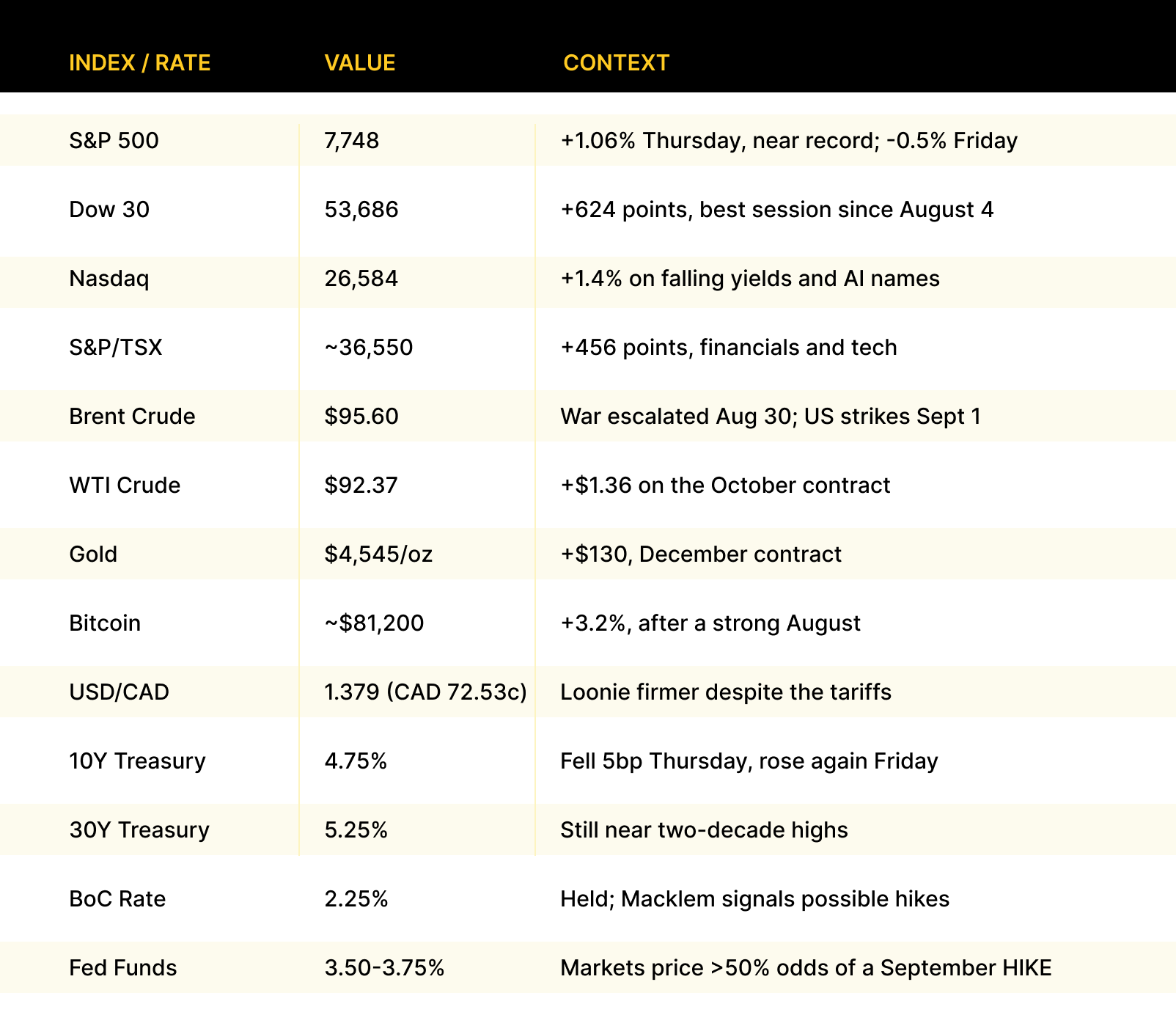
Note: the whole week was a referendum on one number. On Tuesday markets put the odds of a September rate hike near 63%. By Thursday, after Christopher Waller suggested cooling inflation might justify holding and the New York Fed's John Williams said a hike was not necessarily required, those odds had fallen to roughly even, and stocks posted their best session since August 4. Then this morning August payrolls came in at 162,000 against the 53,000 economists expected, with June and July revised up and unemployment steady at 4.1%, and the odds went back above 50%. The two-year yield touched its highest since January 2025. The fundamentals did not change three times in four days; the expectations did. Meanwhile the administration is arguing with itself in public, since Vice President JD Vance said this week the Fed should cut rates to make housing affordable, days after Fed Chair Kevin Warsh hinted at doing the opposite. Oil sits near $95 after the US struck Iranian targets on September 1. In Canada, Ottawa's dollar-for-dollar retaliatory tariffs take effect Tuesday, the trade surplus with the world collapsed from C$4.2 billion in June to C$769 million in July, and Governor Tiff Macklem held at 2.25% while warning the Bank is prepared to raise rates more than once if inflation stays high.
1 USD = 1.379 CAD = 0.88 EUR = 0.75 GBP at Thursday spot.
Sources
Forbes, Popular Science, Bakery & Snacks, American Chemical Society (opener); Wall Street Journal, Singapore Land Transport Authority, Motorist.sg, AsiaOne, Jalopnik, Reuters (Singapore); Take-Two earnings and guidance, Ampere Analysis, DFC Intelligence, Piper Sandler, Konvoy Ventures (GTA 6); Wall Street Journal, White House fact sheet, NABEP, AP, CNBC, CBS News, NPR, Rystad Energy, FDD (Venezuela); The Verge, Dyson product listings and footnotes, TechRadar, Museum of Failure, Stuff, Notebookcheck (Dyson); Bloomberg, TechCrunch, Engadget, Gizmodo, PYMNTS, court filings in the Northern District of California (Apple v OpenAI); CNN Business, Gulf News (closer); CNBC, BNN Bloomberg, Canadian Press, TheStreet, Motley Fool, Trading Economics, Bank of Canada (market data).
Market data pulled Friday September 4, 2026 using September 3 closes, with Friday's payrolls reaction noted where relevant. Live items this edition: every allegation in the Apple case is unproven, OpenAI has moved to dismiss and no court has ruled, with a formal response to the discovery motion expected around today; the Venezuela deal is days old and the two governments have described its duration differently, at 100 years and 25 years respectively, with the corporate entity holding the US stake still not clearly identified; Canada's retaliatory tariffs take effect September 8; the plastic cookies have not been eaten by anyone and human testing awaits institutional approval; and Singapore runs its next certificate auction within the fortnight. Currency at Thursday spot rates.