NASDAQ moves to 23 hr trading, $30B press release, Swiss Banking Regulators, PublicSquare finances guns, Keystone XL back?


44th Edition
Greetings folks and a warm welcome to the 44th Edition of Friday Finance,
On Wednesday November 18, at 2:16:07 in the morning Pacific time, Voyager 1 will be 16,094,799,096 miles from Earth. NASA has calculated it to the second. At that moment it becomes the first human-made object a full light-day away, which means a command sent from Earth takes 24 hours to arrive and any reply takes another 24, so the round trip on a single question is two days. The spacecraft launched in 1977, passed Jupiter in 1979 and Saturn in 1980, crossed into interstellar space in 2012, and is still answering. It is also running down, because its plutonium power source decays a little every year, NASA has been switching off systems one at a time to buy more, and sometime in the late 2020s the power drops below what any instrument needs and it goes quiet for good. Forty-nine years of travel has covered about 0.065% of the distance to the nearest star. Let’s get right to it.
TL;DR: From December 6, Nasdaq wants to trade almost around the clock. It already offers 16 hours a day and about 98% of volume still happens in the 6.5-hour core session. Adding seven more hours does not create orders, it spreads the same ones thinner, which is why market orders will be banned overnight. The one hour it closes is for bookkeeping.
From December 6, Nasdaq intends to trade almost around the clock, adding an overnight session from 9 p.m. to 4 a.m. that stretches the week from Sunday evening to Friday evening with a single one-hour break. The SEC approved the framework back in April; what remains is sign-off on the safeguards and confirmation that the shared infrastructure consolidating trade data across exchanges can run overnight. The pitch is global demand, and the number behind it is real: foreign investors held $17 trillion of US equities by the middle of 2024, up 97% in five years, and a European trading between 3 and 10 in the morning Central European Time could deal in Nasdaq stocks for most of a session before London opens. Nasdaq has offered trading from 4 a.m. to 8 p.m. for years, and roughly 98% of its volume still happens in the six and a half hours of the regular session. The existing extended window is not congested. It is empty.
An exchange’s real product is not time, it is other people’s orders sitting on the other side of yours. Spreading the same volume over 23 hours instead of six and a half does not create liquidity, it dilutes it, and Nasdaq’s own rulebook concedes the point. Market orders will not be available overnight, because a market order in a thin book is how you discover the price of your own impatience. Static price bands will automatically reject orders outside set limits. Traders need separate ports, orders left open at 4 a.m. are cancelled, additional risk disclosures apply, and the law firms advising listed companies are already warning them to expect thinner books and sharper moves after dark.
The opening and closing crosses still determine the numbers everything else is marked against, so an investor trading at 2 a.m. is dealing around a price formed in a session they were not part of. You get access to the market without access to the price formation, which is not nothing but is also not the same thing. As for the single hour the market is shut, it runs from 8 to 9 p.m. so the system can process and roll the trade date, after which trades between 9 p.m. and midnight book with the following day’s date. NYSE is already approved for 22 hours, Cboe and the London Stock Exchange are moving the same way, 24X is live, crypto never closed, and the SEC has a roundtable on the subject scheduled for September. The market no longer closes for sleep. It closes for bookkeeping. My question is, can stay at home market ‘experts’ still call it day trading?
TL;DR: Merck and Moderna's personalised cancer vaccine worked in a Phase 3 melanoma trial, the first time any mRNA cancer treatment has. Moderna added roughly $30B in a session, then gave back a fifth of it the next day with no new information. Analysts model $1.4B of sales by 2032. The market was pricing the platform, not the drug, and melanoma was chosen because it is the easiest case.
On Wednesday, Merck and Moderna said their personalised mRNA cancer vaccine had succeeded in a Phase 3 trial, the first time an individualised neoantigen therapy (no idea what that means) or any mRNA cancer treatment has done so. In 1,137 patients whose melanoma had been surgically removed, the vaccine added to Merck’s Keytruda delayed recurrence and reduced the risk of the disease spreading, and independent monitors judged the interim results strong enough to stop the trial early. Each dose is built from the genetic sequence of the individual patient’s own tumour, nine of them, alongside nine infusions of Keytruda. It is a genuinely significant result. Moderna’s shares rose 177%, adding roughly $30 billion of market value in a single session on volume fifteen times its normal level, Merck closed at an all-time high and the Nasdaq biotech index hit a record. On Thursday Moderna fell about 24%, with no new information of any kind in between.
Leerink now models the therapy at around $1.4 billion of sales by 2032, and the initial melanoma indication covers roughly 30,000 patients across the United States and Europe, so the market added something in the order of twenty to thirty times the drug’s expected peak annual revenue, in an afternoon, for a product whose detailed results have not been published, peer-reviewed or presented anywhere. What was being bought was not melanoma cure. If a bespoke vaccine can train the immune system against one solid tumour, it may do the same in lung, where the adjuvant opportunity alone exceeds 100,000 patients, and results from trials in lung, bladder, kidney, pancreatic and stomach cancers are expected within a year or two. There is a caveat worth holding onto, though, which is that melanoma was chosen partly because it throws off an unusually large number of mutations, making it easier for the immune system to spot.
Keytruda generated about $31.7 billion last year, close to half the company’s revenue, and its main US patent expires in December 2028. The usual defence against a cliff like that is to find another drug. This is something better: a personalised vaccine cannot be genericised, because a biosimilar manufacturer can copy a molecule but not a production process that builds a different product for every patient. Pairing the expiring drug with an uncopyable partner keeps the combination defensible long after the patent is not. In Ed 39 we wrote about Merck buying insurance against the Keytruda cliff, and this is the other half of the same policy. It secured the whole thing for $200 million upfront in 2016 and another $250 million to exercise its option in 2022, after which the two companies split all costs and profits equally, with Moderna responsible for manufacturing. That is $450 million, staged across six years, agreed when the technology had never produced an approved product of any kind. Hopefully we can cure cancer in our lifetime, that would be a monumental feat.
TL;DR: Three years after Credit Suisse collapsed, Switzerland has asked for the power to fine banks, which its regulator currently cannot do at all. The old Federal Banking Commission could name banks publicly in 1999 and did. FINMA lost that habit in 2009. The powers take effect in 2029 at the earliest, and the accountability regime has already been narrowed before reaching parliament.
Three years after Credit Suisse collapsed, the Swiss government has asked for the power to fine banks. This is not a tightening of an existing regime. FINMA, the regulator of one of the world’s most important financial centres, currently has no general power to levy a fine at all: it can pull a licence, ban an individual from the industry, or confiscate illegally obtained profits, and that is the whole toolkit. The August proposal would let it impose penalties of up to 10% of a bank’s annual operating income, publicly name institutions under enforcement, and force systemically important banks to claw back bonuses for up to five years. Consultation closes on November 19, a bill reaches parliament next summer, and the earliest any of it takes effect is 2029, six years after the bank it was written for ceased to exist.
The part that should raise an eyebrow is that Switzerland has been here before, and better armed. In 1999, when the plundering of Nigeria by Sani Abacha came to light, the old Federal Banking Commission froze CHF533 million and then published the names of all 19 Swiss banks holding the money, which was unprecedented. The following year, with Fujimori’s money, it named the banks again and removed a bank executive for the first time. Then in 2009 the Banking Commission was merged with the insurance and anti-money-laundering regulators into FINMA, a bigger and more modern supervisor, and the naming and shaming was quietly toned down. The power the government is now asking parliament to grant is roughly the power its predecessor was exercising 27 years ago.
A bill to regulate banking federally was drafted in 1916 and sat in a drawer in Bern until the Depression pulled it out, and the Federal Banking Act finally arrived in 1935 after the Banque de Genève collapsed and the government spent CHF100 million propping up Schweizerische Volksbank. A finance minister later described the law as a child of necessity. In 1965 the president of the banking commission himself was removed after taking CHF2,000 a month from the man who managed the European fortune of the Dominican dictator Trujillo, while two banks he supervised lent heavily to that man’s companies and duly collapsed. He never appeared in court, and the sole legislative consequence was a clearer licensing rule for foreign-controlled banks. Two anti-money-laundering laws in 1989 moved quickly only because a government minister had just resigned over her husband’s business ties.
The most instructive case is Chiasso. For fifteen years the branch of Schweizerische Kreditanstalt in that border town moved CHF2.2 billion of Italian clients’ money into a letterbox company in Liechtenstein that operated as a bank within a bank, lending, buying non-banking assets, and absorbing both bad loans and the trading losses of senior managers. The eventual hole was CHF1.4 billion, the largest scandal in Swiss banking to that point, at the bank that would later be called Credit Suisse. The rescue is worth noting: at midnight on April 26 1977 the central bank announced a facility of up to CHF3 billion and never lent a franc, because the announcement alone stopped the run. The regulatory response to all this was a voluntary code of conduct, drafted by the central bank and the banks’ own association, which became the cornerstone of Swiss self-regulation. Seven years later, voters rejected an initiative against tax evasion and capital flight by 73%.
The 2008 rescue of UBS produced fifteen years of elaborate too-big-to-fail machinery, built explicitly so that taxpayers would never again have to stand behind a systemically important bank. In March 2023 that regime faced its first real test, and the authorities did not use it. They orchestrated a takeover instead.
The same argument is now running in capital. The government wants UBS to fully capitalise its foreign subsidiaries, lifting the requirement from 60% to 100% and adding roughly $23 billion of common equity, about $26 billion across the whole package, which would take the bank’s capital ratio from around 14% to nearer 20% over seven years. UBS calls the package extreme and internationally misaligned, has lobbied for more than a year, and has let it be known that it could move its headquarters. Both sides have a case, since Switzerland’s largest bank has a balance sheet that dwarfs the economy standing behind it, and UBS does compete with banks facing no equivalent rule. The upper house committee postponed its vote and resumes on August 31. In March the Financial Times reported that a core group of lawmakers had privately assured UBS they would find a compromise, and the accountability regime has already been narrowed to banks with at least 250 employees before reaching parliament at all. Financial penalties rarely deter banks its just an expense item. Just saying.

TL;DR: PublicSquare listed in 2023 as an anti-woke Amazon with Donald Trump Jr. on the board, lost nearly $160M, and abandoned the marketplace entirely. What survived is a buy-now-pay-later lender for firearms retailers, and it is growing fast. In retail a political identity caps your catalogue. In payments, serving industries banks avoid is a real competitive advantage.
PublicSquare listed on the New York Stock Exchange in 2023 as an anti-woke alternative to Amazon, with Donald Trump Jr. as an early investor and board member, and about $60 million raised through a merger with a special purpose acquisition company. Three years later it has abandoned the marketplace entirely. Cumulative losses run to nearly $160 million, roughly two and a half times what the listing raised, and the stock is down 99%, a figure that already accounts for a one-for-fifteen reverse split the company carried out in July to keep its listing. The cost base tells the story better than the strategy does: general and administrative expenses came to $43.3 million in 2024, close to double that year’s revenue. No amount of traffic repairs an overhead line running at twice the top line.
The company paid Trump Jr. $42,000 a month in consulting fees from 2024, more than $500,000 across 2025, at a point when the chief executive’s salary was $300,000. Filings show he attended about 60% of board meetings, the only director below the 75% mark. A brokerage founded by the banker whose SPAC took the company public was paid over $650,000, and a former Trump administration official nearly $400,000. The company says the compensation reflected a public figure who spoke directly to the audience the marketplace was built for, and that his involvement drove real traffic. The market certainly agreed at the time, since the share price more than tripled when the board appointment was announced. It is worth noting the directors do not appear to have sold into that, and put a further $1.3 million in this month. The endorsement moved the stock and never moved the business, which is the trap every celebrity-fronted venture eventually finds: attention converts into a share price far faster than it converts into revenue.
The more interesting question is what survived. The company has sold its diaper brand for $5.5 million, cancelled its television show, cut 41% of its staff, moved from West Palm Beach to Bozeman, Montana, and pointed its own website at Credova, the buy-now-pay-later lender for firearms retailers it bought in 2024. Revenue more than doubled year on year last quarter, with positive operating income on a non-GAAP basis and management guiding to positive operating cash flow in 2027. There is a lesson in that which has nothing to do with politics. As a marketplace, a political identity is a constraint: one artist listed on the site described being questioned about portraits he had painted of Democrats, and reckoned he sold five to ten pieces in two years. Marketplaces are won on selection, and a filter shrinks the catalogue. As a payments and lending business the same identity is a genuine advantage, because mainstream processors decline entire industries, and serving merchants that banks will not touch means limited competition and real pricing power. The acquisition ate the acquirer.
TL;DR: Trump says Keystone XL may be awoken from the grave, hours before tariffs on $20B of Canadian goods were due to bite. The market has already priced this asset: TC Energy wrote it down from $3.3B to $175M, sued the US for $15B, and had the claim thrown out. The company that would build it has since been spun off and said in February it had moved on.
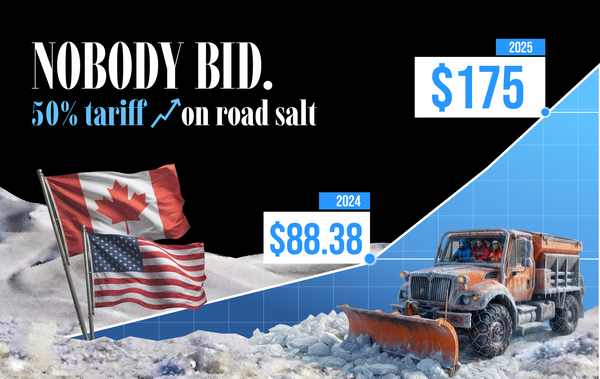
Donald Trump posted this week that Keystone XL “may be awoken from the grave,” hours before American levies on $20 billion of Canadian goods were due to take effect, and alongside an agreement to postpone new 50% tariffs by three days. Those tariffs were invoked under Section 338 of the Tariff Act of 1930, a Depression-era provision that has rarely, if ever, been used. Alberta is understandably interested, and Mark Carney had himself raised reviving the pipeline in earlier talks. TC Energy’s own filings show that when the permit was revoked in 2021 the carrying value of Keystone XL fell from $3.3 billion to an estimated fair value of $175 million, a markdown of about 95%, and the company took a $2.8 billion impairment. Alberta’s $394 million of interests were repurchased for a nominal amount, the province paid off a billion-dollar guaranteed credit facility, and analysts put its total loss at around $1.3 billion.
TC Energy sued the United States for $15 billion in damages, and in 2024 the international tribunal threw the claim out on jurisdictional grounds. Written down, sued, recovered nothing. Alberta’s rationale for putting public money in had been to get construction far enough along that cancelling it would be politically difficult, which is the standard defence against political risk, and it did not work. Meanwhile the company that would have to build the pipeline no longer exists in the same form, because TC Energy spun its liquids pipelines into South Bow in 2024, and South Bow said in February that it had moved on from Keystone XL, adding this week that it was not privy to the discussions between officials. What it is actually evaluating, now with the American operator Bridger Pipeline, is a different and smaller project: 550,000 barrels a day from Alberta into Wyoming, with a decision due by the middle of 2027, reusing some of the pipe still lying in the ground in Alberta but not the American route that was cancelled.
The business case is strong. American shale output is expected to slide from around 13 million barrels a day to 8 million over the next decade, Canada already supplies more than 4 million barrels a day and roughly 60% of US crude imports, and analysts increasingly expect peak demand to arrive later than assumed at exactly the moment Middle Eastern supply carries a permanent disruption premium. The obstacle is not geology and may not even be permits. Two new pipelines imply something like $100 billion of oil sands expansion, and Canadian producers have spent a decade being rewarded by shareholders for returning capital rather than growing, so as one Canadian fund manager put it, investors want return of capital and that reduces growth spending. Ottawa and Alberta agreed in May to build a line to the west coast carrying a million barrels a day to Asia, specifically to reduce dependence on the United States. One pipeline deepens the relationship and the other diversifies away from it, and both need tens of billions of dollars. The permit that decides whether any of it exists gets reissued every four years by someone who was not part of the deal.
Badminton’s World Championships opened in New Delhi this week with an unusual line of defence: three professional mimics hired to imitate the grunts and whoops of the grey langur, because rhesus macaques are terrified of them (hired a big monkey to scare a smaller monkey). One of the men told the Indian Express the skill has been passed down through generations of his family. They are the last layer of a ₹20 crore renovation, about $2.3 million, or roughly twice the prize money of the tournament that caused the problem, after a single macaque wandered into the stands at January’s India Open and the photographs went around the world. Real langurs used to do this work until 2012, when hiring them was banned under the Wildlife Protection Act, at which point the demand stayed exactly where it was and the supply switched species. India is bidding for the 2030 Commonwealth Games and the 2036 Olympics, and the last Delhi Games cost $6 billion. Basically New Delhi has money whisperers to scare naughty monkeys.
“Well done is better than well said.” — Benjamin Franklin
Have a fantastic weekend. I welcome feedback and please forward this if you see fit.
Many thanks,
Sam.
Market Snapshots
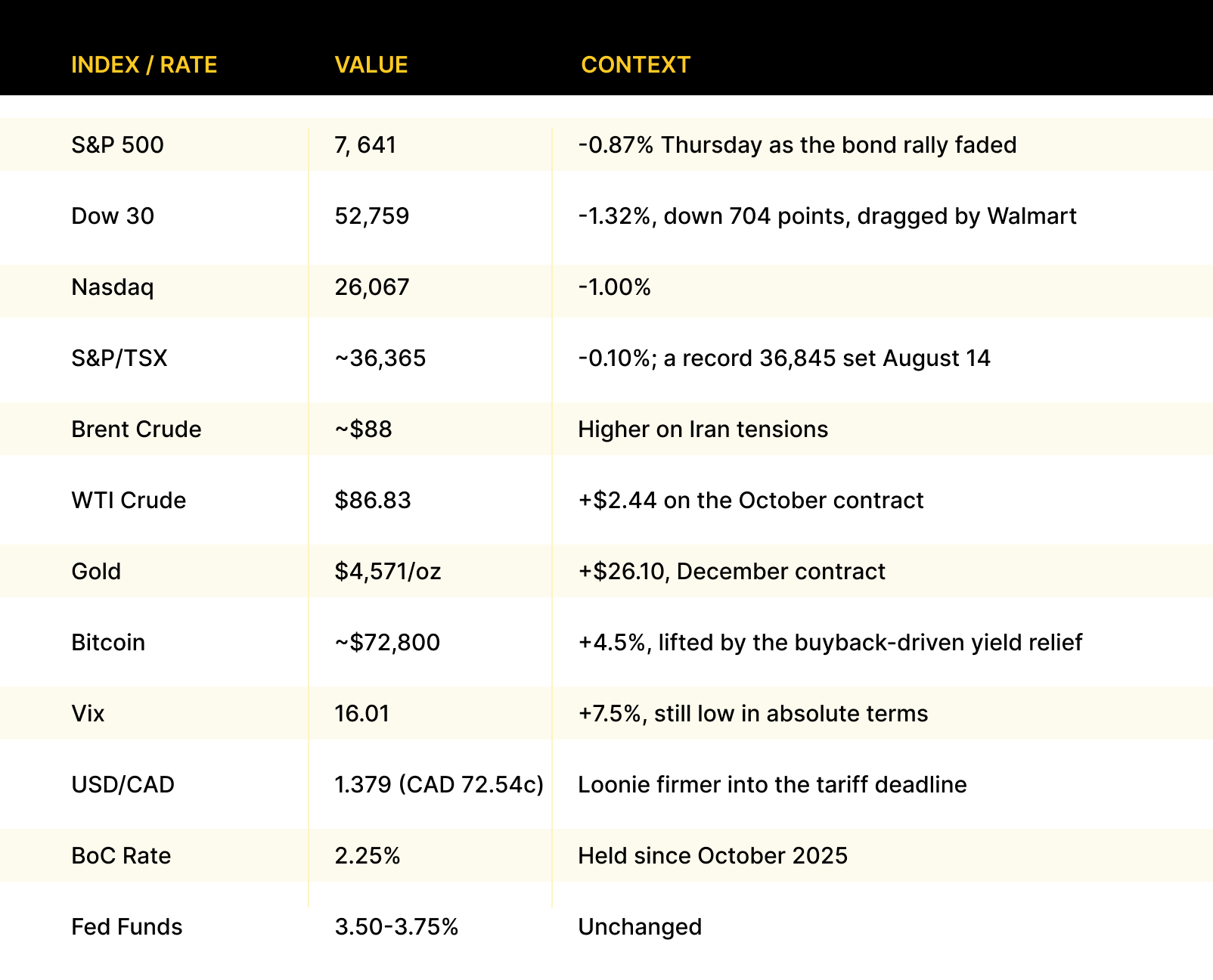
Note: the week belonged to the bond market. The 30-year Treasury yield hit its highest level in nearly twenty years, prompting the Treasury Department to announce it would at least double buybacks of 10, 20 and 30-year debt. Yields duly fell on Wednesday and equities rallied, then on Thursday yields climbed straight back above where they started and the Dow shed 704 points, which is a fairly blunt verdict on whether a buyback programme can hold down the cost of financing a deficit. Walmart did not help, falling 9.2% on the slowest quarterly sales growth in over six years. Oil pushed higher after the President promised a crushing economic operation against Iran, with further sanctions flagged for next week, and the Treasury Secretary suggested the buyback could grow beyond the $4 billion announced. In Canada, the 50% tariffs on wine, hockey sticks and a range of other goods were postponed to end of day today while both governments talked up a framework deal neither has detailed. The Bank of Canada remains at 2.25%.
1 USD = 1.379 CAD = 0.88 EUR = 0.75 GBP at Thursday spot.
Sources
NASA/JPL, CNN, EarthSky, BBC Sky at Night (opener); Nasdaq, Bloomberg, Euronews, Investing.com, Troutman Pepper Locke, SEC approval order (Nasdaq); Reuters, STAT, CNBC, BioPharma Dive, Leerink, Morningstar (Moderna and Merck); swissinfo.ch, Financial Times, Reuters, Bloomberg, Swiss Federal Council, UBS (Swiss regulation); Wall Street Journal, PSQ Holdings filings and releases, Stockopedia, TipRanks (PublicSquare); Financial Times, TC Energy SEC filings, CBC, Canada’s National Observer, EnergyNow (Keystone XL); Reuters, PTI, BBC, NPR, Business Standard, Olympics.com (closer); CNBC, BNN Bloomberg, TheStreet, Yahoo Finance, Schwab, Bank of Canada (market data).
Market data pulled Friday August 21, 2026 using August 20 closes. Live items this edition: the Canada-US tariff deadline falls at end of day today and neither government has released the terms of the framework they announced, so the Keystone position may have changed by the time you read this; Moderna’s share price has moved violently in both directions on two consecutive days and no detailed trial data has yet been published or peer-reviewed; the Swiss consultation runs to November 19 and the upper house committee vote on UBS capital resumes August 31; Nasdaq’s December start still depends on further regulatory sign-off; and the badminton championships in Delhi run until August 23, so the monkeys have not yet had the last word. Currency at Thursday spot rates.