WhatApp Super App, Tariffs Again, Ozempic Increases Deficits, Black Friday? No Thanks and US to confirm Aliens?

58th Edition
Greetings folks and a warm welcome to the 58th Edition of Friday Finance,
A SpongeBob trading card of Squidward’s self-portrait, Bold and Brash, just sold for $58,560 at the auction house Goldin. In the 2001 episode, a critic looks at the painting and says it “belongs in the trash.” A janitor then throws it in the trash. The card is a Topps gold foil Superfractor, the only one in the set, graded PSA 8. Bidding opened at $5,000 in October and drew 27 bids, about 11.7x the starting price. It’s only the second most expensive card from the set: a red foil SpongeBob card sold for $61,610 in September. Today I learnt that there is a market for trading SpongeBob trading cards. Let's get right to it.
WhatsApp eSIMs
TL;DR: WhatsApp says it will soon sell travel data eSIMs inside the app, with carriers including Verizon and Reliance Jio. Canadians pay their carriers up to $18 a day to roam. Airalo, the biggest travel eSIM app, already has 30 million customers.
WhatsApp says it will start selling travel data eSIMs inside the app “in select countries soon.” An eSIM is a SIM card built into the phone, downloaded instead of inserted. Travellers would pick a destination and a data plan, and the eSIM would switch on when they land. Your main SIM and phone number stay the same, so WhatsApp keeps working on your usual number. WhatsApp hasn’t announced prices, countries or a launch date. Code in a test version of the Android app shows users could top up data and reuse the eSIM on later trips.
The partners named so far include Verizon in the US, Reliance Jio in India and Smart Axiata in Cambodia. WhatsApp’s head, Kunal Shah, says the company is “starting our early explorations.” Meta hired Shah in June and invested $900 million in his fintech company, Cred. Meta wants WhatsApp to become a “superapp,” with payments and other services built in. India is its biggest market, with more than 500 million users.
Canadians pay a lot to roam. Telus charges $16 a day in the US and $18 a day elsewhere, and Rogers charges about the same. Bell charges $13 and $16. A 2-week trip to Europe on Telus costs $252 in roaming fees. Although some plans include unlimited roaming. Airalo, the biggest travel eSIM app, says it passed 30 million customers in June. GSMA Intelligence expects eSIM phone connections to outnumber regular SIM cards by 2030. Meta thinks this is revolutionary. China has had a super app, WeChat, for years. Also known as the ultimate surveillance app.
New Tariffs
TL;DR: The US proposed new tariffs of up to 35% on 14 economies, from China to the EU, saying they make more than the world needs. It’s using a different law after the Supreme Court struck down Trump’s last round in February. Canada isn’t on the list, and markets barely moved.
The US has proposed new tariffs on all goods from 14 economies, saying their factories produce more than the world needs. Vietnam faces up to 35%, India up to 25%, and China and Singapore up to 20%. The EU, Japan, South Korea, Taiwan and Switzerland are capped at 15%, matching trade deals they signed over the past year. Bangladesh, Cambodia, Indonesia, Malaysia and Thailand face 18%. Nothing takes effect yet. Public hearings start on January 25.
China’s rate could double. US Trade Representative Jamieson Greer says it would rise to 40% if the US–China trade truce isn’t extended before it expires on January 10. China’s trade surplus passed $1 trillion in the first 10 months of this year. India would pay 17% instead of 25% if it signs a deal, and Vietnam 20% instead of 35%. The US also proposed separate tariffs on Brazil, including 10% on finished aircraft. Canada wasn’t investigated, so it isn’t on the list. Mexico was, but there’s no decision on it yet.
The new tariffs use Section 301 of the Trade Act of 1974. In February, the Supreme Court ruled 6–3 that Trump’s earlier global tariffs, imposed under a national emergencies law, weren’t allowed. The US had collected $133 billion under those tariffs by mid-December last year, and companies are lining up for refunds. Trump said, “We’ll end up being in court for the next five years.” Markets barely moved on the new proposal. European and Asian stocks rose on Thursday, and an HSBC economist said the tariffs were “baked in.” Interestingly, the dates on when the tariffs will be imposed haven’t been announced. That will be known on the next edition of the Apprentice.
Ozempic and the Deficit
TL;DR: Oxford Economics says Medicare coverage of weight-loss drugs will add about $107 billion to the US deficit by 2034, roughly 3 times the CBO’s estimate. It expects nearly 60 million Americans to be on GLP-1s by 2030. In Canada, generic Ozempic already costs about a third of the brand.
Oxford Economics says Medicare coverage of weight-loss drugs like Ozempic and Mounjaro will add close to $18 billion a year to the US deficit by 2034. That’s about $107 billion from 2026 to 2034, roughly 3 times what the Congressional Budget Office estimated. Oxford expects nearly 60 million Americans to be on GLP-1 drugs by 2030. JPMorgan forecast 25 million in February. More than 1.1 million Medicare patients signed up for discounted GLP-1s in a pilot this year. The US deficit was $2 trillion in the last fiscal year, 6.2% of GDP.
The prices come from a deal a year ago. Novo Nordisk and Eli Lilly agreed to sell their GLP-1s to Medicare and Medicaid for $245 a month, down from as much as $1,350. Medicare patients pay a $50 copay. There are some offsets. Oxford says up to 480,000 more Americans could be working by 2030, adding taxable income. A 2024 Cornell study found households with a GLP-1 user cut grocery spending 5.3% within 6 months, and savory snacks 10.1%.
Canada was the first G7 country with generic semaglutide, the drug in Ozempic. Health Canada approved Dr. Reddy’s version in April and Apotex’s in May. Ontario lists the generic at $78.14, against $227.94 for Ozempic, about a third of the price. In June, Apotex’s Sevmia became the first generic version of Wegovy for weight loss. Novo Nordisk’s patents run until 2032 in the US and 2031 in Europe. Spending on weight-loss drugs in Canadian private drug plans rose 61% last year.
Black Friday? No Thanks
TL;DR: Some brands are skipping Black Friday this year to protect their margins. Italian fashion label Pinko expects to give up about €2 million in sales. Deloitte says Canadians plan to spend 14% less on the holidays, the lowest since it started tracking.
Some brands are sitting out Black Friday. Italian fashion label Pinko is skipping it for the first time, and expects to give up about €2 million ($2.2 million) in sales. Its chairman says discounting can become a “vicious cycle,” and the hit to profit is bigger than the hit to revenue. REI closes its stores and gives staff the day off. The Ordinary, owned by Estée Lauder, shuts its stores and runs blood drives in New York and Toronto instead. UK beauty brand UpCircle still offers 25% off. It calls Black Friday “the antithesis” of its values, but makes 20% of its yearly online sales in the 3 weeks around it.
Adobe expects a record $12.9 billion of US online sales on Black Friday, up 9.2%. US online spending from November 1 to 22 was $82.5 billion, up 9.1%. The NRF expects November and December sales to pass $1 trillion for the first time. It also expects 182.7 million people to shop over Thanksgiving weekend, down from 202.9 million last year. PwC expects US holiday spending to rise 5.4%, but only 2.8% after inflation.
Canadians are cutting back. Deloitte expects them to spend $1,305 on the holidays, down 14% from last year and the lowest since it started tracking. Spending on holiday entertaining is expected to fall 22%, and on travel and dining out 20%. 78% plan to hunt for discounts, and Deloitte expects half of holiday budgets to be spent by the end of Cyber Monday. 39% plan to use AI to help them shop, but only 19% would let AI make the purchase.
The Truth Is Out There
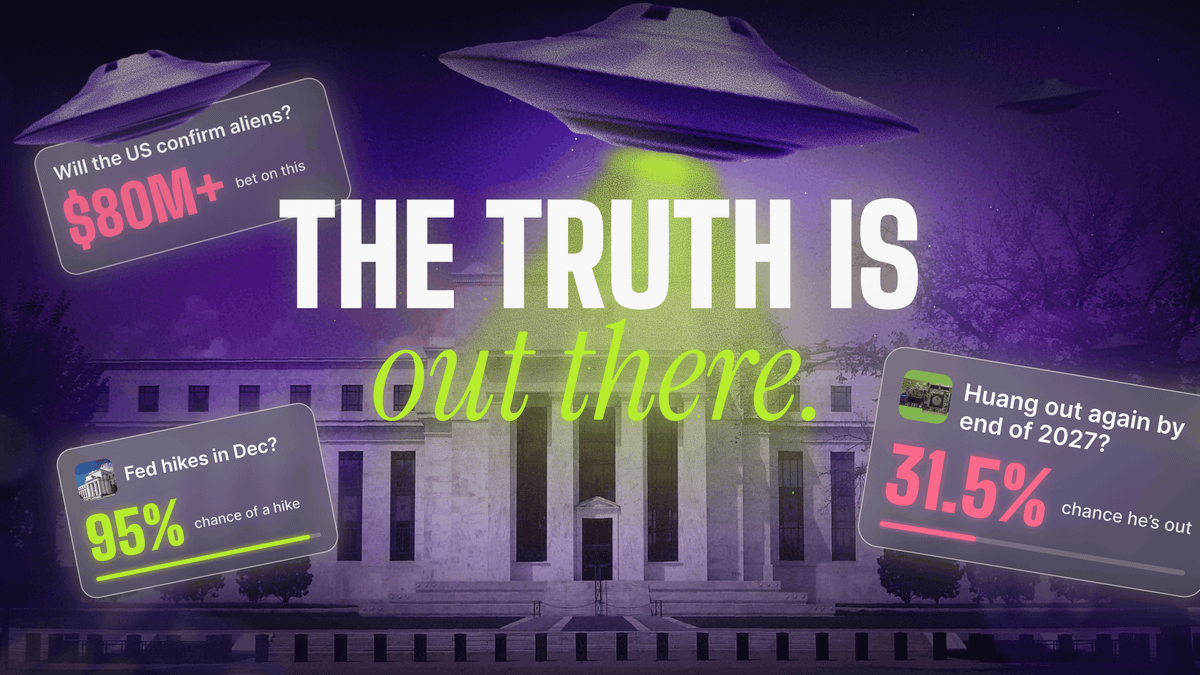
TL;DR: Traders put a December Fed hike at 95%. They give Jensen Huang, reinstated as Nvidia’s CEO on Monday, a 7.5% chance of leaving again this year. They have also bet more than $80 million on whether the US will confirm aliens exist.
Macro: will the Fed raise rates in December? Traders put a 25 basis point hike at 95% on Polymarket and 93% on Kalshi, up from 92% two weeks ago. About $94 million has been bet between the two. On Wednesday, the Fed’s preferred inflation measure, PCE, showed prices up 3.8% from a year earlier. Third-quarter growth was revised up to 4.3%. Polymarket gives no change 4%. The decision is on December 9.
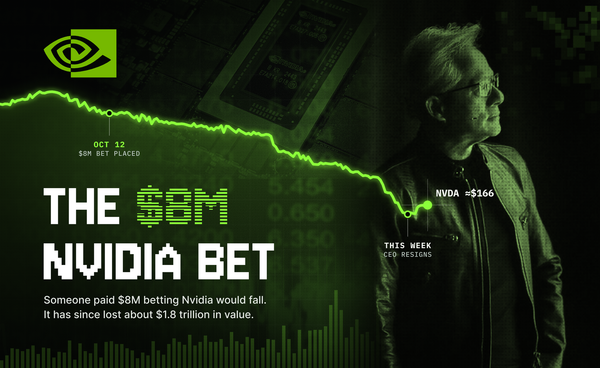
Corporate: will Jensen Huang leave Nvidia again? Nvidia announced Huang’s resignation on November 12. On November 17, the board said it didn’t plan to bring him back. On November 23, it reinstated him. Polymarket gives a 7.5% chance he’s out again by December 31, 18.5% by the end of March and 31.5% by the end of 2027. About $1.6 million has been traded. Under the rules, statements made “in sarcasm or jest” don’t count.
Wildcard: will the US confirm that aliens exist? Polymarket gives a 1.35% chance that the US confirms extraterrestrial life or technology exists by December 31. About $48 million has been traded on that date, and more than $80 million across all the dates. It pays out if the President, a Cabinet member, a member of the Joint Chiefs of Staff or any federal agency “definitively states” it. Every earlier deadline this year, from March to October, has paid out “No.”
An AI agent has bought pizza in the UK without a bank card. It ordered 9 mini margherita pizzas from Papa John’s and paid straight from the customer’s Lloyds account, using payment technology from TrueLayer. The agent never saw an account number or a password. The customer set a limit per order and per month, and approved the payment in their banking app. It ran inside the Financial Conduct Authority’s sandbox, a supervised trial for new financial technology. TrueLayer’s chief executive said, “Today it’s pizza. Tomorrow it’s everything else.” He also called today “possibly the last Black Friday as we know it.” The AI has finally learned to order pizza without a card. It still can't explain why it needed nine. Couldn’t it just order 2 large pizzas?
“Beware of little expenses; a small leak will sink a great ship.” — Benjamin Franklin
Have a fantastic weekend. I welcome feedback and please forward this if you see fit.
Many thanks,
Sam.
Market Snapshots
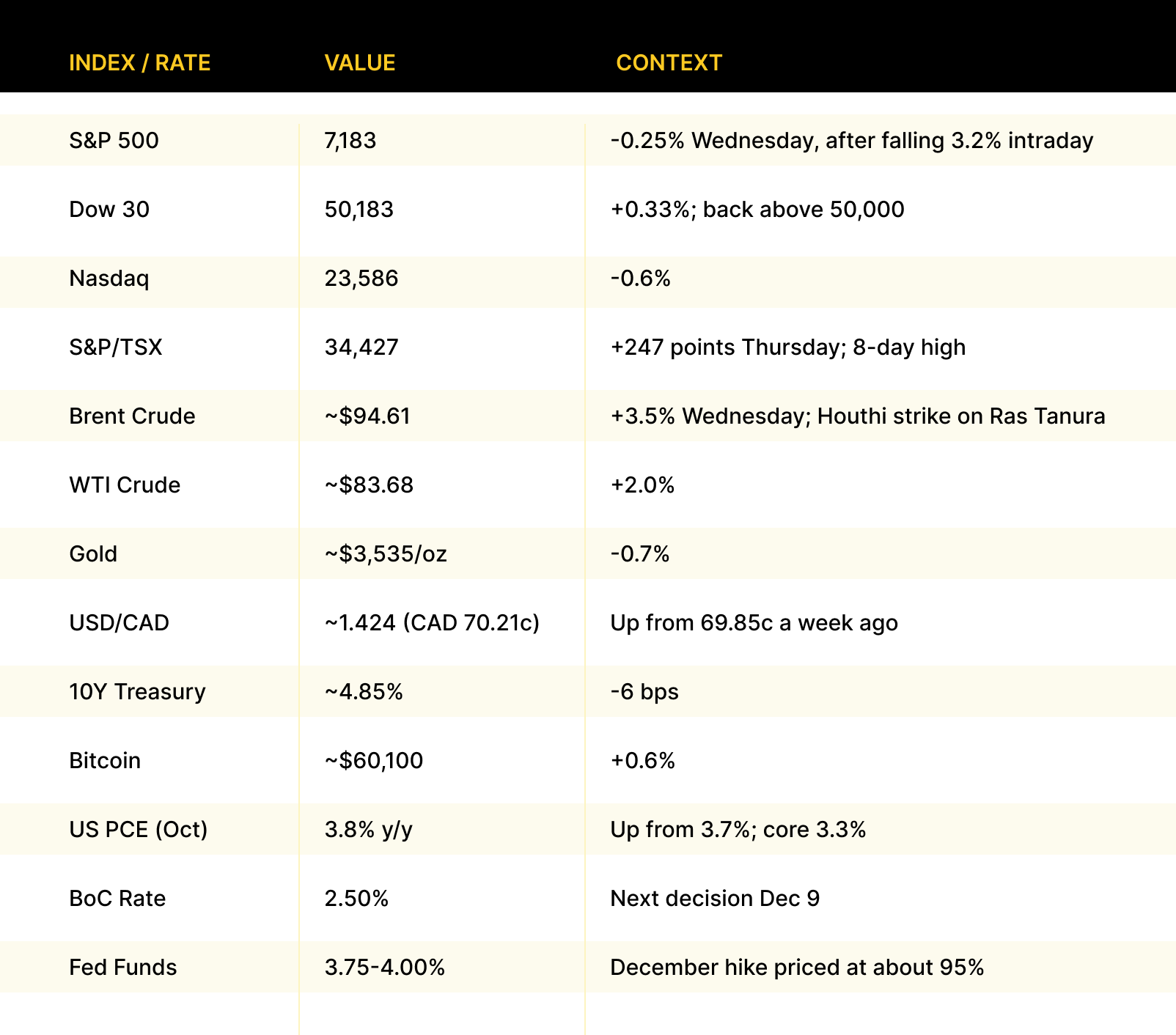
Note: US markets were closed Thursday for Thanksgiving and close early today. On Wednesday, the S&P 500 fell as much as 3.2% in an AI-led selloff before closing down 0.25%, and the Dow finished back above 50,000. Nvidia fell 3.9% and is down about 27% in November. October PCE inflation rose to 3.8% from a year earlier, and third-quarter growth was revised up to 4.3%, so a December Fed hike is close to fully priced. The US proposed new tariffs on 14 trading partners. Brent rose 3.5% after a Houthi strike on Saudi Arabia’s Ras Tanura refinery. In Canada, the TSX rose 247 points on Thursday to an 8-day high, led by energy and mining, and the loonie is at 70.21 US cents.
1 USD = 1.424 CAD at Thursday’s close.
Sources
ComicBook.com (opener); MediaNama, Particle News, TechCentral, MobileSyrup, Airalo (WhatsApp); Investing.com/Reuters, GHY International, NPR (tariffs); Fortune, CBO, CBS News, HealthBiz (GLP-1s); Investing.com/Reuters via WHBL, Adobe/NRF/PwC via roic.ai, Retail Insider/Deloitte (Black Friday); Polymarket, Kalshi, SEC filings, NPR (prediction markets); The Guardian via The Outpost, explainx (closer); Capp Notes, BNN Bloomberg (market data).
Market data pulled Friday November 27, 2026, using November 25 US closes (US markets were closed November 26) and the November 26 TSX close. Prediction market odds were read live on Polymarket and Kalshi on Friday morning. The US tariff rates are proposals and not in effect. The GLP-1 deficit figures are Oxford Economics estimates. WhatsApp has not announced prices, countries or a launch date for its eSIMs. TrueLayer’s “first” claim is the company’s own. Currency at Thursday’s close.