Saudi storing oil in Singapore, DoorDash buys Instacart, Oil to stay above $100, Kushner is hacked and Intel plunges

54th Edition
Greetings folks and a warm welcome to the 54th Edition of Friday Finance,
The ultra-rich are running out of places to park. McKinsey estimates there were about 210,000 yachts longer than 12 metres (39 ft) in the world last year, competing for about 160,000 suitable marina berths. The fleet grows by about 8,000 yachts a year. A new marina takes 5 to 10 years to build and adds about 300 berths. Port Vauban in Antibes has 1,500 berths, and just 18 of them take superyachts over 54 metres (177 ft). A former executive of the 80-metre (262 ft) yacht Savannah told the Financial Times that docking it at top ports in peak summer costs about €3,500 (US$4,000) a night. Some fees have doubled in a decade. Private equity has noticed. Blackstone paid $5.65 billion for Safe Harbor Marinas last year. In August, Safe Harbor agreed to buy MarineMax for $1.5 billion, almost double its share price. InfraVia bought the Mediterranean operator D-Marin from CVC this year for more than €1 billion. Running out of parking for yachts is actually a problem now. Let's get right to it.
Saudi Oil Under Singapore
TL;DR: Saudi Aramco will store crude in caverns 150 metres under Singapore from 2027, to keep oil close to Asian customers while Hormuz stays dangerous. The caverns hold about 9 million barrels. That is less than half a day of what passed through Hormuz before the war.
Saudi Arabia is going to store oil in caves under Singapore. Saudi Aramco signed a preliminary deal on Monday to use the Jurong Rock Caverns, about 150 metres underground beneath Jurong Island. They can hold about 9 million barrels. Storage is due to start in the second half of 2027, and the final terms should be agreed in a few months. Singapore’s energy minister said it “enhances the resilience of the Saudi crude oil supply chain in Southeast Asia.” Before the Iran war, Asia got about two-thirds of its oil from the Middle East. Most of it came through the Strait of Hormuz. Ships are getting through, but there were at least 30 attacks on ships in and around the Strait in October, a monthly record.
The caverns opened in 2014 and cost S$950 million. They are 5 caverns, each 340 metres long and 9 storeys high, with room for about 600 Olympic swimming pools of oil. Singapore built them underground because it is short of land. It saved about 60 hectares on the surface. This is not Aramco’s first stash in Asia. It already keeps 8.2 million barrels in Okinawa, Japan, and 5.3 million barrels in Ulsan, South Korea. In both, the local government gets first call on the oil in an emergency. Saudi Arabia can also pipe oil across the country to the Red Sea, avoiding Hormuz. That route has its own problem: the Houthis.
Before the war, about 20 million barrels a day passed through Hormuz. The caverns hold less than half a day of that. At about $118 a barrel, 9 million barrels is worth about $1 billion. Canada is the only G7 country with no strategic oil reserve. As a net exporter, it doesn’t need one under the International Energy Agency’s rules. When the IEA released 400 million barrels from emergency stocks in March, Canada pledged 23.6 million barrels from supply instead. It’s ironic that we take oil out of the ground to put it back into the ground.
DoorDash to Buy Instacart
TL;DR: DoorDash agreed to buy Instacart for about $17 billion, or $65 a share. In 2021 Instacart was valued at $39 billion, and DoorDash’s first attempt fell apart over price and antitrust. The deal won’t close until late 2027 or early 2028, and Instacart trades about 14% below the offer.
DoorDash has agreed to buy Instacart for about $17 billion, or $65 a share in cash and stock. That is 26% more than Instacart was worth before talks were reported. The deal isn’t expected to close until the end of 2027 or early 2028. Instacart’s shares traded around $57 on Thursday, about 14% below the offer. DoorDash will keep the Instacart brand and app, and the two companies will run separately until then. DoorDash’s chief executive, Tony Xu, said “grocery is one of the hardest things to get right online.” Uber also held talks, but walked away.
This is DoorDash’s second attempt. It bid for Instacart in 2021, when Instacart was valued at $39 billion. Those talks fell apart over price and antitrust concerns. Instacart went public in 2023 at $30 a share, valuing it at $9.9 billion. It now makes money. In the quarter to June it handled 90.3 million orders and earned $111 million. It spent $325 million buying back its own shares. It is also shutting down its smart shopping cart business. DoorDash bought the British delivery company Deliveroo last year for $3.7 billion.
DoorDash is built on restaurants. Instacart is built on groceries, working with more than 2,200 retailers and nearly 100,000 stores. Both are up against Amazon and Walmart in grocery delivery. Semafor reports the deal would likely face few antitrust problems under the Trump administration. Senior Democrats have said they will scrutinize mergers if they win the November 3 midterms. In Canada, Loblaw has worked with both. In 2022 it signed a delivery deal with DoorDash to compete directly with Instacart, which already delivered from its stores.
Oil Back Above $100
TL;DR: Brent was about $118 on Friday morning, 62% above its pre-war price, even with peace talks going on. The oil is moving, but shipping it is dangerous and the US emergency reserve is at its lowest since 1982. Alberta budgeted for $60 oil, then the Canadian heavy oil discount blew out.
Oil is back above $100. Brent was about $118 a barrel on Friday morning, after an outbound tanker was attacked in the Strait of Hormuz on Thursday. It was $72.48 the day before the Iran war began in February. It went above $125 in the spring, then fell back below its pre-war price in June as tankers moved through Hormuz and peace talks went ahead. Today it is about 62% above where it started. On Monday Iranian officials met representatives from Saudi Arabia, Turkey and Pakistan, and they agreed to keep talking. Iran says US sanctions and the blockade of its ports have to be dealt with first.
Standard Chartered says a real deal would take some of the risk out of the price quickly, but expects oil to stay high for months. The oil itself is moving. Gulf exports through Hormuz and the bypass pipelines averaged about 18.8 million barrels a day in the first 3 weeks of October, against 19.9 million before the war. Shipping it is the problem. Tankers are scarce and freight rates are up. Governments also have to refill their emergency stocks. The US Strategic Petroleum Reserve is down to about 283 million barrels, the lowest since 1982. It held 415 million before the war, and about 200 million barrels are due back. UBS expects Brent near $110 at the end of the year.
Alberta’s budget assumed oil at $60 a barrel this year. US crude is now about $104. In April the C.D. Howe Institute estimated higher prices could add more than $14 billion to the province’s revenue this year. The catch is the discount on Canadian heavy oil. Alberta budgeted for $12.90 a barrel. This week it widened to more than $30. C.D. Howe estimates each extra $1 of discount costs the province about $670 million. At $30, that is about $11 billion a year less than the budget assumed. On Wednesday, Bank of Canada raised its rate to 2.5%, worried that high energy prices are spreading to other prices.
Kushner’s Hacked Phone
TL;DR: A new book alleges Dutch spies watched Jared Kushner’s iPhone screen in 2018 as he logged into a UAE bank account, and that Saudi Arabia and the UAE put at least $2 billion into accounts he could use. The money allegedly moved through Azerbaijani banks for a 6% to 7% fee. Kushner, Trump and everyone named deny it.
A new book alleges that Dutch military intelligence hacked Jared Kushner’s iPhone in 2018 and watched him log into a bank account in Abu Dhabi. The book, Princes and Thieves by Matthew Cole, was excerpted in Vanity Fair last week. Cole says the Dutch got in after turning a Russian military intelligence hacker caught in the UK, then finding screenshots of Kushner’s phone on a Russian server. He alleges Saudi Arabia and the UAE put at least $2 billion into accounts Kushner could use while he was a White House adviser. About $750 million allegedly went into an account at First Abu Dhabi Bank. It was owned by a UAE government-funded charity, with Kushner as a signatory. About $1 billion allegedly went to Israel’s central bank. The book relies on unnamed sources and publishes no bank records.
According to the book, every dollar in the Abu Dhabi account came from a bank in Azerbaijan. Cole says some Azerbaijani banks will take Saudi riyals or Emirati dirhams into one account and send the same value in US dollars from another. The fee is about 6% to 7%. On $750 million, that would be $45 million to $53 million. To an auditor, the money looks like it came from Azerbaijan. White House staff with security clearances must disclose any account they can sign on. The book says Kushner never did. A former prosecutor on the Mueller investigation told Cole that taking money in return for influence could breach bribery and foreign agent laws.
Kushner called the claims “completely insane” and said they “never happened.” He says the author offered no bank statements, wire records or account numbers, and his lawyer says they plan legal action. Trump called it “a totally false story.” Former ambassador David Friedman, who the book says passed messages for Kushner, called it “100% false.” The Dutch government hasn’t commented. Some of the Gulf money is on the public record. 6 months after Kushner left the White House, his new investment firm, Affinity Partners, got $2 billion from Saudi Arabia’s sovereign wealth fund. By 2024 it had earned about $157 million in fees from foreign investors, $87 million of it from the Saudi government, without returning a profit. In 2018 his family’s tower at 666 Fifth Avenue had a $1.2 billion mortgage coming due. Toronto’s Brookfield took a 99-year lease on the building and paid the rent upfront. Don’t worry, there is nothing to see here.
Intel Plunges
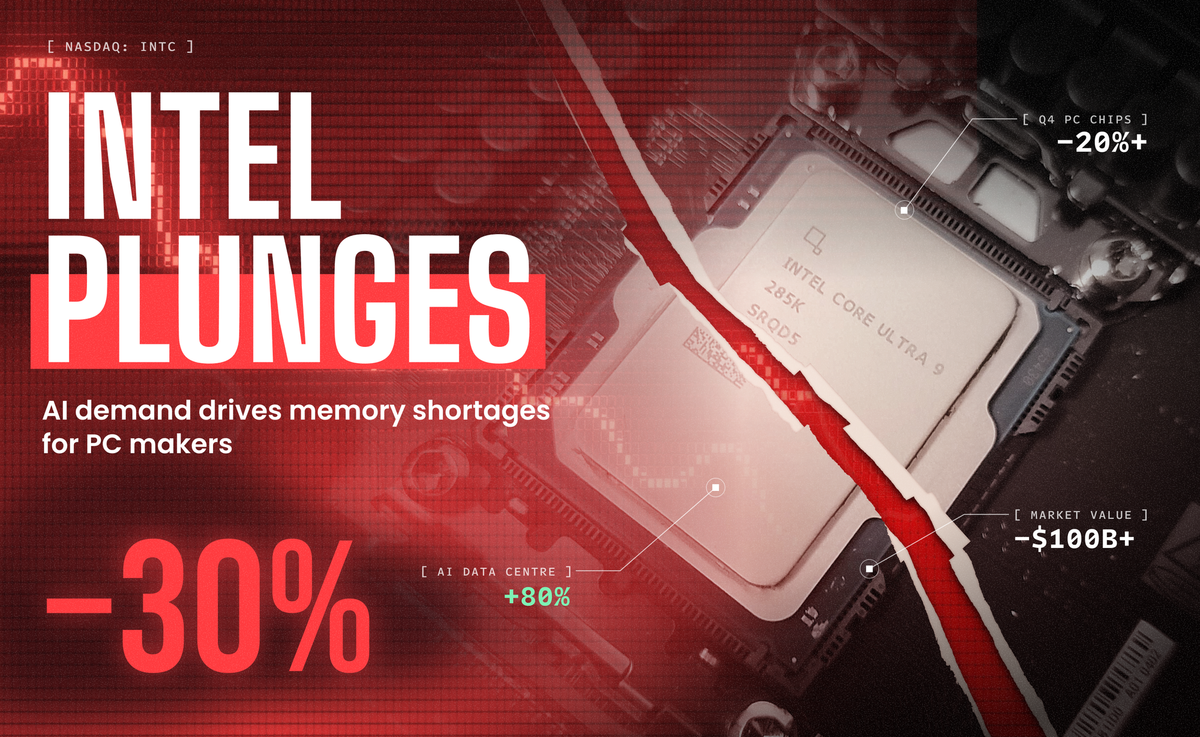
TL;DR: Intel beat on the quarter and its AI data centre business grew about 80%. Then it warned PC chip sales will fall more than 20%, because AI is eating the world’s memory chips. The stock fell about 29% on Friday morning, on track for its worst day since 1974.
Intel shares fell about 29% on Friday morning, to around $65. If that holds, it is the company’s worst day since 1974, and it wipes out more than $100 billion of market value. The quarter itself was good. Revenue rose about 20% to $16.5 billion. Its data centre and AI business grew about 80%, the fastest in 15 years. The problem was the forecast. Intel expects fourth-quarter revenue of $15 to $16 billion, against about $17 billion expected. It expects PC chip sales to fall more than 20% from the third quarter. The stock had started the year at $39 and closed Thursday at $92.
AI is soaking up the world’s memory chips. Memory makers are shifting production to AI data centres, leaving less for laptops and desktops. In February TrendForce forecast PC memory prices would more than double in the first quarter alone. Intel can sell the processors, but PC makers can’t get affordable memory to go with them. Chief executive Lip-Bu Tan said the slump will last “until memory availability and prices begin to normalize.” Intel now expects the PC market to shrink about 12% this year and 10% next year. It also lost about $300 million of sales after an explosion on October 14 at its plant in Kiryat Gat, Israel, which killed 2 workers. Dell fell 13% on Friday and AMD 10%. Nvidia, which barely sells into PCs, fell 3%.
In August 2025 the US government took about 10% of Intel, buying 433 million shares at $20.47 with $8.9 billion of grants Intel had already been promised. At Thursday’s close that stake was worth about $40 billion. On Friday morning it was worth about $28 billion. Nvidia bought $5 billion of Intel shares at $23.28 last year. Intel is also spending heavily on its own factories, and expects no positive free cash flow next year. Its foundry business lost $1.9 billion last quarter, and outside customers brought in only $411 million of revenue. Amazon fell more than 12% on Friday after reporting it had burned more than $42 billion of cash in a year on AI.
A cruise ship that sold cabins as permanent homes has stopped in Cambodia. The Villa Vie Odyssey left Belfast in 2024 on a 3.5-year voyage around the world, after 4 months stuck there for repairs. Cabins sold for $120,000 to $440,000, or rented from $3,500 a month. The company says fuel now costs up to $8,000 a month per cabin in parts of Asia, up from about $1,800. Residents got about 7 hours’ notice to get off, and Bloomberg says about 200 were aboard. The company says no outcome is assured. Days after the 2024 election, it had launched a 4-year package for Americans who said they’d leave the country if their candidate lost. They bought a permanent home to escape American politics, only to discover their new home also had soaring housing costs, an energy crisis, and deportations.
“A ship in harbor is safe, but that is not what ships are built for.” — John A. Shedd
Have a fantastic weekend. I welcome feedback and please forward this if you see fit.
Many thanks,
Sam.
Market Snapshots
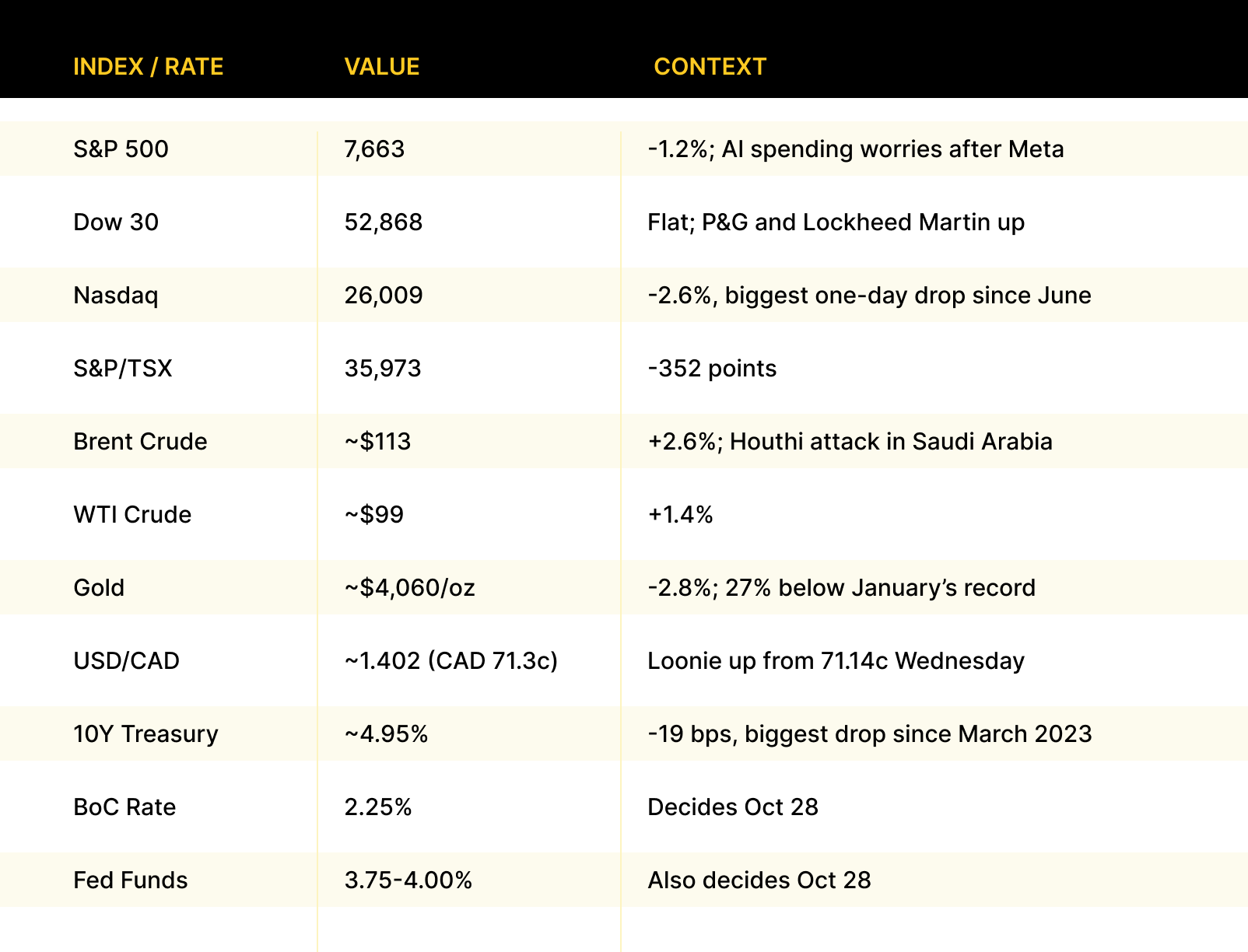
Note: Meta’s results revived worries about AI spending. The Nasdaq fell 2.6% on Thursday, its biggest one-day drop since June. The Dow finished flat on gains in Procter & Gamble and Lockheed Martin. A Houthi attack in Saudi Arabia pushed Brent to about $113, near a 5-month high. Money moved into Treasuries, and the 10-year yield fell about 19 basis points, its biggest one-day drop since March 2023. Gold fell 2.8%. In Canada the TSX lost 352 points, while the loonie edged up to 71.32 US cents. The Bank of Canada and the Fed both decide on October 28.
1 USD = 1.402 CAD at Thursday’s close.
Sources
Bloomberg, ABC Nyheter, Protos (opener); CNBC via CoinDesk, TechCrunch, Market Chameleon, The Next Web, MarketBeat, Wikipedia (Bending Spoons); BBC, SiliconANGLE, Forbes, Crypto Briefing, WIRED via Zetik, Baker Tilly, Wikipedia (Meta and Prop 40); The Wall Street Journal, FSR Magazine, Nation’s Restaurant News, Fortune, Wikipedia (Golden Corral); The Guardian, Reuters via Business Recorder, TechCrunch, The Tech Portal, HDFC Sky, Business Standard (Jio); Euronews, Futurism, Mugglehead, BNN Bloomberg, Cabin Radio (lab-made gold); Fox News citing KVUE, Wikipedia, QSR Magazine (closer); Yahoo Finance, TradingKey, BNN Bloomberg (market data).
Market data pulled Friday October 23, 2026 using October 22 closes. Meta’s closing price is approximate. Live items this edition. Jio’s subscription figures are a snapshot at the close of bidding, and listing is expected October 28. Marathon Fusion’s gold claim has not been independently verified. Nohemi Castillo’s claims are allegations in a lawsuit. Prop 40 is on the November 3 ballot. Currency at Thursday’s close.