Samaya Vs Wall St, Epstein ATM, SpaceX's Chip Bonds, Java4Shell and Elon's Thumbs

57th Edition
Greetings folks and a warm welcome to the 57th Edition of Friday Finance,
KOHO, the Toronto fintech, says users took about $5.2 million through a glitch over Halloween weekend. They started a bill payment and cancelled it straight away. KOHO’s system credited the cancelled amount back, even though no money had left. Users then sent the money out by e-Transfer, more than 1,600 times, up to $5,000 at a time. KOHO shut off bill payments on the afternoon of November 1, about 42 hours after it started. A Toronto judge has frozen 987 receiving accounts at 23 institutions, including all of the Big Six banks. By November 7, only about $234,000 had been confirmed as recoverable. It’s the second time: in 2020 a similar glitch with cancelled transfers cost KOHO about $1 million. KOHO was valued at $1.33 billion in June, and it has been trying to get a banking licence since 2021. A real life money glitch! Let's get right to it.
Samaya vs Wall Street
TL;DR: Fortune let an AI start-up called Samaya forecast the third-quarter results of 50 big companies. It beat the Wall Street analyst consensus 40 times out of 50. It mostly lost on the giants, where analysts have private research it can’t see.
Fortune’s Jeff John Roberts asked Samaya, a financial AI start-up, to forecast third-quarter results for 50 large companies, from Coca-Cola to Carvana. Each forecast came at least a day before the company reported, and was compared with the analyst consensus on Bloomberg. Samaya was closer to the actual number 40 times out of 50. For Palantir, it forecast $2.30 billion of revenue. Palantir reported $2.31 billion, and analysts had expected $2.18 billion. For Permian Resources, Samaya got earnings per share exactly right, at 69 cents.
Samaya only uses public information, such as filings, news and interview transcripts, not analysts’ research. Its chief executive, Maithra Raghu, used to work on Google’s Brain AI team. It raised $43 million last year, and its clients include banks and hedge funds. Analysts did better on the biggest companies, including Amazon and Google, where they have heavy private research coverage. Samaya also missed on Yum Brands: it forecast $1.42 a share, analysts expected $1.49, and Yum reported $1.56.
Samaya also ran its own, bigger test on the second-quarter results of 456 companies, using 7 AI models. All 7 beat the raw analyst consensus. Once Samaya adjusted the consensus for each company’s usual beat or miss, only the 3 newest models still won. Each model got up to 10 minutes per company. Samaya notes that its study covers a single earnings season, and that it sells the product. Fortune’s test covered one quarter too. Finance bros will now do even less work and bill their clients more.
Epstein ATM
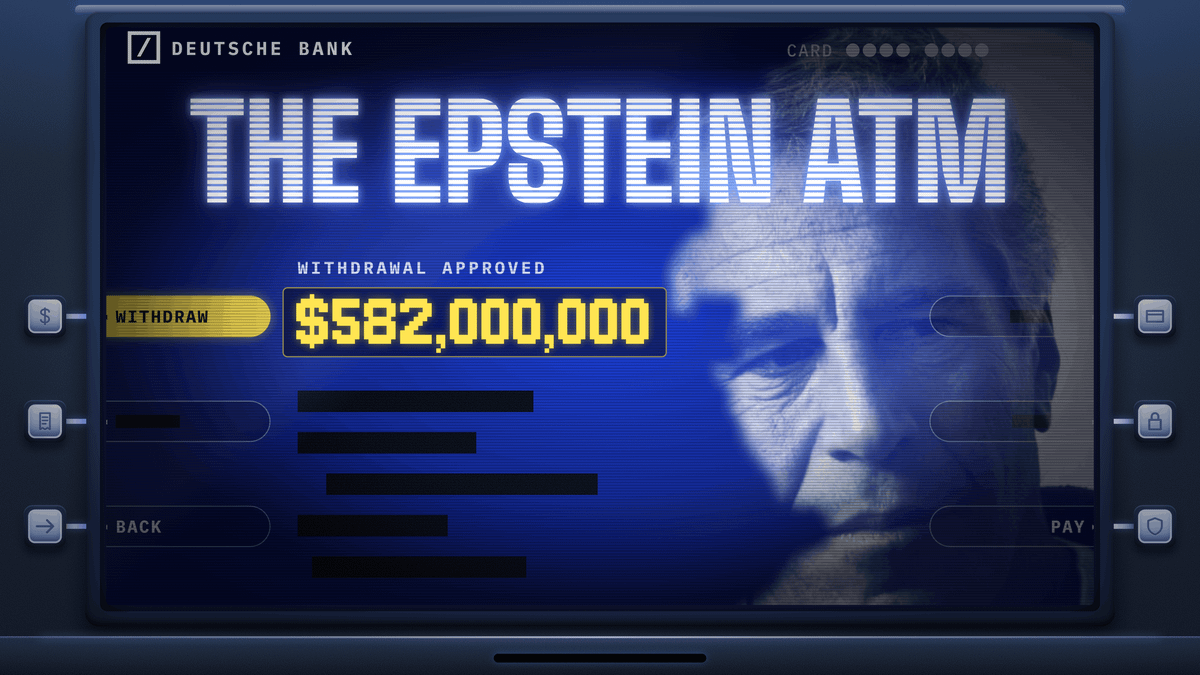
TL;DR: Two whistleblowers leaked 15 million Deutsche Bank files. They show $582 million of suspicious payments linked to Jeffrey Epstein, a Trump tax document sent to the wrong accountant, and a CEO who complained that customer checks were hurting revenue. The bank has paid €18.6 billion in settlements since 2012, about 3 years of its record profit.
Two Deutsche Bank insiders copied more than 15 million internal files, including over 9 million emails, and gave them to journalists and to UK and US authorities. More than 200 journalists worked on them, from the FT, Der Spiegel, Le Monde, The New York Times and others. The files show the bank processed $582 million of payments linked to Jeffrey Epstein that it later flagged as suspicious. That’s far more than previously known. They included payments to women and transfers from wealthy clients such as Apollo co-founder Leon Black. In 2017, the bank accidentally sent one of Donald Trump’s tax documents to another client’s accountant, and didn’t tell the White House. Deutsche’s shares fell more than 6% on Tuesday, before recovering some of the loss.
Christian Sewing has run the bank since 2018 and is credited with turning it around. Last year it made €6.12 billion, its biggest profit since 2007. In a 2017 email, he wrote that know-your-customer checks were “breaking our revenue neck.” The files show he pushed for more risk-taking and kept some problems from shareholders. He was also part of the group that planned to grow the bank’s Russia business shortly before the invasion of Ukraine. In March 2022 the bank said it would wind down in Russia. At the end of 2025 it still had 162 staff there, and made €61 million of profit.
Since 2012, Deutsche has paid €18.6 billion to settle cases including market manipulation, Russian money laundering and mis-selling. That’s about 3 years of last year’s record profit. German authorities have raided it 3 times this year. The files show the bank admitted to regulators it had in effect been “operating outside of law and order.” Deutsche says the issues are old, that it spent €7 billion on controls between 2019 and 2025, and that it expects no significant financial impact. Its chair says he has been comfortable with every decision Sewing made. Germany’s finance minister has called for “full transparency.”
SpaceX’s Chip Bonds
TL;DR: SpaceX sold more than $30 billion of bonds this week backed by Nvidia chips. Lenders wanted a promise that Elon Musk wouldn’t launch those chips into space, where they couldn’t be seized after a default. The bonds pay about 8.3%, more than SpaceX’s own debt.
Lenders backing SpaceX’s new $43 billion debt package tried to stop Elon Musk from launching the chips behind their loans into space. Musk wants to build AI data centres in orbit, and SpaceX has asked US regulators for permission to launch up to 1 million satellites. It runs about 9,500 today. If SpaceX defaulted, lenders couldn’t repossess and sell chips that were in orbit. SpaceX says it plans to use these chips on Earth, in US data centres it owns and runs. It isn’t clear whether the clause made the final documents.
SpaceX sold more than $30 billion of the debt on Thursday, in a package called “Project Saturn.” The biggest piece is a $25 billion bond backed by SpaceX’s 5-year lease payments on Nvidia chips. The bonds were issued by a separate company, which keeps the debt off SpaceX’s balance sheet. Apollo and Goldman Sachs led the deal. Pimco committed $4 billion, and funds run by BlackRock and KKR also signed up. The bonds yield about 8.3%. SpaceX’s own bonds due in 2031 yield about 7.2%.
Moody’s rated the bonds A3, one notch above SpaceX itself. The rating agencies pointed to “hell-or-high-water” clauses that stop SpaceX walking away from the lease. The bonds mature in 2032, but the principal is paid back in less than 4 years. SpaceX listed in June in the largest IPO ever at the time, raising about $86 billion at $135 a share. It bought xAI in February, and lost $4.28 billion in the first quarter. Musk owns about 42% of SpaceX and controls about 85% of the votes. It's interesting to see how bond markets are adapting to the commercialization of space. Next we will have repo companies operating in space.
Java4Shell
TL;DR: A security start-up used AI to find a flaw in Java in about an hour, for under $200. Java runs at 90% of Fortune 500 companies, and the flaw lets attackers take over servers without logging in. South Korea called an emergency meeting, and the US says to patch now.
Calif, a US security start-up, disclosed a critical flaw in Java this week. Java is the world’s third most popular programming language, and Calif says it’s used by 90% of Fortune 500 companies. The bug is in the part of Java that decodes a common text format called Base64. A specially written piece of text can let an attacker take over a server over the internet, without a password. Calif says that works on default settings in Jira, Jenkins and Keycloak. It calls the flaw “Java4Shell.” Oracle rates it 8.1 out of 10, and Calif rates it 9.2.
One Calif researcher pointed an AI model at Java’s code and found the flaw in about an hour. He built a working attack in 2 more hours, for less than $200 of AI computing. Calif used OpenAI’s GPT-6 Cyber, which OpenAI released to approved security firms on November 5. OpenAI says the same model has found 81 new flaws in Firefox. Last month Calif found a similar flaw in PHP, and governments and companies took websites offline while they fixed it. An input that sets off the Java bug was posted publicly in September, in a proposed fix that was never merged.
South Korea’s national security office called an emergency meeting with the military, the spy agency and financial regulators. Java makes up 72% of the code in South Korea’s public-sector systems. The US cybersecurity agency says the flaw needs immediate patching. Oracle released a fix on November 17. One security firm says it’s already seeing attempts to exploit it. A Surfshark engineer warned that “patching that much, that quickly, makes systems less stable.” This could explain why things keep crashing, FAA ground stop, Microsoft, United Airlines, to name a few. To be honest, the Microsoft outage gave me an excuse to go home early. So maybe it’s not a bad thing.
Betting on Elon’s Thumbs
TL;DR: Traders give oil a 3.5% chance of a record high by New Year’s. They think a Tesla and SpaceX merger is likely by the end of 2027. They also bet $3 million on how many times Elon Musk would post in a week.
Macro: will oil hit a record high? WTI crude’s record is $147.27 a barrel, set in July 2008. On Polymarket, traders give it a 3.5% chance of breaking that by December 31, and 14.5% by the end of March. More than $6 million has been traded on the market. WTI closed at about $83 on Thursday, down from about $89 a week earlier, so it would need to rise about 77%. The market settles on the daily high of the front-month CME crude futures contract.
Corporate: will Tesla and SpaceX merge? Polymarket traders give a 17% chance that Tesla and SpaceX officially announce a merger by December 31. That rises to 71% by the end of June and 87% by the end of 2027. About $1.8 million has been traded. An announcement is enough to pay out, even if the deal never closes, as long as one company would take control of the other. SpaceX bought Musk’s AI company, xAI, in February. A separate market gives Jensen Huang a 4% chance of joining SpaceX by the end of the year.
Wildcard: how many times will Elon Musk post this week? Traders bet $3 million on how many times Musk would post on X between November 13 and 20. With minutes to go on Friday, 340 to 359 posts was at 89%. That’s about 50 a day. The count comes from Polymarket’s own tracker. Replies don’t count, but reposts and quote posts do. Deleted posts count if they stay up for about 5 minutes. Next week’s market already has about $476,000 on it.
The US Federal Aviation Administration says it will stop using floppy disks in air traffic control by 2028. They are still used to share weather and other information at more than 400 facilities. The 4 systems being replaced date from the 1980s, and the FAA still relies on decades-old Compaq computers, with some spare parts bought on eBay. Floppy disks haven’t been made in large numbers since 2011. The new system goes into 435 sites by the end of 2028. Congress gave the FAA $12.5 billion last year to fix air traffic control, and Transportation Secretary Sean Duffy wants another $30 billion. Japan’s government declared it had “won the war on floppy disks” in June 2024, after scrapping 1,034 rules that required them. San Francisco’s Muni Metro uses floppy disks as well. Staff reboot the legacy train-control computers at night and load their operating software from floppy disks. Ironic considering San Francisco is a mecca for tech.
“If it ain’t broke, don’t fix it.” — Bert Lance
Have a fantastic weekend. I welcome feedback and please forward this if you see fit.
Many thanks,
Sam.
Market Snapshots
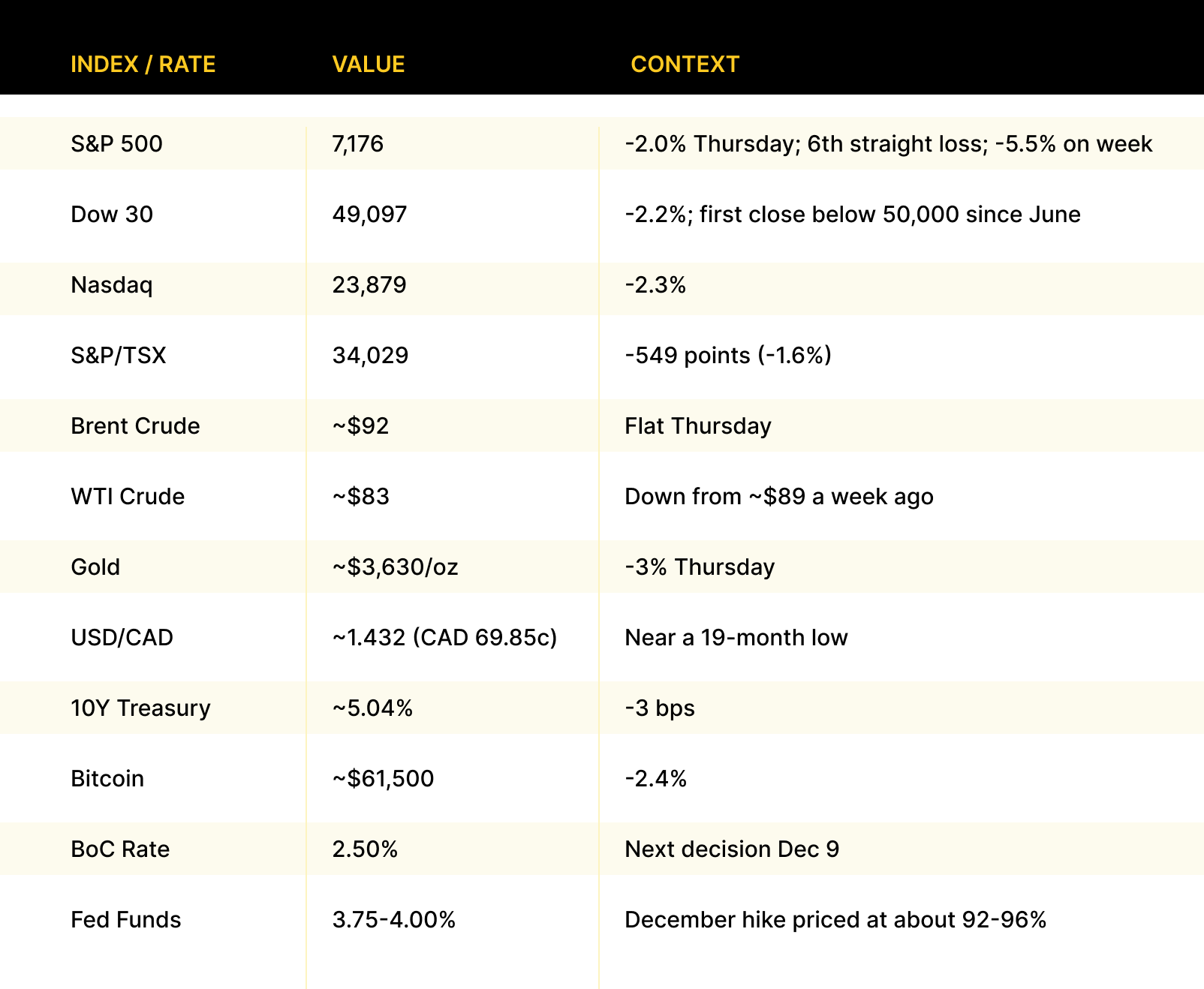
Note: The S&P 500 fell 2% on Thursday, its sixth straight loss, and is down about 5.5% from a week earlier. The Dow closed below 50,000 for the first time since June, and every sector fell. AI stocks led the drop. Nvidia fell 3.3% despite record quarterly revenue of $115.8 billion, and AMD fell 7.7% after a short-seller report. Anthropic listed on Thursday at $83 a share, raising $81.3 billion in the largest IPO on record, and closed at $97.17. Minutes from the Fed’s October meeting showed almost all officials expect more rate hikes, and most flagged AI debt growing through complex and opaque financing. A December hike is close to fully priced. Gold fell 3%. In Canada, the TSX lost 549 points, and the loonie is near a 19-month low at 69.85 US cents.
1 USD = 1.432 CAD at Thursday’s close.
Sources
The Logic, The Globe and Mail (opener); Fortune via Yahoo Finance, Samaya (AI earnings forecasts); Financial Times, Trending Topics, Yahoo Finance UK, Asia Times, RTÉ/Reuters (Deutsche Bank); Financial Times, Investing.com, Scientific American, Capacity, Yahoo Finance, Dealroom (SpaceX); Reuters via CP24 and The Korea Times, Seoul Economic Daily, The Next Web, ITPro, Euronews (Java); Polymarket (prediction markets); FOX 29, The Register, Valley News Live, TechRadar (closer); Capp Notes, The Wall Street Republic, Canadian Cattlemen, The Motley Fool, TheStreet, Finviz (market data).
Market data pulled Friday November 20, 2026 using November 19 closes, with Friday morning’s moves noted where stated. Prediction market odds were read live on Polymarket on Friday morning; the Elon Musk post-count market closed at midday Friday. Samaya’s results cover a single quarter, and its larger study is its own commercial research. Deutsche Bank disputes the reporting and calls the leaked documents “purported.” KOHO’s lawsuit is ongoing and no defendant has been named. The Java flaw has been patched; exploitation attempts have been reported but code execution has not been independently confirmed. Currency at Thursday’s close.