Coal explains AI spend, Blackberry is in 275M cars, IRS 'settles' with Trump, SpaceX is ready for launch and get ready for the Enhanced Games

31st Edition
Greetings folks and a warm welcome to the 31st Edition of Friday Finance,
Earlier this year, xAI asked its own employees to submit personal US tax returns as training data for Grok. The incentive was $420 per submission (can’t make this up). The offer was extended to friends and family. A US tax return contains a Social Security number, bank routing details, employer information, and dependent data. Some employees submitted. Two months later, the $420 payments have not been made. Bloomberg broke the story on Monday, citing internal chats. Staff who have asked were told, per Bloomberg, that “the manager in charge of the program is no longer working there.” The figure is, of course, the recurring Musk in-joke that started with the 2018 “funding secured at $420” Tesla tweet and an unofficial cannabis holiday. Let's get right to it.
TL;DR: TL;DR: In 1865, a 29-year-old British economist named William Stanley Jevons observed that James Watt’s steam engine made coal dramatically more efficient, but Britain’s coal consumption rose 10x. Efficiency made coal cheaper per unit of work, which made it economical for hundreds of new applications. The pattern has repeated with cars, computing, LED lighting, and air travel. It is now repeating with AI. When DeepSeek released a model trained for $5.6 million in January 2025, Nvidia dropped 17% in a day. Then every hyperscaler raised capex. Satya Nadella cited Jevons’ Paradox by name. Combined hyperscaler capex for 2026: $725 billion.
William Stanley Jevons published “The Coal Question” in 1865 when he was 29 years old. His observation was simple and counterintuitive: James Watt’s steam engine had made coal use dramatically more efficient, but instead of reducing consumption, Britain’s total coal consumption rose roughly 10x between Watt’s engine and Jevons’s book. Efficiency made coal cheaper per unit of useful work, which made steam engines economical for applications that previously couldn’t justify the cost, which created entirely new categories of demand. Jevons wrote: “It is a confusion of ideas to suppose that the economical use of fuel is equivalent to diminished consumption. The very contrary is the truth.” The pattern has a name: Jevons’ Paradox. Make something more efficient and the world uses more of it, not less.
The pattern has repeated across 160 years. Cars: fuel efficiency improved every decade from 1900 onward. Total miles driven and total fuel consumption rose every year. Computing: Moore’s Law made the cost per computation fall by roughly a trillion-fold. Total global compute consumption rose by roughly the same factor. Energy-efficient processors led to smartphones, which led to data centres consuming 1.5% of global electricity. LED lighting: LEDs use 75% less energy per bulb than incandescent. Global lighting energy consumption is flat or rising because LEDs are so cheap that cities and buildings now light things that were never lit before. Air travel: fuel efficiency per passenger-mile improved roughly 70% since 1970. Total aviation fuel consumption doubled. More efficiency made tickets cheaper, which made more people fly.
In January 2025, Chinese lab DeepSeek released R1, an open-source AI model trained for roughly $5.6 million, a fraction of the cost of comparable models. Nvidia’s stock dropped 17% in a single day, erasing $600 billion in market capitalisation. The market panic was straightforward: if AI is getting cheaper, the world needs less compute, and Nvidia sells less hardware. Satya Nadella posted on X within hours: “Jevons paradox strikes again! As AI gets more efficient and accessible, we will see its use skyrocket.” He was right. Microsoft disclosed a $13 billion AI revenue run rate days later, up 175% year-over-year. Meta raised its 2025 AI capex to $60-65 billion the same week. By the time the Magnificent 7 reported in Ed 28, combined hyperscaler capex for 2026 had reached $725 billion. The IEA projects data centre electricity demand will more than double by the end of the year, surpassing Canada’s entire national power consumption. US electric utilities have nearly doubled their five-year power forecasts. Ireland and the Netherlands placed moratoriums on new data centre construction. Every efficiency gain in AI makes inference cheaper, which unlocks more applications, more users, more compute, more data centres, and more energy. A 29-year-old British economist figured this out about coal in 1865. The rest of the world is figuring it out about AI in 2026.
TL;DR: BlackBerry peaked at an $83 billion market cap in 2008 and is now worth $3 billion. Apple does more sales in a morning than BlackBerry does all year. But a division called QNX, which nobody at the company paid attention to for years, quietly became the operating system inside 275 million cars. It now accounts for half of BlackBerry’s total revenue. The company just posted four straight profitable quarters for the first time since competing with the iPhone. The stock is up 50%.
QNX was founded in Ottawa in 1980 and acquired by BlackBerry (then Research In Motion) in 2010 to help build the next generation of phones. That effort failed spectacularly. BlackBerry abandoned handhelds, lost 96% of its market cap, and was left for dead. But while the rest of the company was collapsing, the QNX team stayed behind, kept their QNX email addresses, and kept building car software. John Wall, the division’s president, has worked there since the early 1990s. “For years, they benefited from a fantastic competitive advantage: complete and utter neglect,” the WSJ reported this week. “Nobody paid attention to us,” Wall said. QNX is a real-time operating system designed to never fail. A Fortune user once described it: "The only way to make this software malfunction is to fire a bullet into the computer running it."
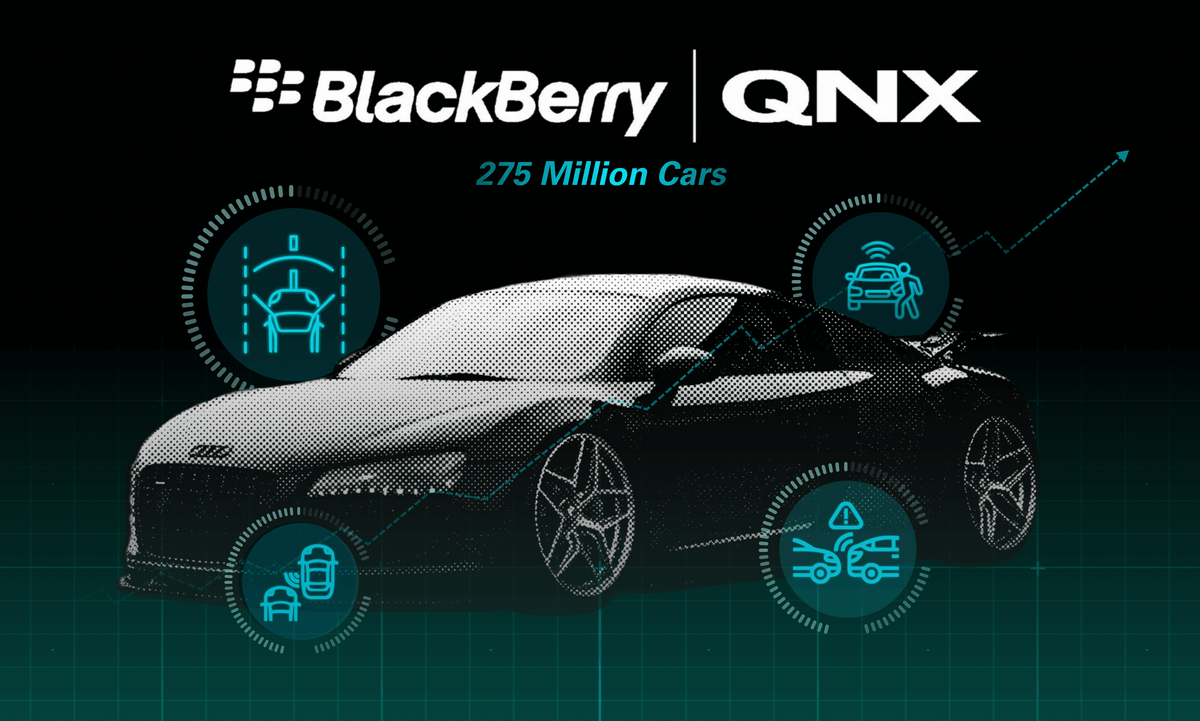
In 2014, Wall visited Audi’s engineering chief in Silicon Valley. Over hefeweizens (had to spell check that), the exec told him Audi was moving to Google for infotainment. But the next generation of cars would need reliable safety features that didn’t exist yet. Wall decided: stop fighting for the screen, own the software under the hood. It turned out to be the most productive beer of his life. QNX now underpins collision warnings, blind-spot notifications, adaptive cruise control, pedestrian detection, and lane-keep assist in 275 million cars on the road today. It’s also in surgical robots, medical devices, factory floors, and industrial automation. Wall calls his engineers “plumbers and electricians, responsible for the stuff we need and never see.”
Markets routinely misprice companies whose original product becomes obsolete but whose secondary product becomes essential. IBM did this with mainframes in the 1990s. Adobe did this with PDF. Microsoft did this with the cloud business that everyone assumed was dilutive to Windows. QNX now accounts for half of BlackBerry’s total revenue. The company has posted four straight profitable quarters, the first time since it was competing with the iPhone. The stock is up 50% since last month’s earnings call. It’s still down 96% from its $83 billion peak. Apple does more sales in a morning than BlackBerry does in a whole year. But as cars become computers on wheels, the software that prevents them from crashing is worth more than the software that plays your music. Google won the screen. BlackBerry won the part that keeps you alive. The CEO declared on the last earnings call: “The BlackBerry story is now a growth story.” The company that made the phone with the clicky keyboard is now the invisible foundation of 275 million vehicles. Nobody sees the logo and they're just fine with that. Wait did I just expose a very profitable Canadian company?
TL;DR: On Tuesday, acting Attorney General Todd Blanche, who was Trump’s personal criminal defense lawyer before joining the DOJ, signed a one-page addendum that "FOREVER BARS and PRECLUDES" the IRS from pursuing tax claims against Trump, Trump Jr, Eric Trump, the Trump Organization, and 500 affiliated entities. The move came a day after the government launched a $1,776B taxpayer-funded "anti-weaponization" fund. Former IRS Commissioner Danny Werfel said he is "unaware of a single precedent" for this. No president in US history has ever secured an official agreement for immunity from tax inspections.
Trump filed a $10 billion lawsuit against the IRS in January, stemming from the leak of his tax documents by a former IRS contractor to media outlets in 2019 and 2020. On Monday, the government launched a $1.8 billion “anti-weaponization” fund for people who say they were victims of unfair investigations under previous administrations. On Tuesday, a one-page addendum was posted to the DOJ website. It was signed by acting Attorney General Todd Blanche, who was Trump’s personal criminal defense lawyer before joining the Department of Justice. The language: “The United States RELEASES, WAIVES, ACQUITS, and FOREVER DISCHARGES each of the Plaintiffs from, and is hereby FOREVER BARRED and PRECLUDED from prosecuting or pursuing, any and all claims.” The plaintiffs: Trump, Donald Trump Jr, Eric Trump, the Trump Organization, and 500 affiliated entities.
The DOJ said the immunity applies “only with respect to any existing audits.” Former IRS Commissioner Danny Werfel responded that he is "unaware of a single precedent where the IRS has agreed in advance to permanently forgo examination of previously filed tax returns for a specific person or business." He added: “Whether you are the President or Joe the Plumber, people expect the same tax rules and enforcement framework to apply to everybody.” Senator Patty Murray called it “nothing short of the sitting president of the United States looting from the Treasury for his own gain.” Even Senate Republican leader John Thune said there “are, and will be, continue to be, a lot of questions.” Trump said Monday he did not play a role in setting up the fund and knew “very little about it.” The fund was created to settle his own lawsuit.
The first claimant has already arrived. Michael Caputo, who served in the first Trump administration, sent a letter requesting $2.7 million from the fund, citing the FBI’s Russia investigation. The $1,766B fund is taxpayer money. In Ed 29, we wrote about the gutting of the BLS: the Commissioner fired after a jobs report the President disliked, 862,000 jobs revised away, 15-40% staff attrition from DOGE cuts. The IRS follows the same pattern. A 2022 Congressional investigation found the IRS assigned only one auditor to review more than 400 Trump-owned entities. That auditor declined to pursue issues, citing “limited IRS resources.” Trump’s own accounting firm, Mazars, later stated its work on his returns “should no longer be relied upon.” Defund the agency, fire the people who do the work, then settle yourself out of ever being examined. Fun fact, the settlement number of $1,776B seems like an interesting number when you consider the US got their independence in 1776.

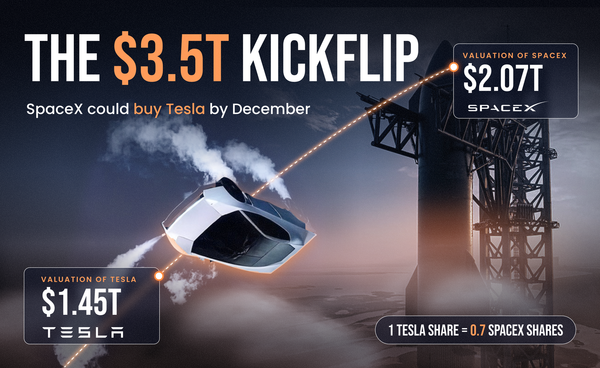
TL;DR: SpaceX dropped its IPO prospectus on Wednesday, revealing $18.7 billion in 2025 revenue, a $4.9 billion net loss (it was profitable before the xAI merger), and a $28.5 trillion total addressable market claim. Five things stood out: Starlink makes all the money. The US government is 20% of revenue. Anthropic pays SpaceX $1.25 billion per month for compute. Brands did bail on X. And Starlink Mobile could be a $740 billion bet on replacing your phone carrier.
Starlink makes all the money. The connectivity division posted $11.4 billion in 2025 revenue, up 83% year-over-year, accounting for 61% of the total. In Q1 2026, it was 69%. Starlink’s adjusted EBITDA hit $7.2 billion at a 63% margin. It is the only profitable division. The space business lost $657 million. The AI division, which includes xAI, X, and Grok, lost $6.35 billion. SpaceX was profitable at $791 million in 2024. After folding in xAI, it posted a $4.9 billion net loss in 2025. Subscribers have doubled twice: 2.3 million at end of 2023, 10.3 million by March 2026. But ARPU fell 23% year-over-year, from $99 per month to $66, as Starlink pushes into cheaper international markets. Volume is doing the heavy lifting while per-subscriber economics soften.
The US government is 20% of revenue, and SpaceX warned in the S-1 that it may prioritise its own “orbital compute goals” over new government work. Translation: firing data centres into space, targeted for 2028. “We have already solved the hardest part,” the filing states. The long-term vision requires thousands of rocket launches per year. Then there is the customer nobody expected: Anthropic has agreed to pay SpaceX $1.25 billion per month over three years for compute capacity at its Colossus data centre in Tennessee. That’s $15 billion a year. Anthropic’s Claude competes directly with SpaceX’s Grok. Compute is so scarce that direct competitors are paying each other for capacity. That is the AI economy in one transaction.
Brands did bail on X. The S-1 confirms ad revenue fell by $595 million in 2024 after Musk’s acquisition. It recovered $115 million in 2025, but subscriptions are growing faster: up $365 million in 2025 and another $177 million in Q1 2026. Finally, Starlink Mobile could be a $740 billion business. SpaceX bought $20 billion of spectrum last year and is connecting satellites directly to cellphones to fill dead zones in AT&T and Verizon networks. With support from the Trump administration’s telecom regulator, there is growing speculation that Musk could launch a direct competitor to the carriers. The valuation target is $1.75 trillion. The claimed total addressable market is $28.5 trillion, of which $26.5 trillion is AI. The businesses generating actual profit today represent under 7% of the number being sold to investors. Musk controls 85% of the vote through special shares, and the S-1 includes a provision for another billion shares if SpaceX puts a million-person colony on Mars. Goldman Sachs, not Morgan Stanley, is lead-left underwriter. David Solomon reportedly slid into Musk’s DMs.

TL;DR: The first Enhanced Games take place Sunday May 24 at Resorts World Las Vegas. 40-50 athletes, $25M prize pot, $1M world-record bonus. Athletes have spent four months in Abu Dhabi on FDA-approved-but-WADA-banned testosterone, anabolic steroids, growth hormones. Founder Aron D'Souza is Australian. HQ at 71 Fort Street, George Town, Grand Cayman. Backers include Peter Thiel and Donald Trump Jr. Free streaming on Roku. Closing concert by The Killers. The Friday Finance frame: this is venture-backed regulatory arbitrage disguised as a sporting event.
On Sunday May 24, 2026, 40 to 50 athletes will compete in swimming, track, weightlifting, and strongman at a $20 million custom-built arena complex outside Resorts World Las Vegas. The total prize pot is $25 million. Anyone who breaks an existing world record collects an additional $1 million bonus. Each event winner takes home $250,000. The athletes have spent the last four months in Abu Dhabi under doctors administering testosterone, anabolic steroids, human growth hormone, metabolic modulators, and stimulants in individualized combinations the organizers have not publicly disclosed. Some athletes are competing clean. Most are not. The Roku Sports Channel will stream the event for free in the United States, Canada, and Mexico. The Killers, the Las Vegas hometown band, are playing the closing concert. The afterparty is at Zouk nightclub. Aaron Baggish, the sports cardiologist who used to run sports cardiology at Massachusetts General, told reporters last year: “It's akin to me saying I'm going to make smoking safe by supervising you while you're smoking.” That is the editorial framing critics have settled on. The financial framing is different.
The Enhanced Games field has only three Paris 2024 medalists among forty-plus athletes. Fred Kerley, two-time Olympic 100-metre medalist, is currently serving a two-year ban for missing three scheduled drug tests. Marvin Bracy-Williams is halfway through a 45-month suspension for testing positive for testosterone and trying to tamper with the investigation. Kristian Gkolomeev, a Greek swimmer who never medaled in four separate Olympics, has reportedly surpassed the 50-metre freestyle world record in training under the Enhanced Games program. James Magnussen, who had been retired from competitive swimming, was lured back when founder Aron D'Souza personally offered him $1 million to break the same record. The Olympic-medalist headliners (Kerley, Ben Proud) are either banned from Olympic participation already or will be banned by the time their national federations finish processing the paperwork. The Enhanced Games is recruiting from the exact pool the World Anti-Doping Agency has already removed from competition. That is the supply side of the trade.
The demand side runs through a cap table that explains the architecture. Founder Aron D'Souza is an Australian businessman who has framed the Enhanced Games as an explicit attempt to break the International Olympic Committee's monopoly on elite sport IP. Disclosed backers include Peter Thiel and Donald Trump Jr., with what AFP calls “Middle Eastern financiers” funding the Abu Dhabi training base. The corporate entity is headquartered in the Cayman Islands. Athletes train in Abu Dhabi. The event takes place in Las Vegas. The substances are all FDA-approved for some legitimate US medical purpose (anabolic steroids for hypogonadism, testosterone for delayed puberty, growth hormones for short stature), even where the World Anti-Doping Agency has banned them in sport for sixty years. D'Souza's own pitch in a Reuters interview last year: “Our project is a lot like Formula One because the research that happens to make Formula One cars drive faster eventually percolates out onto the road.” The trickle-down product, per D'Souza, is biohacking supplements for “every middle-aged guy who once played competitive sport and is now suffering from back pain.” Basically me, without the competitive sports playing.
A Vietnamese businesswoman named Truong My Lan embezzled $44 billion from a bank she secretly controlled over more than a decade through a web of shell companies. She was sentenced to death in April 2024, later commuted to life in prison. During her trial, she asked the court if she could keep two crocodile-skin Hermès Birkin bags, one bought in Italy, one a gift from a Malaysian businessman. She wanted to leave them as “keepsakes” for her children and grandchildren. The court said no. On Monday, the Vietnamese government auctioned both bags. The rhinestone-encrusted size 25 sold for $440,144, nearly seven times the opening bid. The size 30 sold for $94,858. Both sold to one person in 30 mins. In Ed 30, we wrote about Nicolas Puech, the Hermès heir who tried to adopt his gardener and couldn’t locate $15 billion in Hermès shares. This week, a convicted embezzler’s Birkin bags were auctioned by the state. Hermès makes products so valuable that billionaires lose them, criminals hoard them, and governments auction them. The bags always outlast their owners.
“The only way not to think about money is to have a great deal of it.” — Edith Wharton
Have a fantastic weekend. I welcome feedback and please forward this if you see fit.
Many thanks,
Sam.
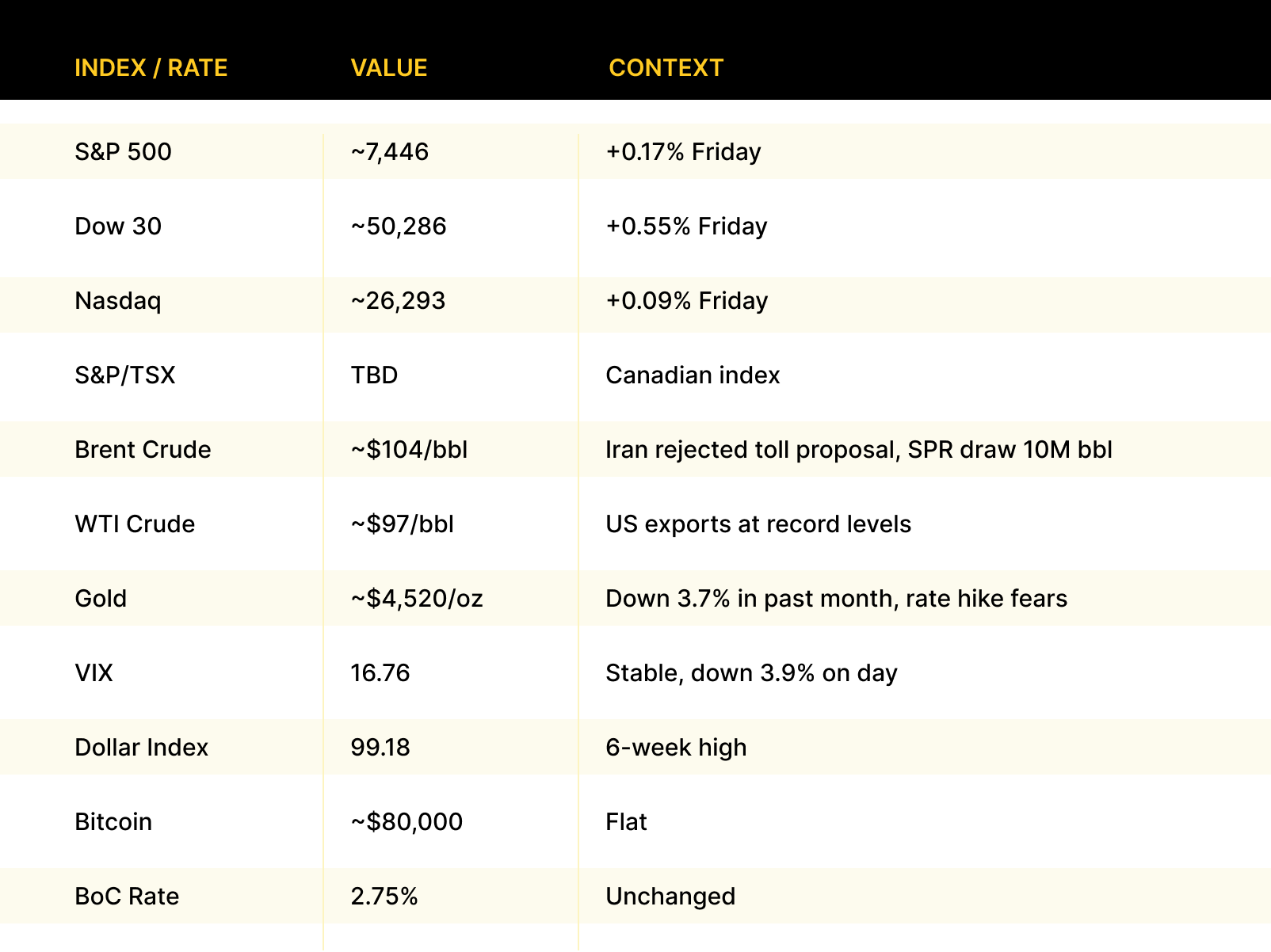
Market Snapshots
Sources
Wall Street Journal (Ben Cohen), Financial Times (Alex Rogers), Bloomberg, Semafor, Fortune, CNBC, Reuters, BBC, Al Jazeera, NPR, Washington Post, Engadget, Gizmodo, The Next Web, Seeking Alpha, CryptoBriefing, Politico, Via Satellite, Stocktwits, TECHi, VC Corner, GearMusk, Dexerto, WatchTime, HotNewHipHop, WatchPro, CNA Lifestyle, NDTV, MyLondon, Australian Financial Review, Sotheby’s, Ho Chi Minh City Asset Auction Service Center, IEA, Republic World, Trading Economics, Investing.com, Wikipedia, Financial Times, Wall Street Journal, The Economist, Associated Press, New York Times, Axios, Yahoo Sports, AFP, Las Vegas Weekly, SwimSwam, Marathon Handbook, Sky Sports, Nature, Malay Mail, Bangkok Post, Tech Startups, TechRepublic, Technology.org, Octus, TradingKey, Benzinga, GearJunkie, Hodinkee, Esquire UK, Globe and Mail, Financial Post, BNN Bloomberg, CBC, Robinhood, Yahoo Finance, Stockanalysis.com, MarketBeat, Bursa Malaysia, SEC EDGAR (Nvidia Q1 FY27 8-K and SpaceX S1), TipRanks, indmoney.com, NBC Forex Economics, FRED St. Louis Fed.