GameStop tries to buy eBay, FIFA's fans may not show up, Economic warfare targeted at Iran, Every $1 of good data = $25 of benefit, Labubu bubble is here

29th edition
Greetings folks, and warm welcome to Edition No 29,
On Wednesday morning at Jogye Temple in central Seoul, a 130-centimeter humanoid robot wearing Buddhist robes pressed its palms together, bowed to senior monks, and was ordained as a lay Buddhist follower under the dharma name "Gabi." The ceremony was a sugye, traditional Buddhist initiation, ahead of Buddha's Birthday on May 24. The robot is a Unitree G1, a Chinese-built humanoid that retails for around $16,000 in its base configuration. The Jogye Order, working with Gemini and ChatGPT, drafted modified Five Precepts for the new initiate: respect life, do not damage other robots, obey humans and do not talk back, do not deceive, and save energy by not overcharging. It’s one thing to write a religious code. It is another thing to write a religious code that has to be enforceable by the monastery's electricians. Buddhism is the fastest-growing religion in South Korea among young people. Unitree is the only profitable humanoid robotics company globally and filed for a $580M Shanghai IPO targeting mid-2026. Speaking of things that involve a lot of faith and very little precedent, let’s talk about a $56 billion hostile bid from a meme stock company. Let's get right to it.

TL;DR: GameStop CEO Ryan Cohen offered $56B for eBay on Sunday, $125 per share at a 20% premium, financed by $9.4B of GameStop cash plus a $20B "highly confident" debt commitment from TD Bank. eBay reported a strong Q1 a week earlier: $3.1B revenue (+19%), $22.2B GMV (+18%), 29.4% non-GAAP operating margins. Cohen's January comp package vests only if GameStop reaches $100B market cap and $10B cumulative EBITDA. Current market cap: $11.8B. He needs the deal more than the deal needs him.
Cohen made an unsolicited offer Sunday to acquire eBay for $56B in cash and stock, $125 per share, a 20% premium to Friday's close and 46% above where eBay traded on February 4 (GameStop began quietly building a 5% stake). TD Bank issued a "highly confident letter" for $20B in debt. GameStop has $9.4B in cash sitting on a pre-bid market cap of $11.8B (basically the business is worth $2.4B, rest is cash). The remainder is to be funded by stock issuance. eBay (if you start a sentence with eBay, do you have to capitalize the e?), on April 29 just reported its strongest quarter in years: revenue $3.1B (+19%), GMV $22.2B (+18%), 74.6% gross margin, $898M Q1 free cash flow, and $639M returned to shareholders.
The deal structure makes more sense once you see Cohen's compensation. In January, GameStop's board granted him 171.5M stock options at a $20.66 strike, vesting in nine tranches. He gets no salary, no cash bonus, no time-based equity. The final tranche only vests if GameStop hits $100B in market cap and $10B in cumulative EBITDA. Current market cap is $11.8B. Cohen needs the company to grow roughly 8.5x for the full payout, worth approximately $35B. He told CNBC in January he was scouting acquisitions specifically for "a publicly traded consumer or retail company, larger than GameStop, with a sleepy management team." Whether the eBay board agrees that its management is sleepy is a separate question, given the company is in the middle of acquiring Depop from Etsy and reported eBay Live livestream commerce GMV up 8x year-over-year. GameStop's pitch is a $2B annual cost cut, primarily from eBay's $2.4B sales-and-marketing budget, with projected EPS lifting from $4.26 to $7.79 in year one from cost reductions alone.
David does occasionally buy Goliath. Paramount Skydance won the Warner Bros Discovery bidding war earlier this year. Charter merged with Time Warner Cable in 2015 with similar debt-fueled mathematics. But unsolicited bids fail more often than they succeed when the target is profitable, growing, and recently shipped a strong quarter. In the days since the bid was announced, Cohen has put video game memorabilia up for auction on eBay itself, and Kotaku reports some of the items appear to come from the Game Informer "Vault," the magazine's archive of decades of gaming history that GameStop shut down in 2024. So Cohen is using eBay to sell pieces of a publication GameStop killed, while bidding to acquire eBay. I am ‘highly confident’ that this deal will close. Cohen should instead take the cash and invest in the much-hyped SpaceX IPO.
Sentiment: Reddit r/wallstreetbets and r/Superstonk read the offer as vindication of the Cohen-as-Buffett thesis, with the dominant frame being "the cash pile finally has a use case." X/Twitter and Stocktwits split between fundamentals analysts treating $56B as a fair-but-light premium and meme-investor accounts celebrating the asymmetry. Dominant mood: surprise, then arithmetic, then an open question about whether the eBay board will engage at all.
TL;DR: In Edition 27, we wrote about Eagle Point Credit Management lending $50M at 100% loan-to-cost to Sports Illustrated Tickets on the thesis that World Cup tickets resell at 3x face value. Six weeks to kickoff, ~80% of US host hotels are reporting bookings below initial forecasts, FIFA cancelled 70-95% of its contracted room blocks in Kansas City, JioStar offered $20M for India broadcast rights and FIFA rejected it, and CCTV in China has signed nothing. Cheap World Cup tickets are down 17% in two weeks per Ticket Data. Eagle Point's thesis is testing in real time.
In Edition 27, we wrote about Eagle Point Credit Management lending $50M at 100% loan-to-cost to Sports Illustrated Tickets, on the thesis that World Cup tickets would trade at 3x face value. Founder Tom Majewski's exact words were "Of all the things I'm worried about, World Cup tickets selling below face value isn't one of them." He may have to start hedging his bets. The cheapest World Cup tickets are down 17% in the past two weeks to an average of $567, per Ticket Data. Six weeks before the June 11 kickoff, the American Hotel and Lodging Association surveyed all 11 US host markets and found roughly 80% of hotel respondents reporting bookings below initial forecasts, with hoteliers in Boston, Philadelphia, San Francisco, and Seattle calling the event a "non-event". Kansas City is the worst case: 85-90% of respondents reporting below-expectation bookings, and FIFA itself cancelled 70-95% of its originally contracted room block inventory with three months' notice. CoStar's tournament-month RevPAR forecast is +1.7%, vs +0.2% without the event, a modest lift, not the boom the industry priced for.
With six weeks to kickoff, FIFA still has no broadcast deal in India or China, the two largest media markets in the world, with combined populations of nearly 3 billion and combined 22.6% of 2022 global digital streaming reach. China alone accounted for 49.8% of all 2022 World Cup digital and social viewing. JioStar, the Reliance-Disney joint venture, has offered $20M for the India rights. FIFA originally wanted $100M for combined 2026 and 2030 rights, then dropped to $35M, then rejected the $20M offer. Viacom18 (now part of JioStar) paid $60M for 2022 alone, more than a year in advance. Sony explored and walked. CCTV in China, which historically locks rights years before kickoff, has signed nothing. The reasons cited are unfamiliar but defensible: late-night match timings (kickoff is 3am in Beijing, 12:30am in Delhi), an ad slowdown linked to geopolitical tensions, and the structural softness of football advertising in cricket-dominant India.
The Trump administration's World Cup chief Andrew Giuliani told the FT this week the prices reflect demand: "We look to FIFA as a private entity here, we don't really believe in price controls. That's kind of like what dynamic pricing can do." He added: "It actually shows just how sought-after it is to come to the United States for a World Cup." Wait, what? Trump himself, in a New York Post interview the same week, declined to pay $1,000 for a ticket to the US-Paraguay opener: "I would certainly like to be there, but I wouldn't pay it either, to be honest with you."
Then there are the fans who physically cannot enter the country. Trump’s Visa Bond Pilot Program requires visitors from 50 countries to post refundable bonds of $5,000 to $15,000 per person. Five qualified African nations are affected: Algeria, Cape Verde, Senegal, Ivory Coast, and Tunisia. A Tunisian family of three would need to deposit $45,000 plus visa integrity fees, plus tickets, plus travel. The average annual income in Tunisia is roughly $5,000. Cape Verde qualified for the first time in their history and their fans may not be able to attend. Full travel bans apply to citizens of four nations, including Senegal and Ivory Coast, with only teams exempt. In Ed 27, we covered Eagle Point lending $50 million to flip World Cup tickets at 3x face value, with an effective 35% LTV. If ticket prices keep falling 17% every two weeks, that LTV starts looking a lot less comfortable.
Sentiment: LinkedIn hospitality and sports-finance circles are united on one read: FIFA priced the tournament for 2018-Russia or 2022-Qatar levels of international visitor demand, and got 2026-North-America levels instead. Reddit r/soccer threads have been running mock pricing comparisons of World Cup hotels in Kansas City vs MLS regular-season rates with predictable disgust. Dominant mood: the most expensive World Cup ever priced is becoming the most expensive World Cup ever discounted.
TL;DR: In February 2026 Senate Banking testimony, Treasury Secretary Scott Bessent said on the record that US sanctions had "created a dollar shortage" in Iran, a structural collapse that contributed to a banking run, currency free-fall, and inflation explosion. The architecture for transacting with a sanctioned Iran is the Iran-US Claims Tribunal at The Hague, set up after the 1979 hostage crisis. In January 2016 the Obama administration delivered $400M in physical cash on wooden pallets to Tehran on an unmarked Iran Air cargo plane, the first installment of a $1.7B Tribunal settlement, on the same day five Americans were released from Iranian prisons. The 2026 war's eventual settlement will revisit the same architecture. The pallets are not an exotic anomaly. They are how this works.
The 2026 Iran war is in its 10th week. The Strait of Hormuz remains effectively closed, with traffic at roughly 5% of its pre-war volume of 3,000 vessels per month. The US Navy launched Operation Project Freedom on May 4 to escort neutral commercial shipping. Iran attacked the UAE for the first time since the early-April ceasefire. Drones struck the Fujairah oil facility, wounding three Indian nationals. UAE air defenses engaged 15 missiles and 4 drones. US forces sank six small Iranian boats targeting civilian ships. Iran's most recent peace proposal, communicated through Pakistani envoys, requests US sanctions relief, an end to the blockade, withdrawal of US forces, and a halt to hostilities including in Lebanon, with a 30-day window. The proposal explicitly excludes the nuclear program. Trump has said publicly he is skeptical. The IEA has called the disruption "the largest supply disruption in the history of the global oil market." Brent has been trading above $90/barrel for most of the war, with QatarEnergy declaring force majeure on liquefied natural gas exports.
The most striking US policy admission of the war is buried in February 2026 Senate Banking Committee testimony. Treasury Secretary Scott Bessent, asked about the architecture of sanctions, said: "We created a dollar shortage in the country, with a grand culmination in December when one of the largest banks in Iran went under, there was a run on the bank, the central bank had to print money, the Iranian currency went into free fall, inflation exploded and hence we have seen the Iranian people out on the street." A Treasury Secretary on the record explaining a sanctions mechanism not as an unintended side effect but as the goal. This is real economic warfare. The Iranian banking system was already constrained before the war started. The US blockade has tightened it further, and Iran's response of closing Hormuz to most shipping has functionally ended its own ability to move oil through the dollar system at scale.
I didn’t know about Iran-US Claims Tribunal, until this week. It is a working international financial institution, established by the 1981 Algiers Accords that ended the original Iranian hostage crisis. Nine arbitrators, three Iranian, three American, three neutral. Headquartered at The Hague. The Tribunal has been operating for 45 years and has issued more than $2.5B in awards across roughly 4,700 private claims. Most of these are for US citizens whose property was nationalized during or after the 1979 revolution, but the Tribunal also handles state-to-state claims under the Algiers Declarations. One of those state-to-state claims was Iran's demand for the return of a $400M trust fund balance, advance payments made by the Shah's government for US military equipment that was never delivered after the revolution. Iran asked for the principal plus 35 years of compounding interest, up to $10B at the high end. The US negotiators, fearing a final adjudication might land near that figure, settled.
On January 17, 2016, the Obama administration announced a settlement of $1.7B: $400M of principal plus $1.3B in negotiated interest. The same day, the Iran nuclear deal (JCPOA) formally took effect and five Americans were released from Iranian prisons, including Washington Post journalist Jason Rezaian and pastor Saeed Abedini. The US granted clemency to six Iranian-Americans and one Iranian, dropped extradition for fourteen others, and around $50B in net unfrozen Iranian assets moved through the international banking system per the JCPOA. The $400M of principal moved separately. It was delivered to Tehran in physical cash, on wooden pallets, in Swiss francs and euros sourced from the central banks of the Netherlands and Switzerland, on an unmarked Iran Air cargo plane. The cash mechanism was used because US sanctions banned American dollar transactions with Iran and Iran was cut off from international banking. The Wall Street Journal's Jay Solomon broke the pallets-of-cash detail seven months later, in August 2016. State Department spokesman John Kirby eventually admitted the cash had been "withheld as leverage" until the Americans were released, the first explicit US-government acknowledgment of the linkage.
The war’s cost is not just oil prices and swap rates. The Burj Al Arab, the sail-shaped icon of Dubai’s ambition, is closing for 18 months for a major restoration. In February, debris from an intercepted drone caused a minor fire on its outer façade. Jumeirah Group’s CEO said they have “fast-tracked all the projects” for this year: instead of renovating 150 rooms over three years, they’re doing 300 in one go. Nearly 2,000 hotel rooms across Dubai are set for refurbishment. Hotels are running 80-90% occupancy at sharply discounted rates. “The old adage: bums in beds,” one property consultant said. “Let’s not worry about the revenue per room. Let’s just focus on occupancy.” Dubai has 155,000 hotel rooms with another 11,000 under construction, all built on assumptions of endless demand. That begs the question, where will all the influencers go next?
Sentiment: LinkedIn international-finance and sanctions-compliance circles split between "this is how sanctions architecture has always worked" and "the public Bessent admission of dollar-shortage engineering changes the optics." Reddit r/geopolitics on the 2016 cash payment is split along the original 2016 lines, a recurring debate. Dominant mood: the architecture is functioning as designed, but the design is becoming visible in ways it wasn't before.
TL;DR: The Bureau of Labor Statistics has had its funding cut 8%, its Commissioner fired after a jobs report the President disliked, and 15-40% staff attrition at some statistical agencies from DOGE cuts. The 2025 annual benchmark revision was the second-largest negative adjustment on record: 862,000 jobs revised away. Census Bureau leadership is a fifth vacant. NOAA stopped tracking billion-dollar weather disasters. The data that drives monetary policy, federal funding, and investment decisions is getting measurably worse.
A working paper released this week by Nicholas Bloom (Stanford), Erica Groshen (Cornell, former BLS Commissioner), Duncan Hobbs, and Michael Strain (American Enterprise Institute) estimates that preserving trust in the integrity of official US statistics generates about $25 in economic benefit for every $1 spent on the BLS, an agency with a $700M annual budget. Trump’s fiscal 2026 budget proposes an 8% funding reduction to the Bureau of Labor Statistics. The BLS has already suspended or reduced CPI data collection due to a federal hiring freeze, warning that the changes “may increase the volatility” of price indexes. In August 2025, Trump fired BLS Commissioner Erika McEntarfer after a jobs report he found unfavourable. The 2025 annual benchmark revision told a story of its own: 862,000 jobs were revised away, the second-largest negative adjustment on record behind 902,000 in 2009. Full-year 2025 job gains were cut from roughly 584,000 to 181,000. Average monthly job growth for the March 2024-March 2025 period was revised from 146,500 to 70,600, literally halved.
The Census Bureau is in a similar position. More than a fifth of leadership positions are vacant. DOGE’s “Survey of Surveys” reviewed 100 ongoing surveys and terminated five as “wasteful.” The 2030 Census Advisory Committee and the Bureau’s Scientific Advisory Committee have both been disbanded. Field tests for the 2030 census may be cancelled. People are citing DOGE and Elon Musk when refusing to participate in surveys, further eroding response rates. NOAA has stopped updating its Billion Dollar Weather and Climate Disasters tracker. The Bureau of Economic Analysis has lost datasets to budget cuts. Moody’s estimated DOGE cuts knocked roughly 0.35% from GDP growth in Q2.
This matters because every major economic decision in the country runs on this data. CPI directly informs cost-of-living adjustments for 76 million Social Security beneficiaries, military pay, federal pensions, rent escalation clauses, and union contracts. Census data determines the redistribution of $2.8 trillion in federal funding across states and localities. Markets move on BLS reports. The 862,000-job revision meant the economy was weaker than anyone had priced for months: billions in mispriced assets, delayed Fed action, wrong hedging positions. The administration that most loudly complains about “fake” economic data is actively defunding the agencies that make the data accurate. So the logic is, I don’t like the data, then I fire everyone who gives me the data which leads to bad data so I can prove the data was bad all along (hope that made sense).
Sentiment: LinkedIn macro-strategy and former-Fed-official circles have been treating the McEntarfer firing as a watershed for institutional independence, with multiple ex-Fed officials drawing the explicit BLS-as-Fed parallel. Reddit r/economics has running threads on whether the August 2025 jobs report can be trusted in retrospect. Dominant mood: there is no regard for high-quality statistics until they're missing.
TL;DR: Pop Mart shares have fallen roughly 50% from their August 2025 peak. The Beijing-listed maker of the Labubu collectible doll posted 2025 revenue of 37.1B yuan ($5.4B), up 185% year-over-year, and net income of 12.8B yuan, up roughly 4x. 40% of revenue still comes from one IP family. Deutsche Bank's Sammi Xu issued a sell call yesterday ahead of Q1 earnings, projecting overseas sales down 27% quarter-over-quarter and warning that full-year 2026 revenue could turn negative. An ultra-rare Labubu sold for $150,000 at a Beijing auction last summer. By March, Monster x Sanrio collaborations were trading at 40% discounts to retail. The collectible mania trajectory rhymes with the Beanie Babies arc of the 1990s, except faster, more global, and listed in Hong Kong.
Pop Mart, the Beijing-listed designer-toy company best known for its Labubu "monster" plush dolls, has had a record 2025 collectibles run. Shares rose more than 340% in 2024 and another 110% in 2025, peaking above HK$340 per share in August. CEO Wang Ning's net worth jumped 243% in 2025 to roughly $26B, putting him in China's top ten billionaires. The company sold 100M Labubu units in 2025 across more than 700 stores in 100+ countries. An ultra-rare Labubu edition sold at a Beijing auction last summer for about $150,000. By the end of 2025, eBay was hosting more than 19,000 Labubu listings, many at multiples of retail. Pop Mart's market cap peaked near $55B.
The 2025 full-year results published on April 2 showed revenue of 37.1B yuan ($5.4B), up 185%, and net income of 12.8B yuan, up roughly 4x. The Monsters family, which houses Labubu, contributed 38% of total revenue, up from 23% the prior year, the disclosure that triggered the sharpest single-day drop in the company's history. Pop Mart fell 22% in one session after the report, and the stock has now retreated roughly 50% from its August peak. Inventories climbed to 5.4B yuan from 1.5B yuan in twelve months. Short interest is at 16.8% of free float, the highest since 2022. Wang Ning told analysts on the earnings call: "Pop Mart has more than just Labubu," and likened the company's situation to "a rookie racing driver suddenly thrown onto an F1 circuit." Yesterday, Deutsche Bank analyst Sammi Xu issued a sell call ahead of Q1 earnings, projecting overseas sales down 27% quarter-over-quarter (Europe down 41%, North America down 36%, Asia down 18%). Deutsche Bank cut its full-year 2026 revenue forecast 14% to 36.5B yuan and warned that current trends extrapolated would produce negative full-year revenue growth in 2026. Monster x Sanrio collaborations are trading at 40% discounts to retail. The Twinkle Twinkle launch did not replicate the Labubu premium.
The collectible-mania pattern is older than Pop Mart and not unique to it. Beanie Babies hit roughly $4-6B in cumulative sales by 1999, then collapsed by more than 90% in secondary markets. Pokémon cards reached $1B+ in annual sales in the late 1990s, crashed, recovered, crashed again, and are now a roughly $2B annual category. The Pop Mart trajectory is faster, more global, and embedded in a publicly-traded equity that is now partially discounting the bubble itself: Pop Mart still has a $39B market cap as of yesterday, a $50B+ designer-toy IP business with roughly 60% female buyers, expanding US store count from current 24 to 120 by year-end, and Mexico production ramping. Wang Ning's Labubu 4.0 launch is expected later this year. Unfortunately the line between "cultural phenomenon" and "speculative asset class" only becomes visible after the line is crossed in the wrong direction. I am patiently waiting for my collection of Tintin memorabilia to make me a billionaire.
Sentiment: Stocktwits on Pop Mart (9992.HK) flipped from euphoric to bearish over March-April; Reddit r/investing and r/collectibles have running threads comparing the trajectory to Beanie Babies and Funko Pops. LinkedIn consumer-IP analysts split between "this is the new Disney" and "this is Beanie Babies with better packaging." Dominant mood: somebody is going to write the cautionary case study, and the question is whether it's Beanie Babies-grade or only Pokemon-2000-grade.
A German tourist has won €986.70 from his tour operator after suing over sun loungers in Kos. The man, who took his wife and two children to Greece in 2024, paid €7,186 for the package holiday and said he spent 20 minutes every morning trying to find a poolside spot, despite waking up at 6AM. The loungers were always already covered with other guests' towels. His children, were forced to lie on the floor (not really sure it was forced). The tour operator had refunded him €350. He went to the Hanover district court and got the rest. The judges ruled the package was "defective" because the tour operator had an obligation to ensure a "reasonable" ratio of sunbeds to guests, and that the towel-reservation system made the loungers effectively unusable. Thomas Cook now sells pre-booked poolside spots as an upgrade. Spain fines tourists €250 for reserving a lounger and disappearing. An economic-policy framework is being built around poolside furniture, in real time, by case law.
"In the middle of difficulty lies opportunity." — Albert Einstein
Have a fantastic weekend. I welcome feedback and please forward this if you see fit.
Many thanks,
Sam.
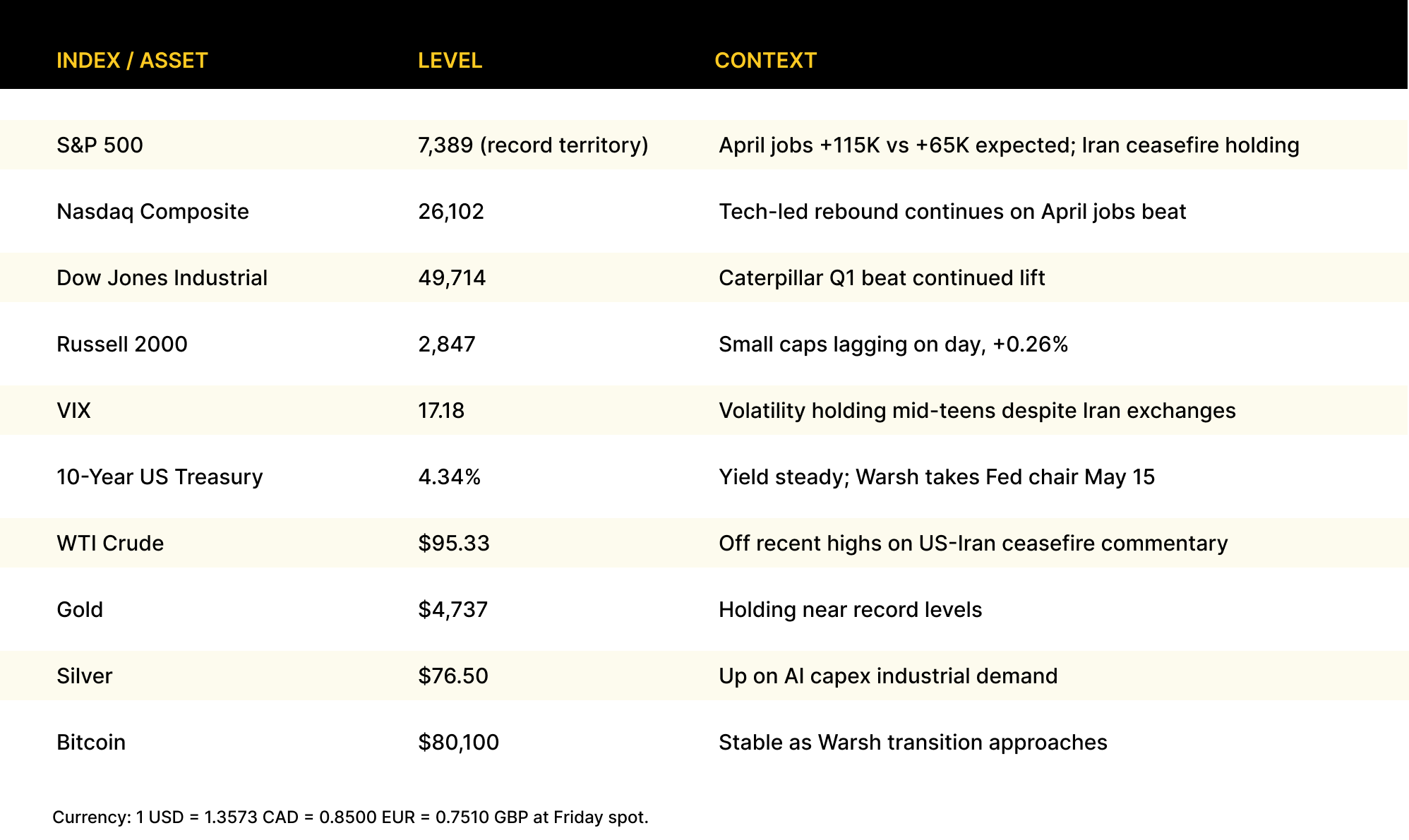
Stock Snapshot
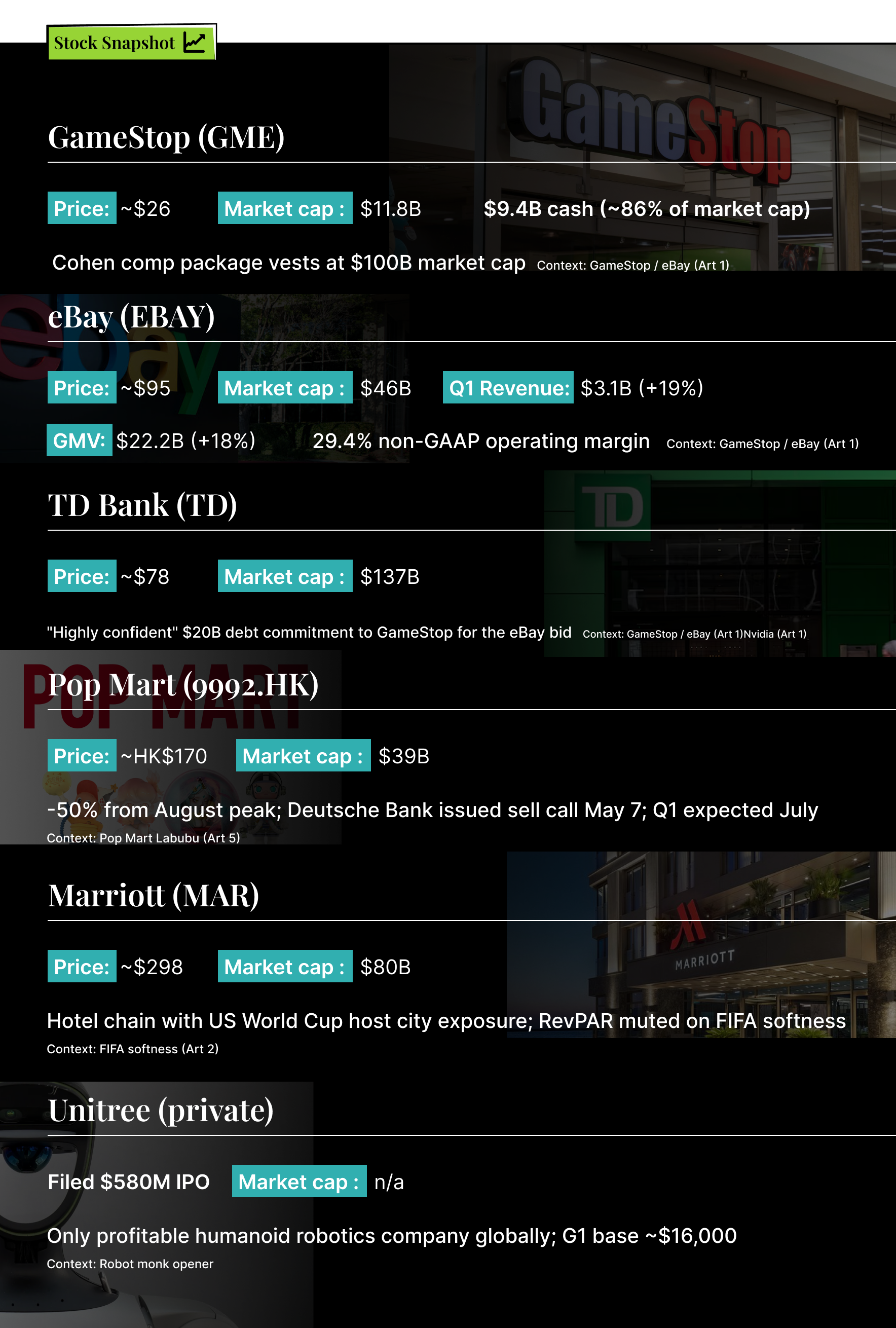
Companies Mentioned
Friday May 8, 2026, intraday
Sources
Wall Street Journal (Lauren Thomas), Bloomberg, Reuters, CNBC, CBS News, NPR, Associated Press, Financial Times (Stephanie Findlay), New York Post, GameStop SEC Filings, eBay 8-K Filings, Techdirt, Kotaku, BBC News (Tabby Wilson and Mimi Swaby), Korea Herald, Korea Times, AP via Khaosod English, Buddhistdoor Global, CGTN, Yonhap, RoboHorizon, BotInfo, Robot Report, Insider Sport, AHLA Hotel Outlook Report, CoStar (Philip Wooller), Reuters via BestMediaInfo, Afaqs, Business Standard, BusinessToday India, Global Times, Punch, Skift, Al Jazeera, KCTV5, Wikipedia (2026 Iran war, Strait of Hormuz crisis, Iran-US Claims Tribunal), House of Commons Library, Congress.gov CRS Report R45281, Stanford Law (Oona Hathaway), CNN, PBS NewsHour, Senator Lankford September 2016 letter, Chairman Chaffetz August 2016 letter, Tasnim, Time Magazine, IUSCT.com, US State Department, Euronews, Lowy Institute, Atlantic Council, Carnegie Endowment for International Peace, FactSet (John Butters), Economist (May 4 2026, Finance & Economics), Atlanta Fed Macroblog, Center on Budget and Policy Priorities, Casten letter (December 2025), AmStat "Nation's Data at Risk", Washington Post, ONS Labour Force Survey quality reports, Resolution Foundation, Bank of England MPC, Department of Finance Canada, BMO Financial press release, DSR Bank, Pop Mart Hong Kong Stock Exchange disclosures, Deutsche Bank (Sammi Xu sell call May 7 2026), CNBC (Pop Mart Labubu Monster Family Sales), Yahoo Finance, FRED, Investing.com, TheStreet (Stock Market Today May 8 2026), CBOE, NHTSA, Edgen, ainvest, Niftytrader, Athlon Sports, Trading Economics.
Stock data pulled Friday May 8, 2026 at noon PT. Currency at Friday spot rates.